


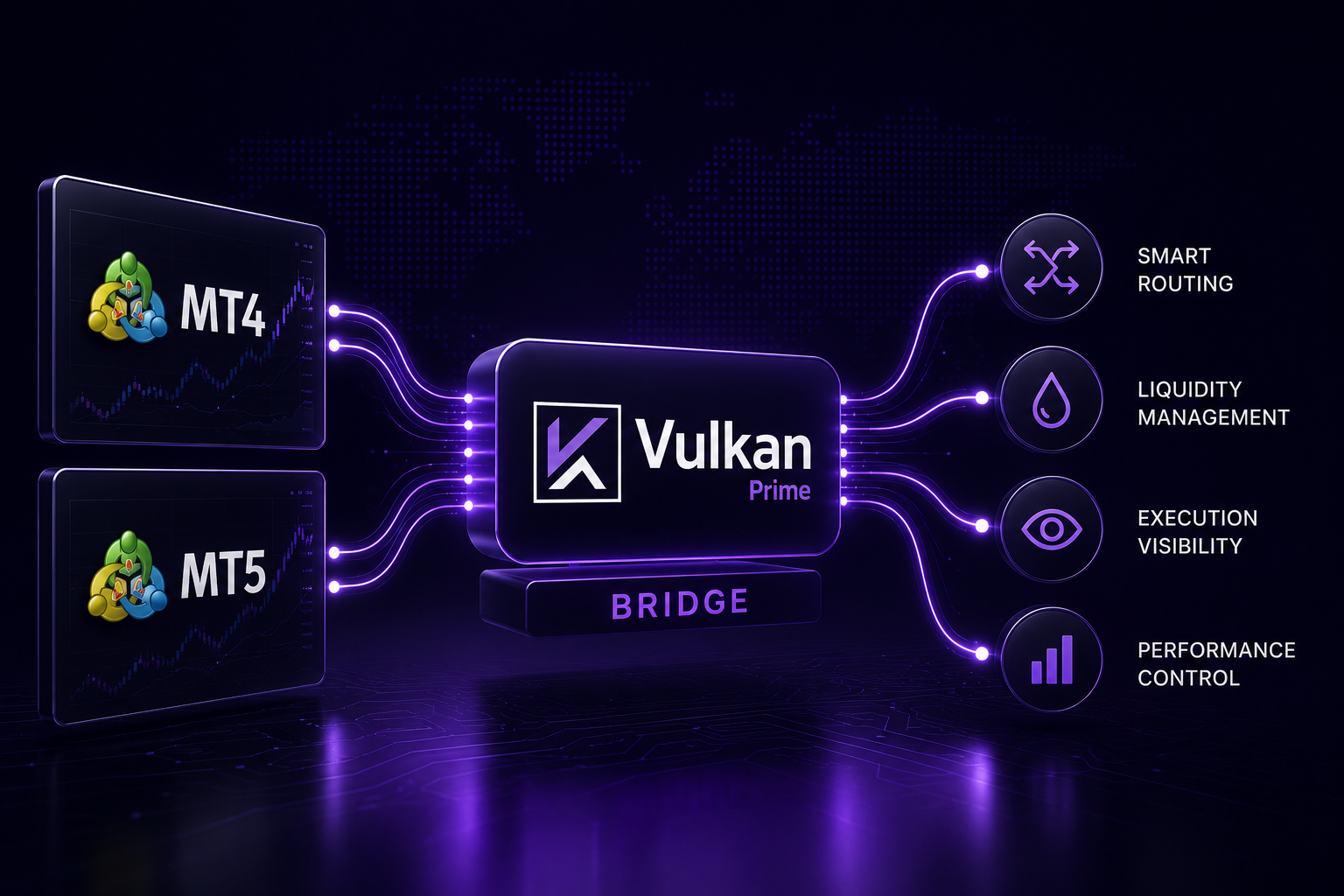
Why Vulkan Bridge MT4 MT5 Integration Matters
MT4 and MT5 continue to power thousands of brokerages around the world. However, the trading platform is only one part of the execution environment. Every order placed by a client must travel through an infrastructure layer before reaching a liquidity provider, and that layer often determines execution quality, routing efficiency, and operational performance.
This is where Vulkan Bridge plays a critical role. By integrating directly with MT4 and MT5, it helps brokers manage order flow, connect multiple liquidity providers, and gain greater visibility into execution activity. Rather than simply connecting trading platforms to liquidity, Vulkan Bridge gives brokerages more control over how orders move through their business.
MT4 and MT5 Are the Front End. Your Bridge Is the Engine Room.
Most traders never think about the technology operating behind their trading platform. They see charts, place orders, monitor positions, and evaluate execution. Behind the scenes, however, every order passes through a bridge before reaching liquidity providers or execution venues.
That bridge performs some of the most important functions inside the brokerage. It determines how orders are routed, which liquidity provider receives the flow, and how execution decisions are managed throughout the trading day. Consequently, many execution problems are not caused by MT4 or MT5 themselves. Instead, they originate within the infrastructure connecting those platforms to the market.
Gain More Control Over Order Routing
As brokerages grow, routing decisions become increasingly complex. Questions quickly begin to emerge.
- Which liquidity provider should receive this order?
- Should execution follow different routing rules for different client groups?
- How should flow be distributed across multiple venues?
Without a flexible bridge, managing these decisions efficiently becomes increasingly difficult. Vulkan Bridge allows brokers to configure routing logic that aligns with their business objectives rather than forcing operations to adapt to infrastructure limitations. This creates greater control over execution while supporting more sophisticated trading environments.
Simplify Multi-Liquidity Connectivity
Most brokerages begin with a single liquidity provider. Over time, that often changes. One provider becomes two. Two become four. Before long, managing liquidity relationships becomes a significant operational challenge.
Rather than working across disconnected systems, Vulkan Bridge centralizes connectivity within a single environment. This allows brokers to manage multiple liquidity providers more efficiently while reducing operational complexity. As liquidity relationships continue expanding, centralized infrastructure becomes increasingly valuable.
Improve Execution Visibility
One of the biggest frustrations facing dealing desks is not understanding why execution issues occur. Orders experience slippage, execution slows unexpectedly, and pricing changes without warning. Without visibility, identifying the root cause often becomes a process of trial and error.
Vulkan Bridge provides greater transparency into routing decisions, order flow, and execution activity, allowing operational teams to identify bottlenecks more quickly and make informed decisions based on real-time information. Because before a problem can be solved, it first needs to be understood.
Build Infrastructure That Scales
Brokerage infrastructure that performs well with hundreds of active clients may not perform equally well with tens of thousands. Growth naturally introduces higher trading volumes, additional liquidity relationships, more complex routing decisions, and greater expectations around execution quality.
Rather than continuously rebuilding infrastructure as the business expands, brokers increasingly look for technology that can scale alongside their operations. Vulkan Bridge was designed with that objective in mind, helping firms support increasing trading volumes while maintaining operational performance.
Reduce Operational Complexity
Technology should simplify brokerage operations rather than create additional administrative work. However, many firms find themselves managing multiple systems, fragmented workflows, and increasingly complicated execution environments.
By centralizing liquidity connectivity, routing management, and execution visibility, Vulkan Bridge helps reduce operational friction across the organization. This allows dealing desks, operations teams, and management to spend less time managing infrastructure and more time improving client experience and supporting business growth.
What Happens When Brokers Outgrow Their Existing Bridge?
Existing bridge infrastructure often performs well during the early stages of growth. However, businesses evolve. Trading volumes increase, liquidity relationships expand, and execution requirements become more sophisticated. As these changes occur, operational limitations often become more visible.
Many brokerages begin evaluating alternative bridge solutions not because their existing technology has failed, but because it was never designed to support the next stage of growth.
Why MT4 and MT5 Integration Continues to Matter
MT4 and MT5 remain the industry’s most widely adopted trading platforms because they provide reliability, familiarity, and a mature trading environment. At the same time, trader expectations continue to increase.
Clients expect:
- Fast execution
- Stable pricing
- Reliable infrastructure
- Consistent performance
Meeting those expectations requires far more than simply offering a trading platform. It requires infrastructure capable of supporting execution quality behind the scenes.
Why Brokers Choose Vulkan Bridge
Brokers rarely implement Vulkan Bridge simply because they need another technology platform. Instead, they choose it because they want:
- Greater control over routing decisions
- Centralized liquidity management
- Better execution visibility
- Reduced operational complexity
- Infrastructure that supports long-term growth
By integrating directly with MT4 and MT5, Vulkan Bridge helps brokerages build execution environments that are more flexible, scalable, and operationally efficient.
Frequently Asked Questions
How does Vulkan Bridge integrate with MT4 and MT5?
Vulkan Bridge connects directly with MT4 and MT5, creating a centralized infrastructure layer between the trading platform and liquidity providers. This allows brokers to manage routing, execution, and liquidity connectivity from a single environment.
Why is bridge integration important for MT4 and MT5?
Bridge integration allows brokerages to improve routing logic, execution visibility, liquidity management, and operational efficiency while supporting more sophisticated trading environments.
Can Vulkan Bridge connect multiple liquidity providers?
Yes. Vulkan Bridge supports centralized connectivity across multiple liquidity providers, simplifying liquidity management as brokerages expand.
Does Vulkan Bridge support both MT4 and MT5?
Yes. Vulkan Bridge is designed to integrate with both MT4 and MT5 environments.
Who is Vulkan Bridge designed for?
Vulkan Bridge is designed for brokers seeking greater control over execution infrastructure, routing decisions, liquidity management, and scalable brokerage operations.
Final Thoughts
Successful brokerages understand that trading platforms are only part of the client experience. Behind every order is an execution infrastructure that determines how efficiently liquidity is accessed, how intelligently orders are routed, and how effectively operational teams manage risk and performance.
Integrating Vulkan Bridge with MT4 and MT5 gives brokers greater visibility, smarter routing capabilities, centralized liquidity management, and infrastructure built to scale as the business grows. Because while traders interact with the platform they can see, brokers succeed because of the infrastructure working behind it.