


Quick Answer
Broker Order execution latency is one of the most overlooked performance metrics in brokerage operations. While brokers often focus on spreads, liquidity, and acquisition costs, they may overlook delays in order routing and execution. As a result, fill quality, slippage, client satisfaction, and long-term retention can all be affected. Vulkan Prime is designed to help brokers reduce unnecessary latency through optimized routing, liquidity connectivity, and infrastructure visibility—helping create a more efficient execution environment from end to end.
The Problem Isn’t That Your Order Execution Is Slow
The problem is that you may not know where it’s slow.
Brokers typically monitor spreads.
Exposure is usually tracked as well.
Liquidity often receives the same attention.
Far fewer monitor latency with the same level of scrutiny.
And that’s a mistake.
Because latency isn’t just a technology metric.
It’s a business metric.
Every millisecond introduced between a client’s click and an executed order creates potential friction inside the trading experience.
Most of the time, nobody notices.
Until they do.
The Cost of a Few Milliseconds
Let’s put aside technology for a moment.
Imagine a broker acquires 10,000 active clients.
The marketing team is generating leads.
The sales team is converting accounts.
The dealing desk is managing risk.
Everything appears healthy.
But clients begin reporting:
- Inconsistent fills
- Occasional slippage
- Execution differences during volatility
- Delays during active market sessions
None of these issues seem significant individually.
Together, they become expensive.
Because clients rarely leave after a single bad experience.
They leave after repeated friction.
And execution friction is one of the hardest problems to diagnose because it often hides behind other symptoms.
Why Latency Has Become More Important Than Ever
Five years ago, many brokers operated with far simpler infrastructures.
Today, a typical brokerage may be connected to:
- Multiple liquidity providers
- Several trading platforms
- Internal risk systems
- Reporting tools
- CRM environments
- Third-party analytics platforms
Every connection creates opportunity.
It also creates complexity.
And complexity introduces delay.
As brokers scale, latency often increases without anyone intentionally changing the broker order execution environment.
What worked at 1,000 clients doesn’t always work at 10,000.
What worked at 10,000 often breaks at 100,000.
The Hidden Journey of Every Order
Most traders see a single action.
Click.
Buy.
Done.
Behind the scenes, the journey is far more complicated.
A typical order may travel through:
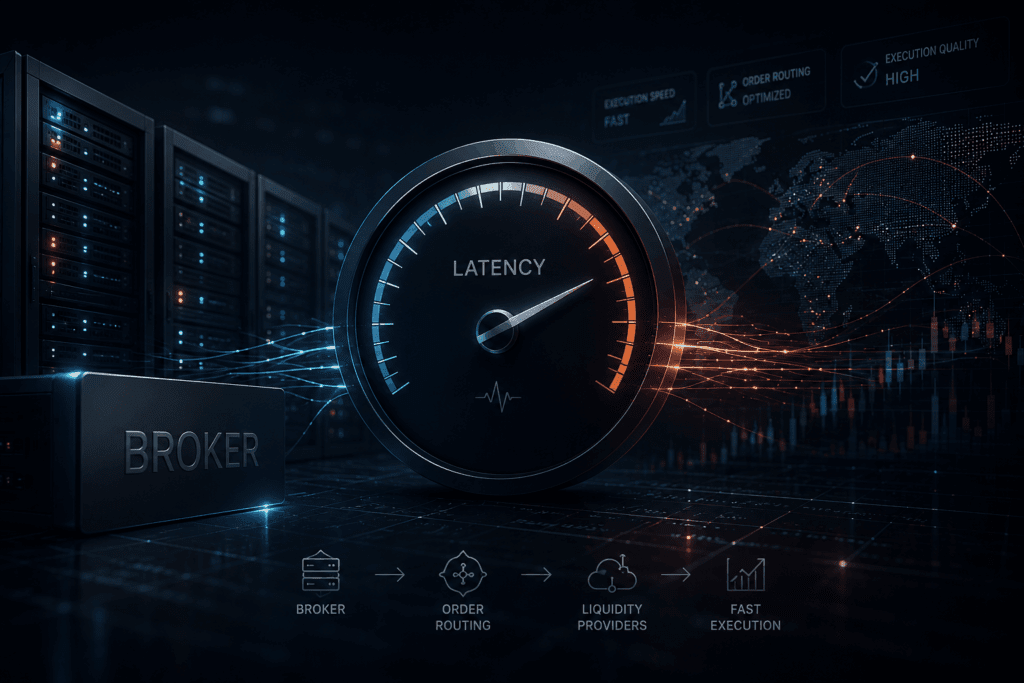
Client Terminal → Bridge Infrastructure → Routing Engine → Liquidity Provider → Confirmation Layer → Trading Platform
Each stage adds processing time.
As a result, every connection introduces another potential bottleneck.
Those bottlenecks can eventually lead to execution inefficiencies.
This is why reducing latency is rarely about solving one problem.
It’s about optimizing an entire chain.
Where Brokers Typically Lose Performance
When Vulkan works with brokers evaluating infrastructure performance, latency issues usually appear in one of four areas.
Routing Logic
Orders are often routed through rules and workflows that made sense years ago.
As the business grows, those rules can become increasingly inefficient.
Many brokers are surprised by how much latency is introduced through routing decisions alone.
Liquidity Connectivity
Adding more liquidity providers sounds positive.
And often it is.
But more connections don’t automatically mean better execution.
Without intelligent routing and visibility, additional liquidity can increase complexity faster than it improves performance.
Infrastructure Growth
Most broker technology stacks evolve rather than being designed from scratch.
New systems get added.
Old systems remain in place.
Layers accumulate.
Eventually, execution paths become longer than necessary.
Visibility Gaps
This may be the biggest problem of all.
Many brokers know latency exists.
They simply don’t know where.
Without visibility, optimization becomes guesswork.
Faster Isn’t the Goal
This is where many infrastructure conversations go wrong.
Everyone wants faster execution.
But speed alone isn’t what clients experience.
Clients experience consistency.
A broker with consistently reliable order execution will often outperform a broker that occasionally delivers extremely fast execution but struggles during periods of volatility.
The real objective is:
- Consistent execution
- Predictable routing
- Stable infrastructure
- Operational visibility
Speed becomes valuable when it supports those outcomes.
Not when it’s pursued in isolation.
How Vulkan Prime Approaches Latency Differently
Most order latency discussions focus on a single component of the execution chain.
A bridge.
A server.
A liquidity connection.
Vulkan Prime was designed with a broader perspective.
The objective isn’t simply reducing milliseconds.
The objective is optimizing how orders move through the entire brokerage environment.
Smart Routing Architecture
Vulkan Prime enables brokers to configure routing profiles that align with their execution objectives.
Rather than treating every order identically, brokers gain greater control over how flow is distributed across available liquidity.
Centralized Liquidity Connectivity
As brokerages grow, liquidity relationships often become increasingly complex.
Vulkan Prime helps centralize those connections while maintaining flexibility, reducing operational overhead and simplifying execution workflows.
Infrastructure Visibility
One of the most valuable features of modern broker technology isn’t speed.
It’s transparency.
Vulkan Prime provides visibility into routing activity, execution behavior, and infrastructure performance, helping teams identify inefficiencies before they become client-facing problems.
Scalable Design
The challenges facing a broker with 500 clients are different from those facing a broker with 50,000.
Vulkan Prime is designed to support growth without forcing infrastructure teams to rebuild execution environments every time volume increases.
The Brokers Winning Today Understand Something Important
Execution quality is no longer a technical discussion.
It’s a competitive advantage.
The brokers attracting and retaining sophisticated traders are investing heavily in infrastructure because they understand the connection between technology and client experience.
Better execution creates:
- Greater client confidence
- Better retention
- Reduced operational friction
- Improved scalability
- Stronger long-term growth potential
Infrastructure decisions increasingly influence commercial outcomes.
Five Questions Every Broker Should Ask
Before evaluating any execution technology, ask:
- Where does latency currently exist in our infrastructure?
- Can we measure routing performance in real time?
- Are our liquidity connections helping or creating complexity?
- How quickly can we identify execution bottlenecks?
- Will our current architecture support future growth?
Many brokers discover they don’t have clear answers.
That’s often where optimization begins.
Latency Is a Symptom of a Bigger Question
The real question isn’t:
“How fast are we?”
The real question is:
“How efficiently does our infrastructure operate?”
Latency is often the first visible symptom when systems become too complex, too fragmented, or too difficult to manage.
That’s why solving order latency isn’t simply about improving broker order execution speed.
It’s about creating a brokerage environment that is more scalable, more transparent, and more capable of supporting future growth.
That’s the philosophy behind Vulkan Prime.
Not just faster execution.
Smarter execution.