
You do not need a thousand tricks to make precious metals trading work. You need one routine that works well from London mornings to US market hours. It should have cash-based sizing on the ticket. You should also be able to read the statements aloud without guessing.
Whether you mostly work gold or you also trade platinum and silver, your platform should feel like a single language across symbols. The right habits make busy days easier. The best metals broker platform helps by being steady and reliable.
The real promise of trading metals online
Metals give clean exposure to macro tone. Gold tracks real rates and the dollar. Silver responds to both precious and industrial narratives. Platinum cares about auto catalysts, supply quirks, and risk appetite. The edge is not a prediction. It is structured. You choose clear windows, you size in cash, and you review the same numbers every week.
“A single routine across symbols beats a catalog you never touch.”
Sessions and catalysts you can actually use
You do not need the full calendar. You need the slice that fits your life.
| Lane | Lively windows* | Common catalysts | What it feels like |
| Gold (XAU) | London morning, US macro hours | CPI, jobs, central bank tone, real yields | Trend friendly around data, clean pullbacks |
| Silver (XAG) | London morning, spillover from US session | Macro prints, risk sentiment, industrial demand signals | Faster than gold, respect whipsaws |
| Platinum (XPT) | Europe morning, US overlaps | Auto demand, supply headlines, USD tone | Quieter stretches, sharp pockets |
*Hours vary by season and venue. Pick a slice you can repeat, not an entire day.
“Trade your window, not the whole day.”
Personality check: gold vs silver vs platinum
| Trait | Gold | Silver | Platinum |
| Typical pace | Smooth trend bursts around data | Faster tempo with snapbacks | Patchy flow with sudden pockets |
| Best setups | Pullback into value, breakout plus retest | Breaks with quick retests, partials sooner | Range edges and mean reversion |
| Risk style | Fixed cash, wider stop acceptable | Smaller size, quicker risk reduction | Smaller size, patience for fills |
| Common trap | Overtrading quiet hours | Chasing spikes | Ignoring liquidity quirks |
Match temperament to instrument and stress falls by half.
Futures or CFDs, and why the difference matters
Some venues offer exchange futures on metals alongside CFDs that mirror those futures. Either road can work if you understand the costs and your use case.
| Dimension | Exchange futures | Metal CFDs mirroring futures |
| Venue | Central exchange order book | Broker routed instrument |
| Sizing | Standard or micro contracts | Flexible fractional sizing |
| Hours | Exchange schedule with extended sessions | Often mirrors futures hours, confirm details |
| Costs | Commission, exchange, clearing, market data | Spread, commission, funding |
| Best for | Strict transparency and deep book | Small accounts, off hour tweaks, fractional moves |
Choose the tool that keeps your behavior repeatable and your invoice predictable.
Ticket math in plain cash
Let the platform do the arithmetic. You provide the risk.
Example: silver CFD with 0.01 equals 1 dollar per contract
- Risk unit: 40 dollars
- Planned stop: 0.40
- Risk per contract: 0.40 × 100 ticks × 0.01 equals 40 dollars
- Position size: 1 contract
If the stop is 0.20, size becomes 2 contracts. The math lives on the ticket so your brain can focus on timing, not arithmetic.
“You cannot control the market. You can always control position size.”
Costs that decide more than you think
Treat costs like an ingredient list. You will cook better trades.
| Cost line | Where it bites | Practical move |
| Spread plus commission | Every fill | Trade liquid windows, pick a tier that fits your average ticket |
| Slippage | Opens and data minutes | Prefer retests over chasing, use limits when tempted |
| Funding or swaps | Overnight holds on CFDs | Hold smaller, shorten duration, or use futures for longer carries |
| Market data | Depth, speed on futures | Buy depth if you use it, skip if you do not |
Track total cost per trade for 20 sessions. Your schedule will naturally drift toward efficient hours.
“Cost clarity turns uncertainty into a trade you can choose.”
What makes the best metals broker platform feel grown up
A good platform is not flashy. It is predictable.
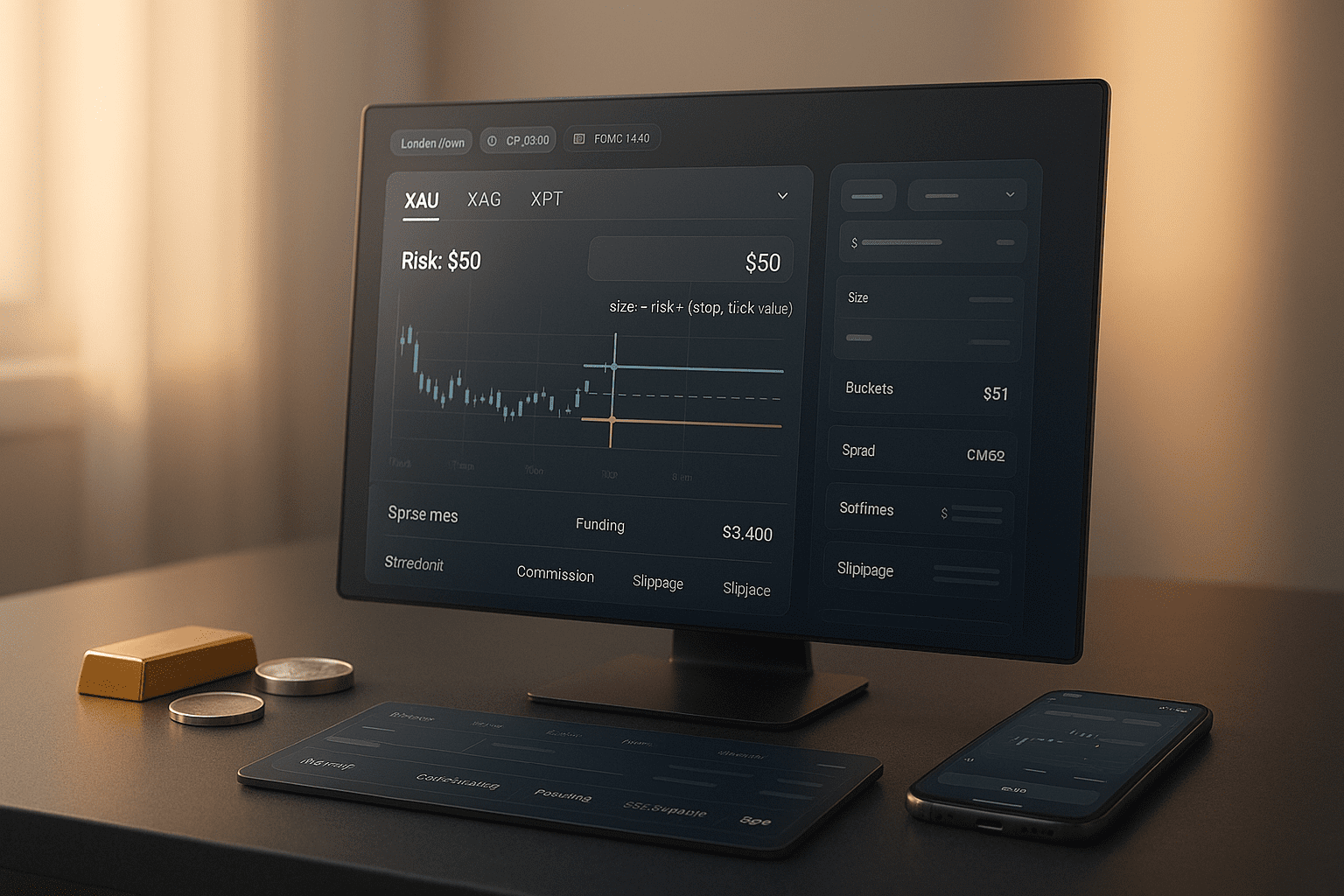
- Cash risk preview on every order ticket
- Brackets by default so stops and targets place with the entry
- Symbol specs in cash contract value, tick value, hours, swaps or roll rules
- Depth of Market or consistent fill quality you can rely on
- Exportable logs with fills, costs, and funding lines
- Status page with timestamps during maintenance or incidents
If these sound boring, that is the point. Boring survives volatility.
If you want to trade platinum and silver alongside gold
You can trade platinum and silver in the same account you use for gold if the platform keeps one grammar across symbols.
- Keep one cash risk unit for all three metals
- Use the same two setups everywhere
- Favor smaller size and quicker partials on silver and platinum
- Respect scheduled prints by standing down or sizing down
The power is not variety. It is coherence.
Three entry frameworks that travel well
Keep definitions short enough to follow when price speeds up.
Pullback into value
Trend on a higher timeframe, prior value zone or VWAP band, first pullback that pauses. Enter with a bracket. Scale partial at 1R, trail behind structure. Great for gold during macro hours.
Breakout plus retest
Box the range, wait for a decisive break, enter on the clean retest. Useful when silver or gold accelerates on news and then settles.
Quiet-session fade
During calmer periods, fade stretches into well tested bands with small size and firm stops. Works for platinum’s quieter stretches.
“If the entry needs a paragraph to justify it, it is not ready.”
Two realistic routines with numbers
Gold pullback with fixed risk
- Window: London morning or US macro hours
- Risk: 50 dollars per trade
- Plan: trend confirmation, first pullback into value
- Management: partial at 1R to pay costs, trail the rest
- Note: stand down ten minutes before and after top tier prints unless that is your edge
Silver range break and retest
- Window: London morning or early US session
- Risk: 40 dollars per trade
- Plan: draw a short range, enter on retest after break
- Management: partial at 1R, tighter trail than gold
- Note: respect whipsaws, size smaller than gold
Common mistakes and clean fixes
| Mistake | Why it hurts | Clean fix |
| Trading through big prints by accident | Spread spikes and slippage | Calendar alerts in local time, clear stand-down rules |
| Sizing from memory | Inconsistent risk | Use cash preview and a fixed risk unit |
| Chasing the first spike | Regret and poor fills | Wait for the retest or first pullback |
| Ignoring swaps on swings | Profits erode overnight | Know funding schedule, pick instruments to match hold time |
| Believing landing page spreads | False confidence | Screenshot quotes in your hours and compare monthly |
A small, steady workflow
Before your window
- Mark yesterday’s high and low plus overnight extremes
- Note two catalysts with local times
- Confirm your cash risk per trade and daily loss cap
During
- Two attempts per idea, then stand down
- Brackets on by default
- Screenshot before and after, write one line reason in and reason out
After
- Tag trades by setup and session
- Log total cost per trade and any slippage
- Close the platform on time
Consistency beats intensity.
A day that proves the point
Picture a Tuesday. Gold pulls back into a level you mapped on Sunday. You size by cash, click once, and the bracket attaches. Ten minutes later silver breaks a small morning box. You size smaller, take a partial at 1R, and trail the rest behind the micro structure. In the evening your statement matches your mental invoice line by line. No creative labels. No guesswork. That is precious metals trading doing the job you hired it to do.
Signals you picked the right partner
- You spend less time rearranging layouts and more time reviewing outcomes
- Alerts feel early and relevant rather than loud and late
- Your journal shrinks because the platform does the boring math
- Withdrawals land on schedule and status notes match reality
- You trust the ticket because it shows cash before you click
“Trust lives in spreadsheets and status pages, not in taglines.”
One quiet nudge before you fund
Write one cash risk number on a sticky note. Choose one gold setup and one silver or platinum setup. Describe each in one sentence. Take a screenshot of spreads at the same minute each day for a week. If those pictures match your fills and your statement matches your notes, you likely found the best metals broker platform for your routine. If not, adjust the window, reduce size, or keep walking until the platform and paper tell the same story.
FAQ
What makes precious metals trading different from index trading
Metals respond directly to macro tone like real yields and the dollar. They trend cleanly around data, then rest. Your job is to pick windows that match those rhythms and size in cash so reactions do not shake you out.
Can I trade platinum and silver in the same account I use for gold
Yes if your venue supports all three with one ticket grammar. Keep a single cash risk unit, the same two setups, and smaller size on silver and platinum to respect their pace.
How do I choose the best metals broker platform
Check for cash-based risk on the ticket. Look for brackets by default. Make sure symbol specs in cash are clear. Ensure logs can be exported. Verify that spreads are believable during your hours. Also, check for a status page with timestamps.
Are CFDs worse than futures for metals
Not automatically. CFDs offer flexible size and simple access. Futures provide strict transparency and a deeper book. Pick the tool that fits your window, size, and cost profile.
How do I keep costs from eating results
Trade liquid windows. Track the total cost per trade for 20 sessions. Use retests instead of chasing. Align your instrument choice with your holding time. This helps you avoid unnecessary funding costs.
What is the simplest way to keep losses from spiraling
Two attempts per idea, a daily loss cap that pauses trading, and brackets that place stops and targets automatically. Those three rules protect your month.