

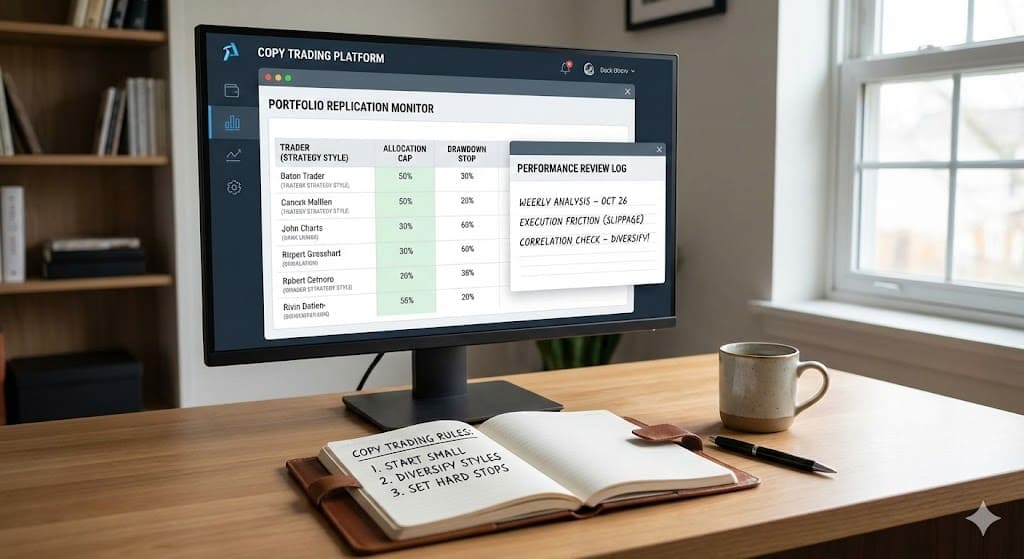
Copy trading sounds simple: find a trader who knows what they’re doing, mirror their moves, and skip the hard learning curve. Sometimes it works. Sometimes it turns into a slow leak of fees, slippage, and mismatched risk. The difference is rarely “luck.” It’s usually selection, settings, and expectations.
If you’re looking for a platform to copy successful traders, treat it like you would treat any investing tool: understand the rules, understand the incentives, and set controls so copying supports your process instead of replacing it. A good setup can help you join a trading social network that teaches through transparency, and a healthy copy trading community can turn trading into a feedback loop rather than a lonely grind.
“Copy trading is outsourcing execution, not outsourcing responsibility.”
This guide breaks down how copy trading actually works, what to check before following anyone, and the risk controls that keep copying from becoming blind faith.
Copy trading in plain terms
Copy trading is a system where your account mirrors the trades of another account (a strategy provider, lead trader, or signal source). When they enter, you enter. When they exit, you exit. The platform handles replication according to rules you choose.
There are two broad styles:
- Trade copying: each trade is mirrored (with scaling rules)
- Portfolio copying: your account is adjusted to match a model portfolio over time
Most “social trading” platforms combine copying with profiles, performance stats, and community features so you can join a trading social network and follow multiple traders.
Why people use a platform to copy successful traders
People choose copy trading for different reasons, and your reason affects your setup.
Common motivations:
- Learning by observation
- Diversifying with strategies you don’t trade yourself
- Reducing emotional decisions
- Saving time
- Testing a strategy before committing to it manually
None of these are wrong. Problems happen when expectations don’t match reality, especially on risk.
“Copy trading fails most often when the follower expects a different risk personality than the provider actually has.”
The hidden mechanics that decide your results
Two followers can copy the same trader and get different outcomes because the mechanics differ.
Allocation method: how your size is calculated
Most platforms use one or more of these:
| Allocation method | What it means | When it fits | Common trap |
| Fixed amount | you commit a set amount | simple budgeting | ignores stop distance and volatility |
| Percentage of equity | scales with your balance | easy and proportional | can copy too large during drawdowns |
| Risk-based | sizes by defined risk rules | consistent loss control | requires clear stop logic |
| Multiplier | your size is a multiple | fast scaling | amplifies mistakes quickly |
If you’re new, fixed amount or conservative percent-of-equity tends to be safer than a multiplier.
Execution differences: slippage and partial fills
Copy trades aren’t telepathy. Your fills can differ because of:
- Latency
- Spreads widening during volatility
- Liquidity differences by instrument
- Order type differences (market vs limit)
A trader with thin-margin scalping can look great on their account and disappoint followers due to execution friction.
Fees and incentives: who gets paid and how
Copy trading may involve:
- Spread/commission costs
- Performance fees
- Subscription fees
- Profit split models
- Platform service fees
A trader can be “successful” in gross terms while followers net less because costs aren’t modeled.
Join a trading social network: what to look for beyond the feed
A trading social network is useful when it improves transparency and learning, not when it becomes a highlight reel.
A healthy platform helps you:
- See risk metrics, not just returns
- Understand the strategy style and time horizon
- Review trade history and drawdowns
- Understand fees clearly
- Adjust copy settings without friction
A less healthy environment tends to reward:
- Short-term leaderboard spikes
- High leverage, high drama behavior
- Vague strategy descriptions
- Marketing language instead of process
“If the platform sells excitement, your risk controls need to be twice as strict.”
Copy trading community: signals of quality
A copy trading community isn’t just a comment section. It’s a set of behaviors: how traders explain risk, how followers ask questions, and how the platform handles transparency.
Green flags
- Providers share a clear strategy description
- Risk metrics are visible and consistent over time
- Drawdowns are discussed calmly and honestly
- Followers talk about sizing and limits, not only wins
- The platform enforces disclosure standards
Red flags
- Constant “guaranteed” language
- Cherry-picked screenshots
- Unexplained performance spikes
- No clear drawdown history
- Deleted comments when people ask about losses
A community that normalizes risk discussions helps you make better decisions.
A practical checklist for choosing who to copy
Before you follow anyone, go past the headline return number.
1) Match the strategy style to your patience
Ask:
- Is this a scalper, swing trader, or position trader?
- How long do trades last?
- How often do they trade?
If you hate frequent trades, copying a scalper will feel stressful even if it’s profitable.
2) Study the drawdown, not just the gain
Look for:
- Max drawdown
- Average drawdown length
- Recovery behavior after losses
A trader with huge returns but massive drawdowns might be fine for someone with strong risk tolerance, but not for a beginner.
3) Check consistency across regimes
Try to see:
- Performance in calm and volatile periods
- Whether results depend on one type of market
- Whether risk increases after losing streaks
4) Review trade history for “behavior”
Returns can hide bad habits. Look for:
- Adding to losers without stops
- Holding losers too long
- Frequent revenge-style bursts
- Huge position size changes
“Behavior is the strategy. The chart is just the evidence.”
5) Confirm transparency on costs
If you can’t estimate your net costs, you can’t judge results.
Copy settings that keep you safe
Even if you find a great trader, copying without controls is risky.
Set a maximum allocation per trader
Example:
- No more than 20% to 40% of your copy capital to one provider
Use a drawdown stop
Many platforms let you set:
- Stop copying if the copied strategy hits a loss threshold
- Pause copying after a defined drawdown
This prevents “ride it to zero” behavior.
Use conservative multipliers
If you use multipliers:
- Start small
- Increase only after consistent performance and comfort
Diversify across uncorrelated styles
Better than copying five “momentum” traders:
- Copy one trend trader
- One mean reversion trader
- One slower macro-style trader
Diversification only works when strategies fail differently.
Keep a cash buffer
Don’t allocate 100% of your funds to copying. A buffer prevents forced liquidations and gives you flexibility.
A realistic way to use copy trading for learning
If your goal is learning, structure matters.
A good learning workflow:
- Copy one trader with small allocation
- Journal every copied trade category (why it likely happened)
- Review weekly: where did it win, where did it lose, what market conditions mattered
- Compare the provider’s risk metrics to your comfort level
This way, a platform to copy successful traders becomes a study tool, not a dependency.
“Copying teaches best when you review more than you watch.”
Mistakes that make copy trading underperform
Choosing based on the leaderboard
Leaderboards are often short-term and can reward risk-taking. Use longer windows and risk metrics.
Copying with too much size too soon
Start small. If the strategy is real, you’ll have time to scale later.
Ignoring correlation
Copying three traders who all trade the same market the same way is not diversification.
Not accounting for execution friction
Scalping strategies can be especially sensitive to slippage and spreads.
Staying through behavior changes
Traders can change style under stress. If risk suddenly increases, pause and reassess.
A platform to copy successful traders can be a useful tool if you treat copying as a structured investment decision, not a shortcut. Use it to join a trading social network that values transparency, pick providers based on drawdown behavior and consistency, and set hard limits so one strategy can’t dominate your account. A strong copy trading community will talk openly about risk, fees, and execution realities, which makes your decisions calmer and more informed; if you share your risk tolerance, preferred holding time (day vs swing), and the markets you want exposure to, I can suggest a copy setup template with allocation caps, drawdown stops, and a weekly review checklist.
FAQ
Is copy trading safe for beginners?
It can be safer than random discretionary trading if you use strict allocation limits and drawdown stops. It can be dangerous if you copy with large size or chase leaderboards.
What should I check first on a platform to copy successful traders?
Risk metrics: drawdown, trade frequency, average holding time, and evidence of consistent behavior. Then check fees and whether you can pause or stop copying easily.
Can I lose more than I expect while copy trading?
Yes, especially if leverage is high, stops are loose, or market conditions change. Use conservative sizing, cash buffers, and drawdown limits.
How do I choose between multiple traders in a copy trading community?
Pick uncorrelated styles and prioritize risk consistency over high returns. Avoid traders whose performance depends on massive position size jumps.
Does joining a trading social network improve learning?
It can, if you use it for review and transparency. The learning comes from analyzing trade behavior and risk decisions, not from watching wins.
Should I copy scalpers?
Scalping can be sensitive to spreads and slippage. If the provider’s edge is small per trade, followers may see weaker results. Test with small allocation first.