
Futures can look intimidating until you realize most of the complexity comes from a few repeatable ideas: contract size, tick value, margin, and rules for risk. Once those click, trading futures feels less like a mystery and more like a structured game with clear inputs.
This guide is built for people searching how to trade futures but who don’t want a lecture or a hype pitch. You’ll get a practical map of what matters, the mistakes that cost the most, and a clean workflow for trading something popular like nasdaq futures online from a real futures trading account.
“Futures reward clarity. Confusion gets charged in ticks.” (Trading journal)
Futures in plain English
A futures contract is an agreement tied to an underlying market (an index, oil, gold, interest rates). You’re not buying “a share.” You’re trading a standardized contract with a defined tick size and tick value.
Key ideas you must know early:
- Tick size: the minimum price movement (example: 0.25 points).
- Tick value: the dollar value of one tick (example: $5 per tick).
- Contract multiplier: what turns points into dollars.
- Margin: the capital your broker requires to hold the position.
Futures are leveraged by design. That’s not a problem by itself. The problem is using that leverage without a risk rule.
Why traders like futures and what they underestimate
What futures do well
- Clear pricing and structure: contract specs are standardized.
- Active markets: major index futures often have deep liquidity.
- Two-way trading: long or short is equally straightforward.
- Defined tick math: you can calculate risk precisely.
What surprises beginners
- Leverage magnifies small errors: an extra few ticks of slippage can matter.
- Margin rules change outcomes: intraday margin vs overnight margin is a real difference.
- Fast markets punish hesitation: you can’t “think it through” mid-move.
“If you don’t pre-plan the exit, the market will plan it for you.” (Risk note)
Futures trading account basics that actually matter
A futures trading account is different from a stock cash account in a few ways, mainly around margin and product rules.
Here’s what to understand before you place trade one:
Margin is not the same as risk
Margin is the broker’s required deposit to hold the position. Risk is what you can lose if the trade hits your stop (or worse, gaps through it).
A small margin requirement does not mean the trade is “cheap.” It just means it’s leveraged.
Intraday vs overnight margin
Many brokers offer lower intraday margin for day trading and higher margin if you hold past the session close.
If you plan to hold trades longer than a day, confirm:
- Overnight margin requirements
- When the broker switches to overnight rules
- What happens if your account can’t meet overnight margin
Commissions and fees are part of the system
Futures costs often include:
- Commission per side (entry and exit)
- Exchange fees
- Clearing fees
- Platform fees (sometimes)
If you’re taking lots of small scalps, fees become a real performance factor. If you’re taking fewer, larger swings, fees matter less, but they still matter.
Data feeds and market access
Your platform may require a paid data feed for certain exchanges. Know what you’re paying for and whether delayed data is accidentally turned on.
Contract specs: the cheat sheet you should keep open
Your first goal is to trade one contract you understand deeply rather than five you barely understand.
Use this table format for any contract you trade:
| Spec | Meaning | Why you care |
| Tick size | Minimum price move | Defines stop precision |
| Tick value | Dollars per tick | Converts chart to money |
| Trading hours | When it’s active | Liquidity and slippage |
| Margin (intraday) | Day trading requirement | Determines max contracts |
| Margin (overnight) | Holding requirement | Prevents forced liquidations |
If you can’t fill this out for a contract, you’re not ready to size it confidently.
The core math: turning a stop into dollars
This is the part that makes futures feel controllable.
Step 1: Decide your dollar risk per trade
Example: You risk $100 per trade.
Step 2: Know the tick value of your contract
Example: $5 per tick.
Step 3: Decide your stop size in ticks
Example: 20 ticks.
Step 4: Calculate risk per contract
20 ticks x $5 = $100 risk per contract.
That’s the moment the question of how trade futures becomes less abstract. You’re not guessing anymore. You’re choosing a stop size, and the math tells you the maximum contract size.
“Position size is a math decision, not a mood.” (Weekly review)
Order types you should use on purpose
Futures platforms are packed with buttons that all look harmless. The easiest way to reduce mistakes is to keep your order toolkit small.
Common order types
- Market order: fastest entry, least control over price.
- Limit order: price control, may not fill.
- Stop order: triggers when price hits a level, used for exits or breakout entries.
- Stop-limit order: adds price control, but can fail to fill in fast moves.
For beginners, limit entries plus stop exits tend to reduce “surprise fills.” Market orders can be fine, but only when you accept the tradeoff.
Bracket orders save mental energy
If your platform supports bracket orders, they can place:
- Entry
- Stop loss
- Take profit as a package.
This reduces the classic error of entering first and “adding the stop in a second.”
Risk management that survives real futures speed
You can be right about direction and still lose money in futures if your sizing is sloppy. This is where most accounts get wrecked.
Three rules that keep a futures trading account alive
- Fixed risk per trade
Pick a number that you can repeat without emotional swings. - A daily loss limit
Example: stop trading after -2R or after two rule-breaking trades. - A max contracts cap
Even if margin allows more, your skill level may not.
Here’s a simple framework you can start with:
| Rule | Beginner-friendly range | Why it helps |
| Risk per trade | 0.25% to 1% of account | Keeps losses boring |
| Max loss per day | 2R to 3R | Prevents spirals |
| Max trades per session | 2 to 5 | Avoids revenge trading |
Trading nasdaq futures online: what changes
When people say nasdaq futures online, they usually mean trading an index futures contract tied to the Nasdaq 100 (commonly called NQ) or its smaller version (MNQ).
The Nasdaq tends to move fast. That’s not good or bad, but it changes your process.
What Nasdaq-style volatility demands
- Wider stops relative to noise
- Smaller contract size until you’re consistent
- Fewer trades, better filters
- Respect for news and open volatility
If you’re new, consider starting with a micro contract if available. The goal is to learn execution without paying full tuition per mistake.
“Trade the smallest size that still makes you care.” (Trader note)
A practical session plan for Nasdaq futures
Instead of “watch all day,” use windows:
- First 15 to 30 minutes after the open: observe volatility and range
- Next 60 to 90 minutes: look for your best setup only
- Final 10 minutes: log trades and shut it down
You’ll learn faster with consistent reps than with endless screen time.
A beginner-friendly futures playbook
If you want a clean answer to how trade futures, this is it: pick one setup, one contract, one session, and repeat for 20 sessions.
Setup 1: Opening range break with confirmation
- Mark the first 15 minutes high and low.
- Only trade the break if price returns to test the level and hold.
- Stop goes on the other side of the range.
- First target is 1R, then trail or scale.
This reduces fakeout pain because you’re not chasing the first spike.
Setup 2: Trend pullback in a defined trend window
- Identify trend direction on a higher timeframe.
- Wait for a pullback to a level.
- Enter on a clear reclaim or reversal.
- Stop goes beyond the swing point that breaks the thesis.
The key is waiting. Futures punish impatience more than lack of indicators.
Setup 3: Range fade at extremes only
This is for calmer conditions:
- Define the range.
- Trade only at edges, not in the middle.
- Small targets, strict invalidation.
This setup fails when you try it on strong trend days. Use it selectively.
The most common futures mistakes and the quick fixes
Mistake: sizing based on margin instead of stop size
Fix: size based on dollar risk using tick value math.
Mistake: moving stops to “give it room”
Fix: if your stop is too tight, the entry is wrong or the size is too big.
Mistake: trading every wiggle on nasdaq futures online
Fix: set a trade limit and require a checklist. No checklist, no trade.
Mistake: holding past overnight margin rules by accident
Fix: set an alarm 15 minutes before the broker’s overnight margin cutoff.
Mistake: skipping the journal because it feels boring
Fix: keep journaling tiny: screenshot, entry reason, rule grade, one improvement.
“Your journal doesn’t need to be pretty. It needs to be honest.” (Weekly recap)
A simple tracking table that keeps you sane
Track in R (risk units) so you can compare trades cleanly even as your account size changes.
| Field | Example | Why it matters |
| Contract | MNQ | Different tick values |
| Setup | Pullback | Strategy consistency |
| Stop size | 18 ticks | Validates sizing |
| Risk per trade | 1R | Normalizes results |
| Result | +1.5R | Measures edge |
| Rule grade | A/B/C | Process feedback |
If your results are negative but your rule grades are improving, you’re moving in the right direction. If results are positive but rule grades are poor, the market is gifting you and the bill arrives later.
Building a two-week ramp plan
Use this to move from “reading about futures” to actually trading them responsibly.
Days 1 to 3: learn the contract
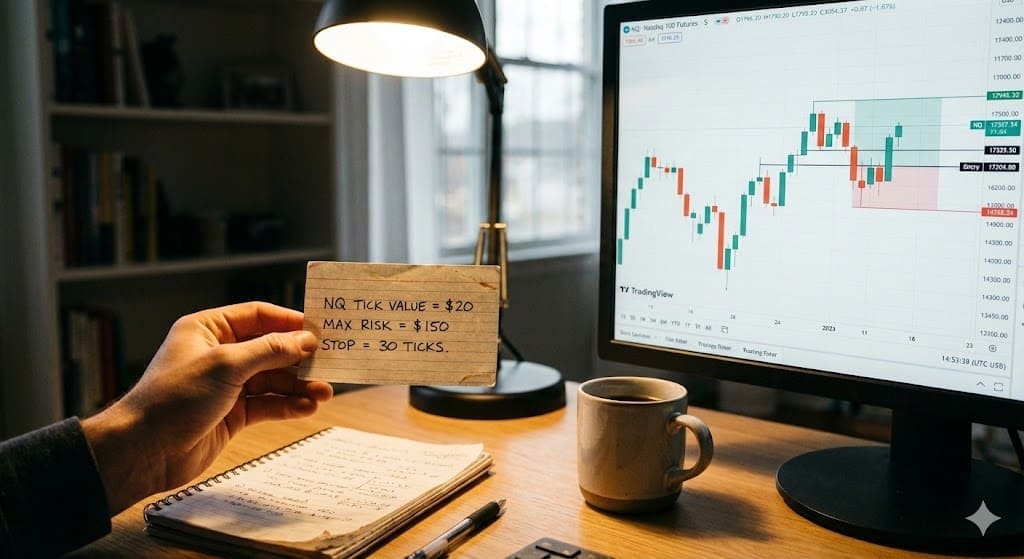
- Write tick size and tick value on a sticky note
- Watch price move and translate moves into dollars
- Practice bracket orders in simulation
Then, Days 4 to 7: trade simulation with one setup
- One setup only
- Fixed risk per trade
- Stop and target placed immediately
Days 8 to 10: micro size in a real futures trading account
- Smallest contract size possible
- Strict daily loss limit
- Trade limit per session
Days 11 to 14: review and tighten
- Count A trades vs C trades
- Identify top mistake category
- Adjust one rule only
This keeps the learning curve from turning into account damage.
A practical next step before the FAQ
If you’re ready to move from theory to reps, open a simulation mode in your futures trading account, pick one contract (especially if you plan to trade nasdaq futures online), and run the two-week ramp plan with fixed risk and a daily stop rule. If you want the fastest clarity, write your tick value, your max risk per trade, and your max trades per session on one page next to your screen, then follow it for 20 sessions before you change anything.
FAQ
How trade futures without blowing up early?
Start with the smallest contract size you can, use fixed dollar risk per trade, and set a daily loss limit. Most early damage comes from oversizing and revenge trading, not from bad market reads.
What is a futures trading account minimum to start?
Minimums vary by broker and by contract margins. Focus less on the minimum deposit and more on whether you can trade the smallest contract with your chosen risk per trade.
Is nasdaq futures online too volatile for beginners?
It can be fast. Beginners usually do better starting with micro contracts, fewer trades, and a strict checklist. Speed is manageable if size is small.
Should I use market orders or limit orders for futures?
Limit orders give price control but may not fill. Market orders fill fast but can slip in volatile moments. Many traders use limit for entry and stops for exits, then adjust based on experience.
Can I hold futures overnight safely?
You can, but you must understand overnight margin requirements and gap risk. If your account can’t meet overnight margin, you can be forced out at a bad time.
How many contracts should I trade?
Only as many as your stop size and dollar risk allow. Margin might let you trade more, but risk rules should decide your size, not the broker’s margin screen.