


A forex trading strategy is a fixed set of rules for when to enter a trade, when to exit, and how much to risk. It removes guesswork and emotion from your decisions. Most beginners lose money not because they pick the wrong strategy, but because they trade with no rules at all. This guide breaks down seven proven strategies, who each one suits, and how to start.
What is a forex trading strategy?
The forex market trades over $7.5 trillion a day across pairs like EUR/USD, GBP/USD, and USD/JPY, so there is no shortage of opportunity — only a shortage of discipline. A forex trading strategy is a repeatable plan that tells you exactly what to do in that market. A complete strategy answers four questions:
-
- Entry — what signal puts you in a trade?
-
- Exit — where do you take profit, and where do you cut a loss?
-
- Position size — how much do you risk on each trade?
-
- Market and timeframe — which pairs do you trade, and on what chart?
Without those four rules, you are not trading a strategy. You are guessing. The strategies below give you a starting framework you can test and refine.
Before you pick a strategy: two rules that matter more
No strategy works without risk control. Two habits protect your account more than any entry signal:
-
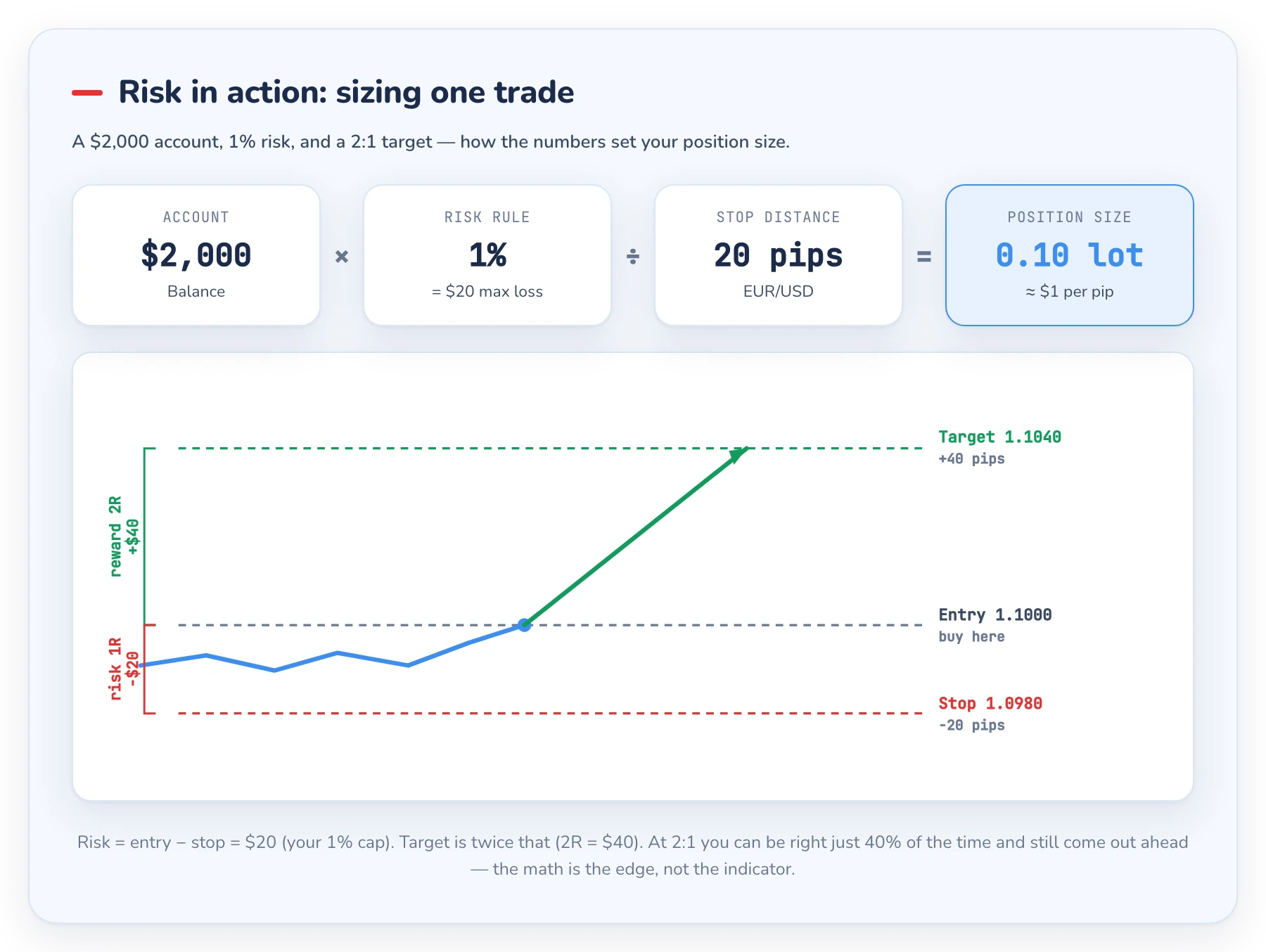
- Risk a small, fixed percentage per trade. Many traders cap risk at 1–2% of their balance on any single position. That way a losing streak stings but never wipes you out.
-
- Always use a stop-loss. Decide your exit before you enter, and let the order do the work. Hope is not an exit plan.
The 7 strategies
1. Trend following
You trade in the direction of the dominant move — buying in an uptrend, selling in a downtrend. Entries often come from a pullback to a moving average such as the 50-period or 200-period EMA. It is the most beginner-friendly approach because you are working with market momentum, not against it. The catch: trends are obvious in hindsight and messy in real time.
Best for: patient beginners. Timeframe: 4-hour to daily. Tools: 50/200 EMA.
2. Breakout trading
You enter when price breaks past a clear level — a prior day’s high, or a round number like 1.1000 on EUR/USD — aiming to catch a fresh burst of momentum. Breakouts can lead to fast, clean moves. The risk is the false breakout, where price pokes past the level then snaps back. Waiting for a candle to close beyond the level filters out many fakes.
Best for: traders who can act decisively. Timeframe: 1-hour to daily. Watch: the London open (3am ET) often sparks breakouts.
3. Range trading
When a pair trades sideways between a floor and a ceiling, you buy near support and sell near resistance — often confirmed with an oscillator like the RSI reading below 30 (oversold) or above 70 (overbought). Markets range more often than they trend, so opportunities are frequent. The danger is holding a range trade when price finally breaks out — which is why a stop just outside the range is essential.
Best for: calm, rule-following traders. Timeframe: 15-minute to 4-hour. Tools: RSI, support/resistance.
4. Swing trading
You hold positions for two to five days to catch a medium-term “swing” in price. It needs far less screen time than day trading, which makes it popular with people who trade around a job. You do carry overnight risk, including swap fees and the gaps that can open on the Sunday reopen.
Best for: part-time traders. Timeframe: 4-hour to daily. Screen time: minutes a day.
5. Day trading
You open and close all positions within the same day, so you never hold overnight. It works best during the London–New York overlap (roughly 8am to 12pm ET), when volume and volatility peak. It demands focus and quick decisions, and trading costs add up because you trade often. Done with discipline it removes overnight risk entirely. Done on impulse it drains accounts fast.
Best for: traders who can commit real screen time. Timeframe: 5-minute to 1-hour. Best hours: 8am–12pm ET.
6. Scalping
The fastest style. You take dozens of tiny trades for 5 to 10 pips each, holding for seconds or minutes. Scalping needs tight spreads, fast execution, and total concentration, so traders favor the most liquid pairs like EUR/USD where spreads can sit near 1 pip. It is high-effort and unforgiving of hesitation — better suited to experienced traders than to beginners.
Best for: advanced, focused traders. Timeframe: 1-minute to 5-minute. Needs: tight spreads, fast fills.
7. Carry trade
A longer-term approach that earns the interest-rate difference between two currencies — a classic example is AUD/JPY, pairing a higher-yielding currency against a lower-yielding one. You collect the daily swap while you hold. Returns are slow and steady, but a sharp move against you can erase months of interest, so it rewards patience and a strong stomach for volatility.
Best for: longer-term, position traders. Timeframe: daily to weekly. Example pair: AUD/JPY.
A worked example: risk in action
How to choose the right strategy for you
The best strategy is the one that fits your time, temperament, and account — not the one with the flashiest results. Match it to how much screen time you actually have and how much volatility you can sit through.
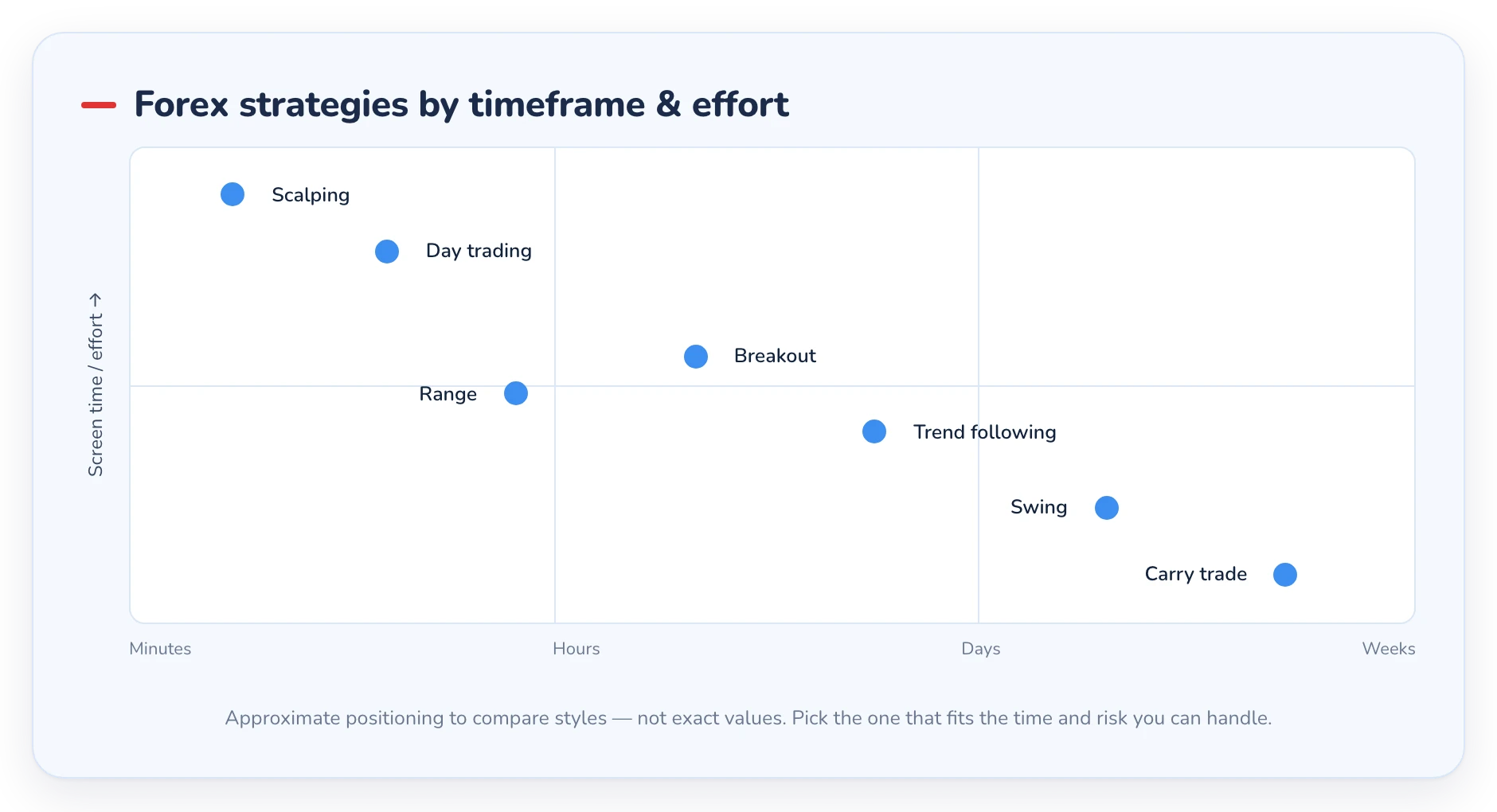
Ask yourself three questions:
-
- How much time can I give it? Little time favors swing trading or the carry trade. A free trading day suits day trading or scalping.
-
- How do I handle stress? If watching every tick rattles you, slower timeframes will serve you better.
-
- What are my costs? Frequent styles like scalping only work with tight spreads and low commissions, because costs eat small gains.
Pick one strategy, not five. Trade it on a demo account until the rules feel automatic, then start small with real money.
Practice before you risk real money
Prefer not to build your own strategy?
Building and testing a strategy takes time and discipline that not everyone has at the start. If you would rather learn by following experienced traders, copy trading lets you mirror their live positions automatically while you learn the ropes. Our guide to how copy trading works covers it in full, and Tradeview offers it through CommuniTraders. It is a way to stay in the market while you develop your own approach — not a shortcut around learning risk management.
How to start with Tradeview Markets
-
- Open a demo account and choose one strategy from this guide to test.
-
- Trade it on the MetaTrader or cTrader platforms until the rules feel natural.
-
- Set your risk per trade (many start at 1–2%) and always attach a stop-loss.
-
- When you are consistent on demo, open a live account and start small.
Related guides
Frequently asked questions
What is the best forex trading strategy for beginners? Trend following is the usual starting point. You trade with the market’s momentum instead of against it, and the slower timeframes give you time to think. The “best” strategy, though, is whichever one fits your schedule and risk tolerance and that you can follow consistently.
Can I make money with forex trading strategies? A tested strategy with strict risk control improves your odds, but nothing guarantees a profit. Your results depend on discipline, costs, and the market. Losses are a normal part of trading, which is why position sizing and stop-losses matter so much.
How many strategies should I trade at once? Start with one. Trading several at once makes it impossible to judge what is actually working. Master a single strategy on a demo account first, then add others slowly if you want to.
Do I need indicators to trade forex? Not necessarily. Some traders rely on price action — support, resistance, and candlestick patterns — with no indicators at all. Others use moving averages or oscillators for confirmation. Keep your charts simple at first.
Is scalping good for beginners? Rarely. Scalping needs fast decisions, tight spreads, and constant focus, which is a lot to handle while you are still learning. Most beginners do better on slower timeframes like swing or trend trading.
Sources
-
- Barber, B. M., & Odean, T. (2000). Trading Is Hazardous to Your Wealth: The Common Stock Investment Performance of Individual Investors. The Journal of Finance, 55(2), 773–806. doi.org
-
- Bank for International Settlements (2025). Triennial Central Bank Survey — OTC foreign exchange turnover in April 2025. Global FX turnover reached $9.6 trillion per day. bis.org
Risk warning. Trading Forex and CFDs carries a high level of risk and may not be suitable for all investors. Leverage can work against you as well as for you. The strategies described are educational examples, not trading advice, and past performance is not indicative of future results. This article is for educational purposes only and does not constitute financial advice.