


The best traders never stop learning, and books are still the cheapest, deepest way to do it. A single title can save you months of costly mistakes. This list covers ten must-reads across the four areas that matter most — psychology, technical analysis, strategy, and timeless classics — with a note on what each one gives you.
How to choose a trading book
Great trading books fall into four buckets. A well-rounded trader reads across all of them rather than stacking five books on the same topic.
- Psychology — the discipline and mindset that decide whether you follow your plan.
- Technical analysis — reading charts, patterns, and indicators.
- Strategy & risk — building and sizing a repeatable edge.
- Classics — the timeless lessons that never go out of date.
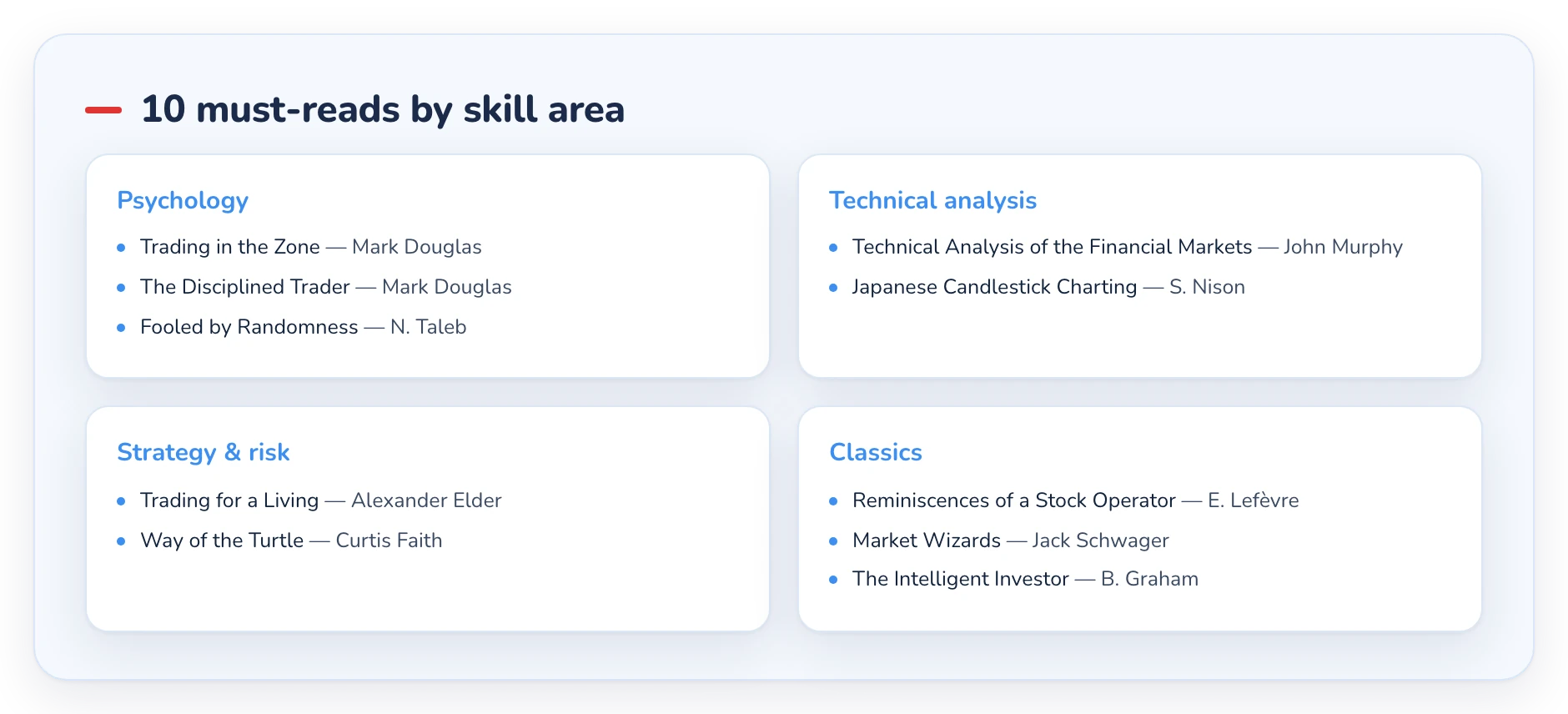
The 10 best books for traders
Trading psychology
1. Trading in the Zone — Mark Douglas. The definitive book on the mental game. Douglas explains why most traders sabotage themselves and how to think in probabilities. If you read one psychology book, make it this one.
2. The Disciplined Trader — Mark Douglas. Douglas’s earlier work, focused on building the self-discipline to execute a plan without fear or greed. A natural companion to Trading in the Zone.
3. Fooled by Randomness — Nassim Nicholas Taleb. A sharp look at how luck masquerades as skill in markets. It will make you humbler about your wins and smarter about risk.
Technical analysis
4. Technical Analysis of the Financial Markets — John J. Murphy. The standard reference. Murphy covers trends, patterns, and indicators in a clear, comprehensive way — effectively a textbook for chart reading.
5. Japanese Candlestick Charting Techniques — Steve Nison. The book that introduced candlestick analysis to the West. Essential if you want to read price action, which nearly every trader relies on.
Strategy & risk
6. Trading for a Living — Dr. Alexander Elder. A complete framework covering psychology, technical analysis, and money management — Elder’s “three M’s.” One of the best all-in-one guides for a developing trader.
7. Way of the Turtle — Curtis Faith. The inside story of the famous “Turtle Traders” experiment, showing how a mechanical, rules-based system with strict risk control can win. Great on position sizing.
Timeless classics
8. Reminiscences of a Stock Operator — Edwin Lefèvre. A fictionalized biography of legendary speculator Jesse Livermore, first published in 1923 and still quoted daily. Endlessly re-readable on market psychology and timing.
9. Market Wizards — Jack D. Schwager. Interviews with some of the greatest traders alive, revealing that there is no single path to success — only shared habits like discipline and risk control.
10. The Intelligent Investor — Benjamin Graham. The value-investing bible. Even active traders benefit from Graham’s core lesson: the difference between price and value, and the danger of emotion.
A quick-reference table
| # | Book | Author | Best for |
|---|---|---|---|
| 1 | Trading in the Zone | Mark Douglas | Mindset |
| 2 | The Disciplined Trader | Mark Douglas | Discipline |
| 3 | Fooled by Randomness | Nassim Taleb | Risk & luck |
| 4 | Technical Analysis of the Financial Markets | John Murphy | Charting |
| 5 | Japanese Candlestick Charting Techniques | Steve Nison | Price action |
| 6 | Trading for a Living | Alexander Elder | All-round guide |
| 7 | Way of the Turtle | Curtis Faith | Systems & sizing |
| 8 | Reminiscences of a Stock Operator | Edwin Lefèvre | Classic wisdom |
| 9 | Market Wizards | Jack Schwager | Trader interviews |
| 10 | The Intelligent Investor | Benjamin Graham | Value & emotion |
From reading to doing
Books build the foundation, but trading is a skill you learn by doing. The fastest way to turn theory into practice is a demo account — apply what a book teaches with virtual funds and zero risk. Tradeview Markets offers demo and live trading on the MetaTrader and cTrader platforms, so you can test a candlestick setup from Nison or a risk rule from Elder without staking real money. When you are ready to build a method, our forex markets page is a practical next step, and how to start trading lays out the full beginner roadmap.
Frequently asked questions
What is the best book for beginner traders?
Trading for a Living by Alexander Elder is a strong first read because it covers psychology, charts, and risk in one place. Pair it with Trading in the Zone for the mental side.
Which trading book should I read first?
Start with psychology — Trading in the Zone — because mindset is what makes or breaks execution. Then move to a technical reference like Murphy and a strategy book like Elder.
Are trading books still worth reading in 2026?
Yes. Markets and tools change, but the core skills — reading price, managing risk, and controlling emotion — do not. The classics on this list are decades old and still relevant.
What is the best book on trading psychology?
Trading in the Zone by Mark Douglas is the most widely recommended. The Disciplined Trader and Fooled by Randomness make excellent follow-ups.
Do I need to read books to trade?
No, but it dramatically shortens the learning curve. Reading a few well-chosen books first can save you from expensive beginner mistakes — far cheaper than learning every lesson with real money.
Sources
- Chague, F., De-Losso, R., & Giovannetti, B. (2020). Day Trading for a Living? — of persistent retail day traders in Brazil, 97% lost money. papers.ssrn.com
- Barber, B. M., & Odean, T. (2000). Trading Is Hazardous to Your Wealth. The Journal of Finance, 55(2), 773–806 — the most active individual traders badly underperformed the market after costs. doi.org
Risk warning. Trading Forex and CFDs carries a high level of risk and may not be suitable for all investors. The books listed are educational recommendations, not trading advice, and mentioning them is not an endorsement by their authors. This article is for educational purposes only and does not constitute financial advice.