
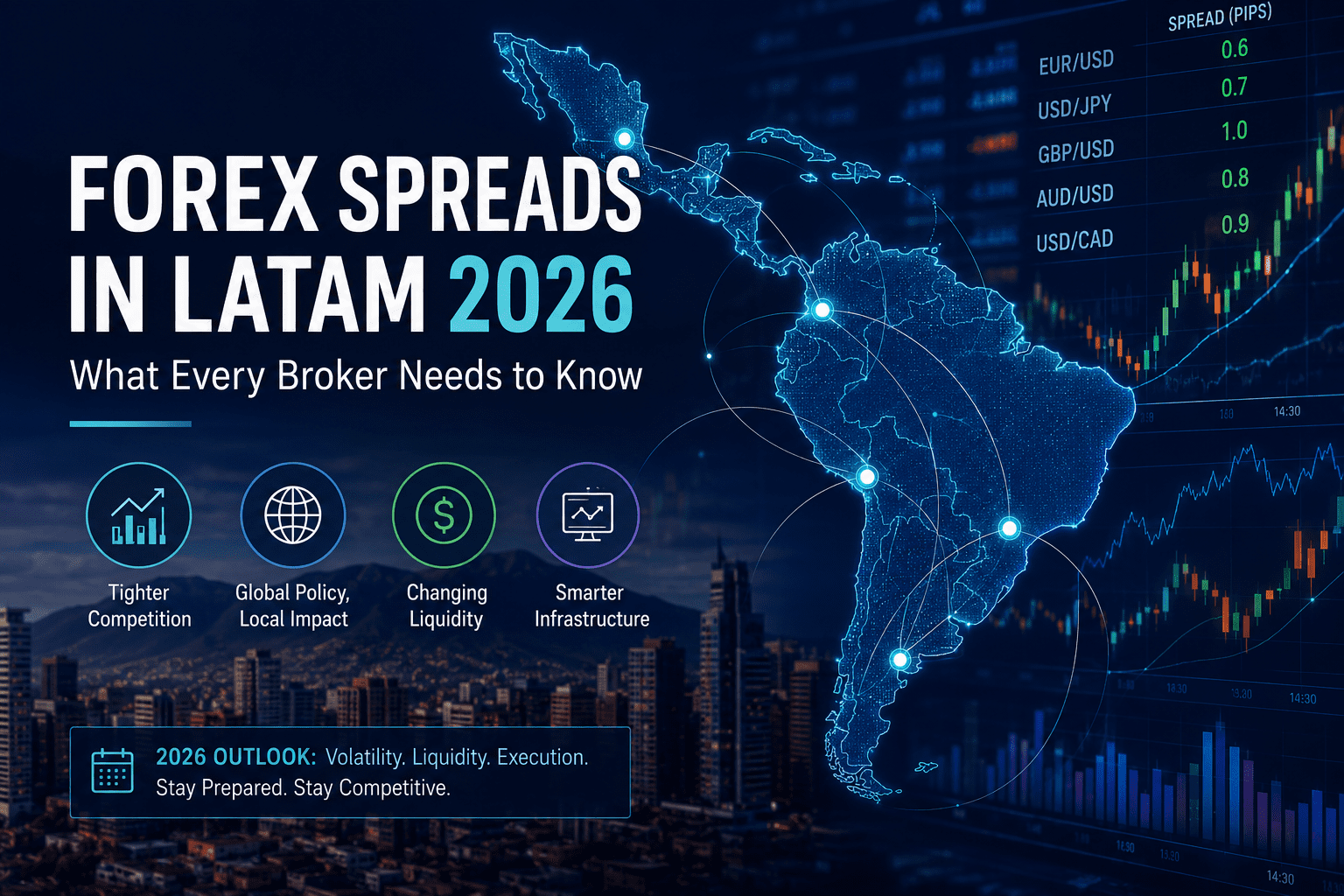
Forex Spreads in LATAM Are Becoming More Dynamic. In this article, we’ll look ahead at forex spreads in LATAM for 2026 and what changes may be on the horizon.
Forex spreads in LATAM are becoming increasingly sensitive to global market conditions. While traders often focus on price movements, brokers must also manage changing liquidity, execution quality, and pricing stability. In 2026, one of the biggest drivers behind these changes continues to be U.S. monetary policy.
Every Federal Reserve decision influences more than exchange rates. It can reshape liquidity across global forex markets, widen spreads during periods of uncertainty, and place additional pressure on broker infrastructure. For brokerages serving clients across Latin America, understanding these relationships is becoming essential for maintaining competitive pricing and delivering a consistent trading experience.
Why Forex Spreads in LATAM Matter More Than Ever
Most discussions about forex spreads focus on trading costs. However, brokers understand that spreads reveal much more than the difference between bid and ask prices. They reflect changing liquidity conditions, influence execution quality, affect hedging costs, and ultimately shape the trading experience clients receive. As competition among brokers continues to increase across Latin America, maintaining stable and competitive forex spreads has become both an operational and commercial priority.
How Federal Reserve Decisions Affect Forex Spreads
Every Federal Reserve meeting generates the same questions.
Will rates rise?
Will rates fall?
Or will policymakers hold steady?
Financial media focuses on the announcement, while traders react to price movements. Brokers, however, must deal with what happens after the headlines. When expectations around U.S. interest rates change, liquidity providers reassess risk, market makers adjust pricing, and volatility increases. Consequently, forex spreads often widen as liquidity becomes more selective. Although these changes begin in the United States, they quickly influence brokers serving clients throughout Mexico, Colombia, Peru, Chile, Argentina, and the rest of Latin America.
Why Liquidity Changes During Major Market Events
Liquidity providers don’t like uncertainty. When markets become difficult to price, they often widen spreads to compensate for increased risk. This commonly happens during:
- Federal Reserve announcements
- Inflation reports
- Non-Farm Payrolls releases
- Unexpected economic data
- Major geopolitical events
As a result, currency pairs that normally trade with tight spreads can become significantly more expensive to execute. For brokers, maintaining competitive forex spreads during these periods becomes increasingly challenging.
The Spread Story Most Traders Never See
Imagine EUR/USD normally trades with a spread of 0.2 pips. A Federal Reserve announcement approaches. Liquidity providers become more cautious, pricing confidence declines, and consequently, spreads widen. Most traders simply notice the higher trading cost. Brokers, however, recognize several operational changes happening simultaneously.
These include:
- Liquidity fragmentation
- Increased execution risk
- Higher hedging costs
- Greater pricing variability
This is why managing forex spreads involves much more than simply connecting to additional liquidity providers.
Why Some LATAM Brokers Feel the Impact More Than Others
Many brokerages across Latin America serve clients who actively trade:
- EUR/USD
- GBP/USD
- USD/JPY
- Gold
- NASDAQ
- S&P 500
- Other U.S. dollar-linked products
When Federal Reserve policy increases volatility across these markets, trading volumes often rise sharply. Although increased activity creates new opportunities, it also places additional pressure on execution infrastructure, liquidity relationships, routing systems, and risk management processes. As a result, brokers with stronger infrastructure are often better positioned to maintain consistent forex spreads and execution quality.
Not Every Spread Problem Is a Liquidity Problem
This is where many brokers make incorrect assumptions. When forex spreads widen, it’s easy to blame liquidity providers. Sometimes that’s true. However, the underlying cause may actually be internal.
Wider spreads can also result from:
- Routing inefficiencies
- Infrastructure bottlenecks
- Slow liquidity selection
- Execution delays
- Connectivity limitations
In other words, two brokers operating under identical market conditions can deliver completely different execution experiences. More often than not, technology determines the difference.
Infrastructure Is Becoming a Competitive Advantage
Periods of volatility rarely create operational weaknesses. Instead, they expose weaknesses that already exist. Systems that perform well during normal market conditions may struggle once trading activity accelerates. As a result, leading brokers increasingly evaluate four critical areas.
Routing Efficiency
Can orders reach the best available liquidity without unnecessary delays?
Liquidity Management
Can multiple liquidity providers be managed intelligently?
Infrastructure Visibility
Can operational teams identify execution bottlenecks in real time?
Scalability
Can the trading environment support sudden increases in trading activity without affecting execution quality?
Answering these questions has become increasingly important for brokers competing across Latin America.
Maintaining Competitive Forex Spreads Requires Greater Visibility
Most brokers don’t have a spread problem. They have a visibility problem. They know spreads have changed. However, they don’t always know why. Without complete visibility into execution performance, operational teams are forced to react after problems appear rather than identifying them beforehand.
Solutions such as Vulkan Prime help brokers improve execution environments through:
- Intelligent order routing
- Multi-liquidity connectivity
- Real-time execution monitoring
- Infrastructure visibility
- Scalable trading architecture
These capabilities help brokers better understand how orders move through their environment, particularly during periods of heightened market volatility.
Preparing for the Future of Forex Spreads in LATAM
Global markets will continue to react to changing economic conditions. Federal Reserve decisions will remain one of the biggest drivers of liquidity and volatility. As a result, forex spreads in LATAM will continue evolving alongside those market conditions. Rather than trying to predict every central bank decision, successful brokers prepare for its operational impact.
That means investing in:
- Resilient infrastructure
- Intelligent routing
- Flexible liquidity management
- Consistent execution quality
- Greater operational visibility
Because while no broker controls the next Federal Reserve announcement, every broker can control how prepared they are when market conditions change. Increasingly, that’s what separates brokers that simply react from those that consistently stay ahead.