
Differences Between MAM and PAMM Explained
When brokers compare managed account solutions, one of the most common questions is: What are the differences between MAM and PAMM?
Although both technologies allow professional money managers to trade on behalf of multiple investors, they are designed to solve different operational challenges. A PAMM focuses primarily on percentage-based profit allocation, while a MAM offers greater flexibility, multiple allocation methods, and more sophisticated account management.
For newer brokerages, a traditional PAMM may provide everything they need. However, as managed account programs expand, many firms require additional functionality to support multiple managers, different investor structures, and more complex reporting requirements.
Understanding the differences between MAM and PAMM helps brokers choose technology that not only meets today’s needs but also supports long-term growth.
What Is a MAM?
A Multi-Account Manager (MAM) is a technology solution that allows a professional money manager to execute trades across multiple client accounts from a single master account.
Instead of placing the same order separately for every investor, the manager executes one trade. The system then distributes that trade automatically according to predefined allocation rules.
Modern MAM solutions typically support several allocation methods, including:
- Percentage allocation
- Equity-based allocation
- Balance-based allocation
- Lot allocation
- Ratio allocation
Because of this flexibility, MAM platforms are widely used by brokers serving professional asset managers, introducing brokers, family offices, and institutional clients.
As managed account businesses grow, MAM platforms also simplify administration by centralizing execution, reporting, and account management within a single environment.
What Is a PAMM?
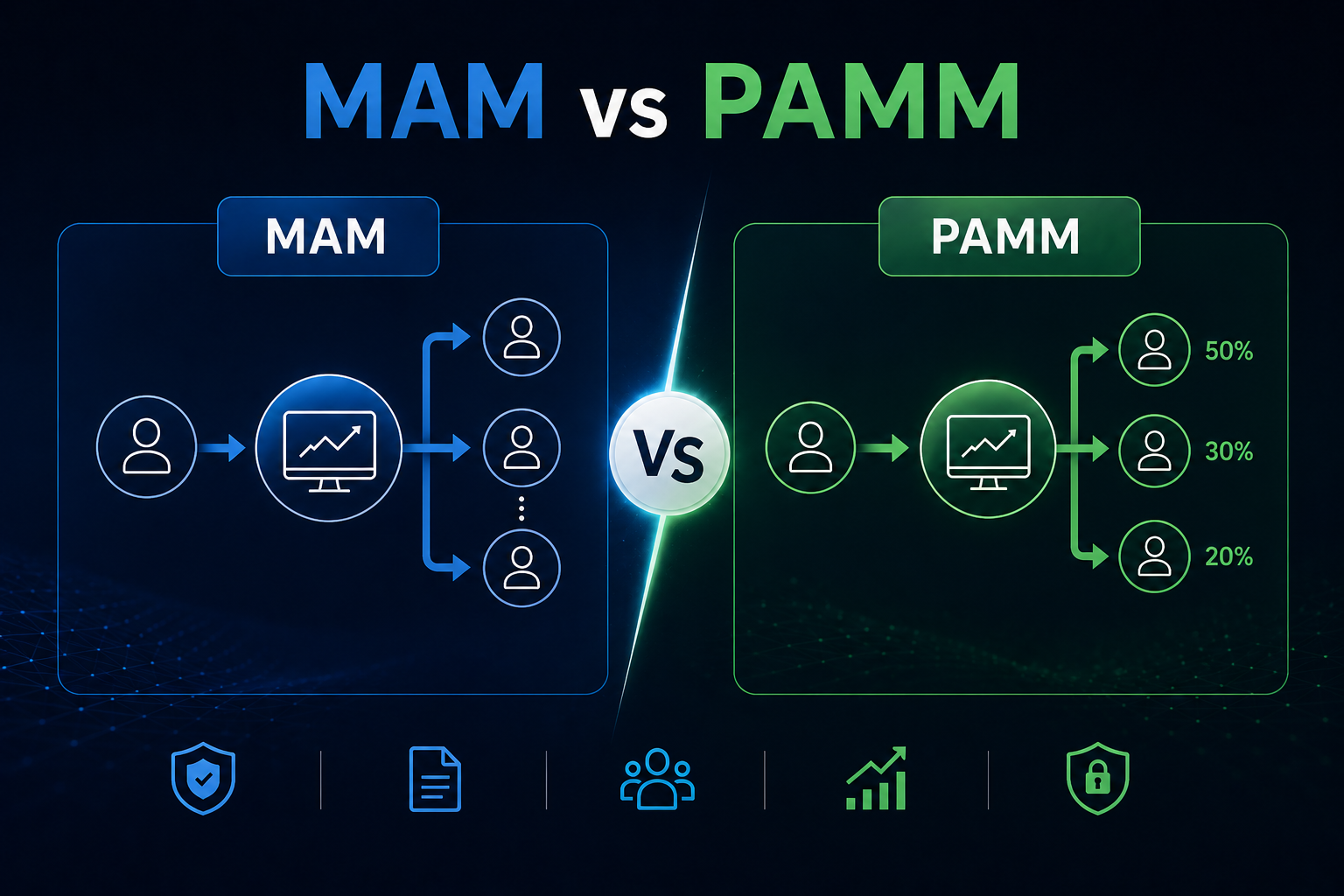
A Percentage Allocation Management Module (PAMM) is a managed account solution that allocates profits and losses according to each investor’s percentage ownership of a pooled investment.
For example, imagine three investors contribute different amounts of capital.
- Investor A contributes 50%
- Investor B contributes 30%
- Investor C contributes 20%
If the portfolio generates a profit, each investor receives gains based on those percentages.
Likewise, if the portfolio experiences a loss, the allocation follows the same proportional structure.
Because the calculation is straightforward and transparent, PAMM remains one of the most widely used managed account models for brokers offering professionally managed investment strategies.
Its simplicity makes it particularly attractive for smaller managed account programs and brokers launching managed investment services for the first time.
MAM vs PAMM: What’s the Difference?
At first glance, MAM and PAMM appear very similar.
Both allow professional managers to trade multiple investor accounts simultaneously.
Both automate trade allocation.
Both reduce operational workload for brokers.
However, the similarities largely end there.
The biggest differences between MAM and PAMM lie in flexibility, scalability, and operational control.
Where a PAMM focuses primarily on proportional allocation, a MAM provides brokers with a broader framework for managing complex managed account operations.
As brokerages grow, those additional capabilities often become increasingly valuable.
MAM vs PAMM Comparison
| Feature | MAM | PAMM |
|---|---|---|
| Allocation methods | Multiple allocation methods | Percentage allocation only |
| Trade execution | Single master trade | Single master trade |
| Investor allocation | Flexible | Percentage based |
| Multiple money managers | Yes | Typically limited |
| Scalability | High | Moderate |
| Operational flexibility | High | Lower |
| Reporting capabilities | Advanced | Basic to moderate |
| Best suited for | Growing brokerages | Smaller managed account programs |
The Biggest Differences Between MAM and PAMM
Although both systems simplify managed account trading, they approach account management differently.
Allocation Flexibility
The most obvious difference between MAM and PAMM is the way trades are allocated.
A PAMM distributes profits and losses according to each investor’s percentage ownership of the investment pool. Because this model is easy to understand, it remains popular among both brokers and investors.
A MAM, however, supports multiple allocation methods rather than relying exclusively on percentages. As a result, brokers have greater flexibility to accommodate different investment strategies and manager preferences.
Operational Scalability
Many brokers begin with a single money manager.
Over time, that often changes.
New managers join.
Investor numbers increase.
Additional strategies are introduced.
Consequently, operational complexity grows alongside the business.
While a traditional PAMM can continue supporting percentage allocation, managing larger programs often requires more sophisticated administration, reporting, and account management capabilities.
This is where MAM platforms typically provide greater long-term value.
Broker Flexibility
Every brokerage operates differently.
Some firms specialize in retail managed accounts.
Others work with professional asset managers or introducing brokers.
Some support only a handful of strategies.
Others oversee dozens of managers across multiple investment programs.
Because of these differences, brokers increasingly require technology that adapts to changing business models rather than limiting future growth.
That flexibility is one of the primary reasons many firms choose a MAM solution over a traditional PAMM.
Which Solution Is Better?
The answer depends less on today’s requirements and more on where the brokerage expects its managed account business to be in three or five years.
For brokers launching a relatively simple managed account program, a PAMM may provide everything required.
However, firms planning to support multiple managers, expand investment offerings, or build larger managed account businesses often benefit from the broader capabilities of a MAM platform.
The decision is therefore not about whether one solution is universally better than the other.
Instead, it is about choosing technology that aligns with both current operations and future growth.
Why Many Brokers Outgrow Traditional PAMM Solutions
For many brokerages, a PAMM is the ideal starting point. It provides a simple and transparent way to allocate profits and losses, making it easy for both money managers and investors to understand how performance is distributed.
However, successful managed account businesses rarely stay small.
As a brokerage attracts more investors, launches additional strategies, or partners with multiple money managers, operational requirements become significantly more complex. What worked for a single manager and a handful of investors may no longer provide the flexibility needed to support future growth.
This is why many brokers don’t replace PAMM because it stops working. Instead, they outgrow the operational limitations surrounding it.
As managed account programs expand, brokers often need to support:
- Multiple money managers
- Different allocation preferences
- Separate investor groups
- Multiple fee structures
- Advanced reporting requirements
- Greater operational oversight
At that stage, brokers are no longer looking for a simple allocation engine. Instead, they need a complete managed account infrastructure.
Modern Brokers Need More Than Allocation
Percentage allocation remains one of the most effective methods for distributing profits and losses. Nevertheless, allocation is only one part of running a successful managed account business.
Operations teams need visibility.
Compliance teams require reporting.
Risk managers need oversight.
Money managers expect flexibility.
Meanwhile, investors want a simple and transparent experience.
Supporting all these stakeholders requires technology that extends well beyond basic allocation.
As a result, many growing brokerages are moving toward MultiMAM environments that combine familiar allocation methods with enterprise-grade account management capabilities.
Why MultiMAM Is Becoming the Preferred Choice
The differences between MAM and PAMM become more noticeable as brokerages scale.
While a PAMM focuses primarily on allocation, a MultiMAM platform supports the broader operational framework required to manage growing businesses.
For example, brokers often need to:
- Launch new money managers quickly
- Support multiple investment strategies
- Manage different client groups
- Monitor account activity in real time
- Generate detailed operational reports
- Scale without rebuilding infrastructure
Rather than replacing percentage allocation, a MultiMAM solution builds upon it.
This allows brokers to preserve the simplicity investors already understand while giving operational teams significantly greater control behind the scenes.
How Vulkan MultiMAM Combines the Best of Both
One common misconception is that brokers must choose between a traditional PAMM and a MultiMAM platform.
In reality, modern brokerages increasingly benefit from both.
Vulkan MultiMAM includes percentage allocation capabilities within a broader multi-account management environment. This means brokers can continue offering the familiar allocation model that investors and money managers prefer while gaining access to more advanced operational tools.
Instead of forcing firms to sacrifice simplicity for flexibility, Vulkan MultiMAM combines both within a single solution.
As a result, brokers benefit from:
- Percentage allocation management
- Multiple allocation methods
- Support for multiple money managers
- Flexible account structures
- Centralized operational oversight
- Advanced reporting
- Infrastructure designed for growth
This approach enables brokerages to scale their managed account business without replacing the allocation model their clients already know.
Choosing the Right Managed Account Solution
There is no single solution that fits every brokerage.
A traditional PAMM may be ideal for firms launching their first managed account offering or supporting a small number of professional managers.
However, brokers planning for long-term growth should consider how their operational requirements may evolve.
Questions worth asking include:
- Will we support multiple money managers?
- Do we expect to launch additional investment strategies?
- Will reporting requirements become more complex?
- Are we planning to expand our managed account business over the next several years?
If the answer to any of these questions is yes, choosing a platform designed for scalability can reduce future operational challenges.
Ultimately, the decision isn’t simply about choosing between MAM and PAMM.
It’s about selecting technology that supports the business you plan to build.
Frequently Asked Questions
What are the differences between MAM and PAMM?
The main differences between MAM and PAMM are flexibility, allocation methods, and scalability. A PAMM uses percentage-based allocation, while a MAM supports multiple allocation methods and provides broader account management capabilities.
Which is better, MAM or PAMM?
Neither solution is universally better. A PAMM is well suited to smaller managed account programs that rely on percentage allocation. A MAM is generally more appropriate for brokers that require greater flexibility, multiple managers, and long-term scalability.
Can a MAM support percentage allocation?
Yes. Many modern MAM platforms, including Vulkan MultiMAM, support percentage allocation alongside other allocation methods. This allows brokers to retain the simplicity of PAMM while benefiting from a more flexible management environment.
Why do growing brokers move from PAMM to MultiMAM?
As managed account businesses expand, brokers often require additional reporting, operational visibility, support for multiple managers, and more flexible account structures. A MultiMAM platform provides these capabilities without sacrificing familiar allocation models.
Is Vulkan MultiMAM suitable for professional money managers?
Yes. Vulkan MultiMAM is designed for brokerages that support professional money managers, multiple investment strategies, and growing managed account programs while maintaining operational control and scalability.
Final Thoughts
Understanding the differences between MAM and PAMM is no longer just a technical decision. For brokers, it is a strategic one.
Both solutions allow professional managers to trade on behalf of investors, and both simplify trade allocation. However, as managed account businesses grow, operational requirements become more demanding.
While PAMM remains an excellent solution for straightforward percentage allocation, many brokerages eventually require the flexibility, visibility, and scalability that a MultiMAM environment provides.
Vulkan MultiMAM was designed with that evolution in mind. By combining percentage allocation capabilities with advanced multi-account management, it gives brokers the tools to support today’s managed account programs while preparing for tomorrow’s growth.