
Crude oil is one of those markets that can feel “easy” right up until it isn’t. It trends hard, snaps back fast, and reacts to headlines in a way that can make a clean setup look messy in minutes. If you want to trade crude oil consistently, the edge usually comes from structure, not prediction: knowing your product, sizing your risk, and building a workflow that keeps you from improvising under pressure.
This is also where tools matter. You can trade oil with a basic chart, sure. But serious oil trading gets smoother when your workflow includes trading software solutions that help with execution, monitoring, and journaling, plus automated risk control that prevents one bad decision from turning into a week-long hole.
“Crude oil doesn’t punish being wrong. It punishes being vague.”
Crude oil as a trading market
Oil is not just another ticker. It’s a macro-sensitive commodity with its own rhythm.
Why oil behaves differently than many markets
A few things make crude unique:
- It reacts to both economics (demand) and geopolitics (supply risks).
- Liquidity and volatility can change sharply around reports and session transitions.
- Price moves can be clean trends one week and choppy whipsaws the next.
If you trade crude oil like it’s a slow-moving index, you’ll often set stops too tight and misread normal noise as “failure.” If you trade it like it’s pure chaos, you’ll oversize and chase momentum at the worst moments. The goal is to respect its volatility without being intimidated by it.
WTI vs Brent in practical terms
You’ll usually see two main benchmarks:
- WTI (West Texas Intermediate): often the go-to for US-focused trading.
- Brent: more internationally referenced.
They can move similarly, but spreads, contract specs, and responsiveness to certain headlines can differ. Most retail and many pro workflows pick one as the “primary” oil product and stick with it for cleaner stats and fewer variables.
Product choices that change your risk
Before you talk strategy, get clear on what you’re actually trading. “Crude oil” can mean several products, each with different cost and risk mechanics.
Common ways traders get oil exposure
- Futures (e.g., WTI futures): direct, standardized, leveraged, contract specs matter a lot.
- CFDs (contract-for-difference): broker-dependent pricing and rules, often simpler access.
- ETFs/ETNs tied to oil: can be easier operationally, but have their own tracking and roll effects.
- Options on futures or ETFs: flexible risk profiles, more complexity.
This article stays practical and platform-agnostic, but your risk math must match your product.
Contract and cost awareness table
| Product type | Strength | Trade-off | Good fit for |
| Futures | deep liquidity, standardized | leverage, margin dynamics, contract roll | active traders with strong risk rules |
| CFDs | accessibility, smaller sizing | broker rules, potential wider costs | traders prioritizing simplicity |
| ETFs | simple custody, long-term friendly | tracking issues, roll effects | investors or slower traders |
| Options | defined risk setups | complexity, pricing sensitivity | traders who manage Greeks and volatility |
“Your strategy isn’t real until it survives the product’s contract specs and costs.”
Oil’s volatility drivers you should actually care about
You don’t need to become an energy analyst to trade oil, but you should know which events reliably change behavior.
Drivers that often move crude oil
- Inventory and supply data releases
- OPEC-related headlines and production expectations
- Geopolitical disruption risk
- Broader risk sentiment (risk-on vs risk-off)
- USD strength and rates narratives (sometimes indirect, but noticeable)
The important part is not predicting the news. It’s anticipating volatility windows so your execution and sizing aren’t caught off guard.
Event windows that can change the “normal” spread and slippage
- Major scheduled releases (inventory-focused)
- Sudden headline bursts (geopolitics)
- Session transitions (liquidity shifts)
If you’re using tight stops, you need a clear rule: either avoid the window, reduce size, or widen stops with smaller size. Pick one. Don’t improvise.
Trading software solutions that actually help in oil
A lot of tools look impressive and do nothing for outcomes. The best trading software solutions reduce errors, make monitoring easier, and speed up review.
Core tool categories worth caring about
Execution and order management
Oil moves fast, so order workflow matters:
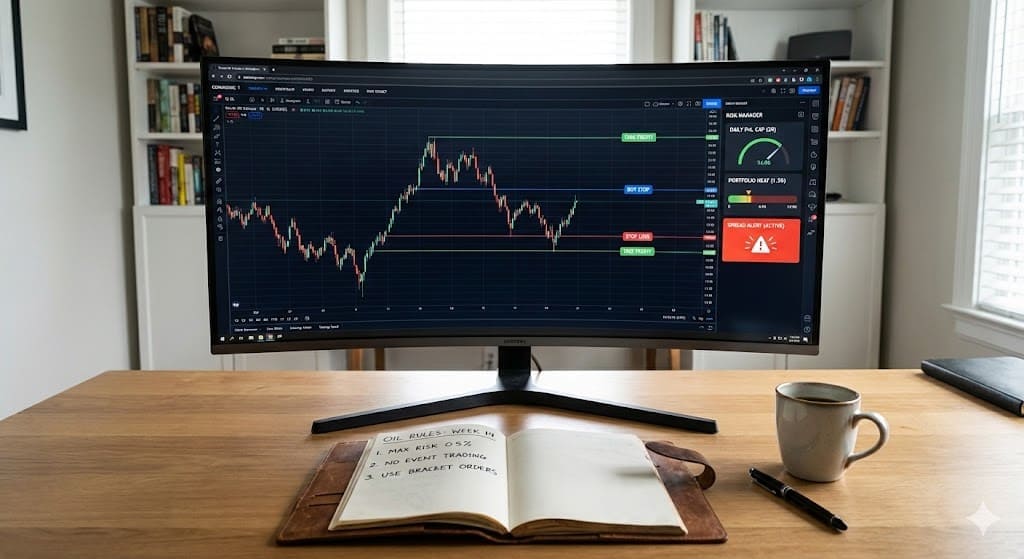
- Bracket orders (entry + stop + target)
- Quick modify/cancel functions
- Position sizing based on stop distance
- Reliable order confirmations and logs
If your platform makes it easy to place a trade but hard to manage it, you’ll end up manually “fixing” positions under stress.
Market monitoring and alerts
Oil traders benefit from alerts that reduce screen time:
- Price level alerts tied to your plan
- Volatility or spread alerts (if available)
- Session reminders for liquidity changes
Keep alerts sparse. Too many alerts creates decision fatigue.
Journaling and analytics
The fastest improvement usually comes from review. Good software helps you capture:
- Entry and exit timestamps
- Stop distance and size
- Notes on volatility regime
- Spread or slippage observations when relevant
- Screenshots of structure at entry
A lightweight journal beats vague memory every time.
Tool-to-problem mapping table
| Problem | Tool feature that helps | Simple outcome |
| chasing entries | level alerts + checklist | fewer impulse trades |
| inconsistent sizing | risk-based position sizing | stable loss profile |
| exits driven by fear | bracket orders | cleaner execution discipline |
| dispute over fills | execution logs and timestamps | faster review and learning |
| hidden cost drag | spread/slippage tracking | realistic performance view |
Automated risk control that prevents “one bad day” spirals
Automated risk control doesn’t need to be a complex institutional system. It can be a set of enforced rules that stop you from making the same expensive mistake repeatedly.
Guardrails that make sense for crude oil
- Max risk per trade (fixed)
- Max daily loss (hard stop)
- Max open positions in oil (often 1 is enough)
- Spread filter (avoid trading when spreads are abnormal)
- Volatility filter (optional, but useful if your strategy hates chaos)
- Time filter (avoid thin hours)
A practical automated risk control table
| Control | Example rule | Why it helps |
| Daily loss cap | stop after 2R loss | prevents revenge trading |
| Max open risk | cap total open risk at 2% | prevents stacked exposure |
| Spread filter | skip trades if spread > 2x baseline | avoids bad fills |
| Trade count limit | max 3 oil trades per day | reduces overtrading |
| Cooldown after loss | wait 30 minutes after stop-out | breaks emotional loops |
These rules are not restrictive. They’re protective. Oil will offer endless opportunities. You don’t need to take all of them.
“Risk control is a feature you add to yourself, not just your platform.”
Trading orders execution in oil: cost and stability matter
Execution is where many oil strategies quietly lose money. Even a decent strategy can underperform if costs and fills are ignored.
The three execution costs you should track
- Spread cost: visible, often widens in stress windows
- Slippage: invisible until it hits, especially in fast moves
- Rejects/partials: friction that breaks your intended plan
If you’re serious about trading orders execution, track outcomes in percentiles, not averages:
- Average slippage can look fine while tail events are painful
- p95 slippage tells you what happens on the worst 5% of trades
Trading speed and stability as a workflow issue
“Fast” isn’t the goal. “Predictable” is.
You want:
- Stable platform behavior during your trading hours
- Predictable order modification time
- Consistent fills when you use the same order types
- Logs that explain what happened when something looks off
If your platform becomes unstable during the windows you trade, oil will punish that.
Examples that make the framework concrete
These are simplified examples to show how structure works. They are not trade signals.
Example 1: Trend continuation with clean risk math
- Market condition: oil trending higher on a daily structure
- Setup: pullback to a defined level plus confirmation on your timeframe
- Invalidation: below the pullback low with buffer
- Risk: 0.5% of account, one position only
- Management: partial at 1R, trailing only after partial
Why it works: the plan is explicit, size is consistent, and management rules prevent emotional meddling.
Example 2: Range mean reversion with strict filters
- Market condition: oil stuck in a tight range for days
- Setup: fade range extremes only when volatility is normal
- Invalidation: beyond range boundary with buffer
- No-trade: skip if spreads widen or if headline volatility spikes
- Risk: smaller than trend strategy if whipsaw risk is higher
Why it works: you’re not forcing mean reversion during breakout conditions.
Example 3: Event-aware avoidance that saves money
- You know a volatility window is coming
- Your strategy is not designed for event spikes
- You either:
- Reduce size dramatically, or
- Step aside
This is boring and effective. Many traders improve by trading less during the worst conditions for their system.
Common mistakes oil traders repeat
Treating oil like a slow market
Oil can move sharply. Tight stops without size reduction are a common trap.
Overtrading session noise
If you trade every wiggle, you stop trading a strategy and start trading stimulation.
Ignoring cost drag
Spreads and slippage can quietly eat an edge. Track them.
Changing rules mid-trade
If you adjust stops or targets based on fear, your stats become meaningless.
Using tools as a substitute for clarity
Fancy trading software solutions can’t fix vague rules. They can only execute what you define.
A practical checklist you can run weekly
Use this to tighten your process as you trade crude oil more consistently.
Strategy clarity
- One primary setup style
- One invalidation method
- One risk model in percent and R units
Execution hygiene
- Bracket orders used by default
- Spread and slippage notes captured for outlier days
- No trading during known bad windows for your system
Risk control
- Daily stop enforced
- Portfolio heat cap enforced
- Trade count limit enforced
Review
- Trades graded A/B/C for rule adherence
- One improvement focus chosen for next week only
If you do this weekly, you’ll often see fewer “mystery drawdowns” because the system becomes less random.
If you want to trade crude oil with less stress, build your process around three pillars: a simple setup you can repeat, automated risk control that prevents spirals, and trading software solutions that make execution and review easier rather than noisier. Start by tracking spreads and slippage tails during your actual trading hours, then tune your rules so your trading orders execution stays predictable and your trading speed and stability don’t fall apart in the exact windows that matter. If you share your timeframe (intraday vs swing), the product you trade (futures, CFD, ETF), and the hours you’re active, I can outline a minimalist rule sheet plus a monitoring checklist tailored to your workflow.
FAQ
Is crude oil better for day trading or swing trading?
Both can work, but oil’s volatility demands clear rules and consistent sizing. Day trading needs tighter execution control; swing trading needs cost awareness for holds and wider structural stops.
Do trading software solutions really matter for oil?
They can, especially for order templates, logs, alerts, and journaling. The main value is fewer execution mistakes and faster review, not extra indicators.
Which automated risk control rules help the most?
Daily loss caps, portfolio heat limits, spread filters, and cooldown rules after stop-outs. These prevent emotional spirals in a fast market.
How can I improve trading orders execution in crude oil?
Use bracket orders, track slippage percentiles, avoid thin liquidity windows, and log outlier days. Improvement comes from reducing tail events, not from chasing perfect averages.
Why do spreads suddenly widen in oil?
Liquidity conditions change by session and event risk. Spreads often widen around volatility bursts, headline risk, and periods of thinner participation.
Should I trade oil during major headline volatility?
Only if your strategy is designed for it and your risk is adjusted. Otherwise, stepping aside is often the highest-quality decision.