
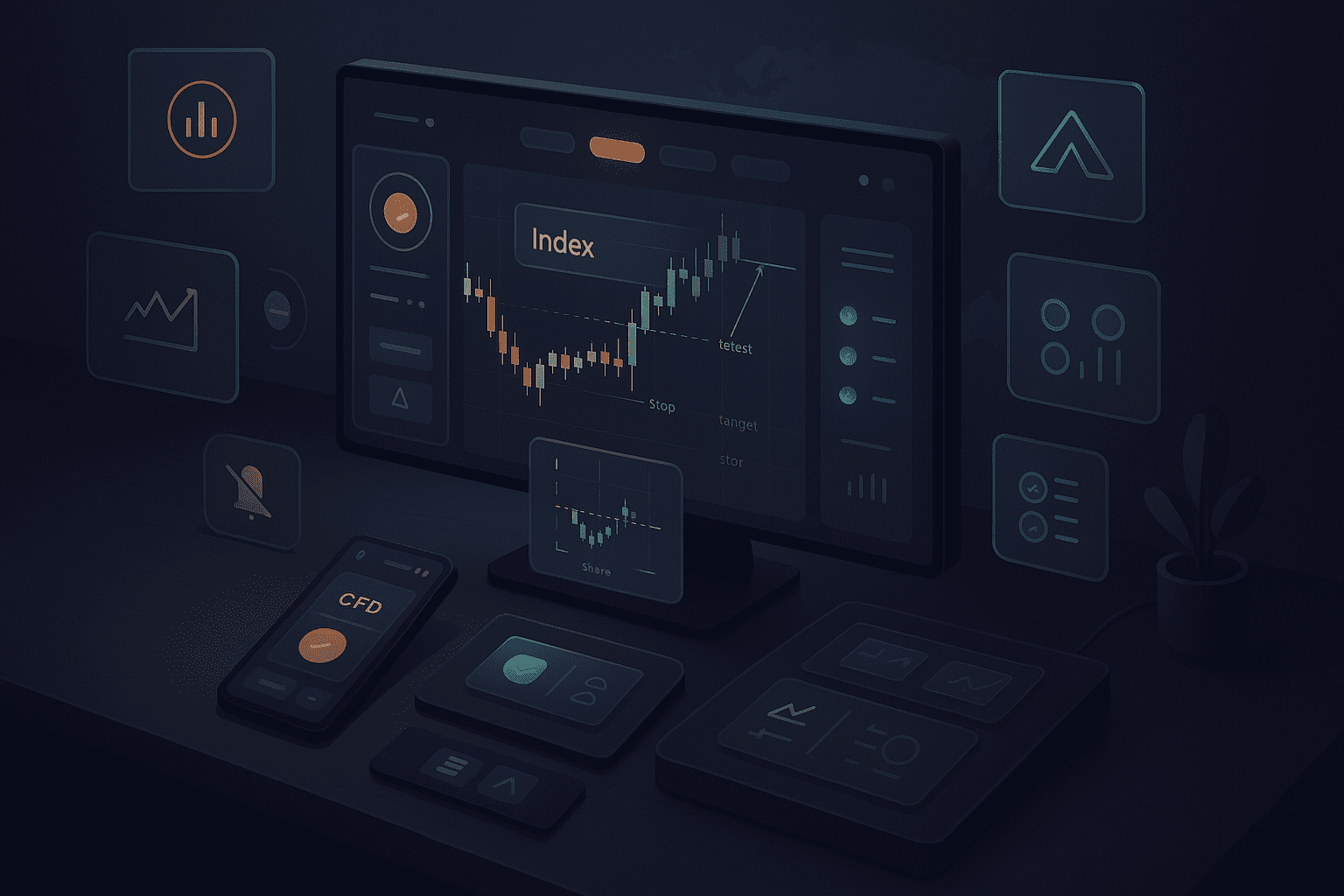
You want the best CFD broker for index trading for real life, not a glossy ad. On busy days you need a quiet ticket that shows cash risk before you click, routes orders cleanly, and produces statements that match exports line by line.
This guide defines what “best” should mean, answers what are the most traded stock indices, and lays out the differences between index and stock trading so you can pick a platform with confidence.
The quick take
- One login, one order ticket, one cash risk number per trade
- Brackets attach by default so exits stay honest
- Typical spreads and slippage behave during your hours
- Reporting equals exports, which ends debates in minutes
Choose tools you can audit, not just admire.
What the best broker looks like in real life
| Area | Must-have behavior | Why it matters |
| Order ticket | Cash risk preview, OCO brackets, market-if-touched | Prevents accidental oversizing and late exits |
| Index coverage | US, Europe, and at least one Asia index | Access to your session’s liquidity |
| Routing quality | Session-aware with price collars | Cleaner fills at opens and data minutes |
| Risk controls | Per day loss cap, max size, symbol and session filters | Small mistakes stay small |
| Mobile parity | Same ticket logic on phone and desktop | No second learning curve |
| Reporting | Statement totals equal CSV or API exports | Faster audits and fewer support tickets |
| Status page | Public timelines with start, fix, and planned revert | Calm communication during stress |
If a demo cannot show these in ten minutes, live will not be kinder.
What are the most traded stock indices
Below are the usual workhorses for CFD traders. Pick the ones that match your window.
| Index | Region and session rhythm | Personality | Why traders like it |
| S&P 500 (US 500) | US open and close dominate | Structured, deep, reacts to macro | Clear setups and tight typical spreads in core minutes |
| Nasdaq 100 (US Tech) | US tech-led flow | Faster, momentum friendly | Strong moves on data and earnings clusters |
| Dow Jones (US 30) | US open and lunch swings | Cleaner but slower than tech | Fewer whipsaws when the tone is steady |
| DAX 40 | Europe open and pre-US overlap | Punchy first hour | High energy in European morning catalysts |
| FTSE 100 | UK session | Range friendly, dividend quirks | Useful for steadier European themes |
| Euro Stoxx 50 | Euro session | Index of leaders, macro tone | Compact way to trade EU risk |
| Nikkei 225 | Asia plus overlap | Gap-prone, reacts to yen moves | Distinct rhythm for early sessions |
| Hang Seng | Asia session | Volatile, news-driven | Strong trend days when themes align |
| ASX 200 | Asia morning | Calmer, bank and commodity tone | Good for early routine building |
Start with one US index and one from your local zone. Add a third only after two quiet weeks where fills, costs, and notes behave.
Differences between index and stock trading
| Dimension | Index CFDs | Single stocks |
| Diversification | Basket reduces single-name risk | Company-specific risk can dominate |
| Catalysts | Macro prints, rates, sector flows | Earnings, guidance, sector news |
| Gaps and volatility | Smoother on average, still jumps at data | Larger gaps around earnings and headlines |
| Liquidity rhythm | Session opens, overlaps, and closes | Varies by stock and market cap |
| Research load | Fewer items to track | More symbols and calendars to monitor |
| Costs and slippage | Often tighter bands in core minutes | Can widen on thinner names or events |
| Strategy fit | Great for technical routines and repetition | Ideal when you have a company-level edge |
“Pick the instrument that matches your calendar and your patience.”
Sizing index trades in plain cash
Let the platform do the arithmetic. You set dollars, it converts to size.
- Risk per trade: 45 dollars
- Planned stop: 9 points
- Dollar per point on your contract: 1
- Contracts = 45 ÷ 9 = 5
“Cash language travels across assets. Keep it.”
Platform checklist you can copy
Must-haves
- Cash risk shown on the ticket before submit
- Bracket presets saved as default
- Symbol specs in cash terms: tick value, hours, funding rules
- Session filters and optional news blackout for heavy prints
- CSV export that equals the statement total without edits
Nice-to-haves
- One-click screenshot for journaling
- Price and time alerts in your time zone
- Layouts that switch cleanly between indices and FX
Costs decide more than headlines
Track real numbers for twenty sessions so your comparison is honest.
| Cost line | Where to check | Practical move |
| Spread and commission | Ticket preview and actual fills | Trade core minutes, avoid chasing |
| Slippage | Fill minus expected price at entries and exits | Favor retests over first bursts |
| Funding or swaps | If you hold overnight | Match hold time to cost or day trade early on |
| Data or platform fees | Only pay for what you use | Keep the toolset lean and effective |
| Payments | Deposit and withdrawal timelines and fees | Document steps to avoid surprises |
“Cost clarity turns uncertainty into a choice you can live with.”
Two index setups that travel across markets
Opening range break and retest
Box the first minutes of the session. After a decisive break, take the first clean retest to the box edge with brackets attached. High clarity on S&P 500, Nasdaq 100, and DAX.
Pullback into value
Confirm direction on a higher timeframe. Mark a value band such as VWAP. Take the first measured pullback that pauses. Useful on US and EU indices after the open settles.
Short definitions survive loud markets.
Daily workflow that keeps you steady
Before the window
- Check the status page and spreads on your chosen index
- Set your cash risk preset on the ticket
- Review the day’s prints in your time zone
During
- One setup per session, two attempts max
- Brackets on by default
- Screenshot the plan before you click
After
- Save before and after images and two journal lines
- Export fills and confirm totals equal your statement
- Adjust weekly, not mid session
“Progress is a series of small, boring upgrades.”
A small nudge before you commit
Write a one page plan with your session, fixed cash risk, two setups, and the three numbers you will track for twenty sessions: spread, slippage, export parity. Then pick the platform that makes your journal calm and your reporting exact. That is how you recognize the best CFD broker for index trading in practice.
FAQ
Which indices are best for beginners
S&P 500 and DAX are popular for clear structure and deep liquidity. Start with one index that matches your hours, then add a second after two quiet weeks.
How many indices should I trade at once
Begin with one. Add a second only after your logs show stable costs and behavior. Depth beats quantity.
Are CFD costs higher than futures
Depends on your provider and session. Measure spread, slippage, and any commission or funding for twenty sessions in your window. Pick the product with cleaner all-in costs for your routine.
Should I focus on indices or single stocks
If you have limited research time, indices are simpler. If you follow company news closely and enjoy earnings season, single stocks can reward that effort. Use the table above to match your style.