
Most trading problems look like strategy problems until you zoom in. Then you realize the chart was fine and the execution wasn’t. You entered late because you felt you were missing it. You moved the stop because taking the loss felt worse than being wrong. You doubled size after a win because confidence was high. None of that is technical. It is behavioral.
That is why trading psychology tips matter. They are not motivational quotes. They are operational controls for attention, emotion, and decision-making. The goal is not to become emotionless. The goal is to trade with emotions present, without letting them steer the wheel.
“Discipline is not a personality trait. It is a system you practice.”
This guide covers practical psychology tools you can apply immediately, plus how to use a stock trading community or live trading community as an asset rather than a distraction.
The real psychology battle: uncertainty and identity
Trading forces you to make decisions with incomplete information. That is uncomfortable, especially when you attach your self-worth to being “right.”
Most psychological pain in trading comes from two places:
- Uncertainty intolerance: needing certainty before acting
- Identity fusion: feeling a losing trade means you are a losing trader
A healthy mindset separates “this trade lost” from “I am bad.” Losses are tuition. The question is whether you learn or repeat.
A short reframe that helps in real time
Instead of asking, “Will this work?” ask:
- “Is this a valid setup with defined risk?”
- “Is my size appropriate for the stop?”
- “Can I take this trade ten times without changing the rules?”
That moves your focus from prediction to process.
Trading psychology tips that reduce unforced errors fast
Below are tips that show up repeatedly in traders who improve. They are practical because they change behavior, not mood.
Tip 1: Pre-commit to risk before you look for entries
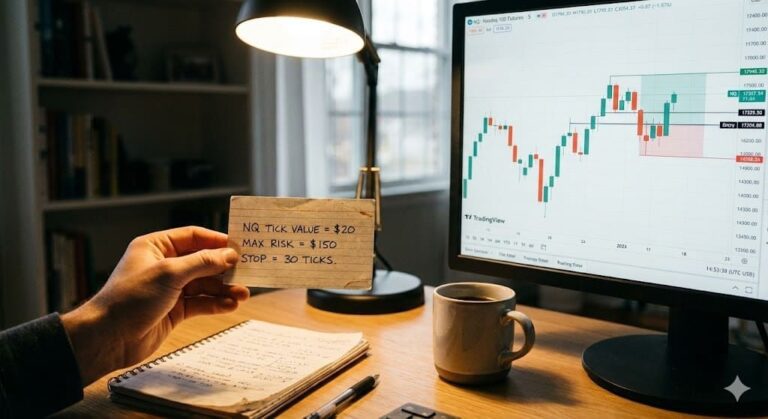
If you decide to take a risk after you find an entry, emotion is already involved. Set your daily and per-trade limits first.
A simple structure:
- Risk per trade: fixed (example: 0.5% to 1% of account)
- Max loss per day: fixed (example: 2R to 3R)
- Max trades per session: fixed (example: 2 to 5)
“When risk is decided first, entries get calmer.”
Tip 2: Use a “one sentence” trade thesis
If you can’t explain the trade in one sentence, you are likely trading noise.
Template:
- “If the price holds above/below X, I expect Y; invalidation is Z.”
This forces clarity and makes it harder to rationalize bad entries.
Tip 3: Build friction against impulsive clicks
Psychology improves when impulsivity becomes inconvenient. Add friction:
- Trade only from a checklist
- Remove one-click market orders if they trigger bad behavior
- Use bracket orders so stops are automatic
- Set alerts for levels, then step away
Friction is not weakness. It is design.
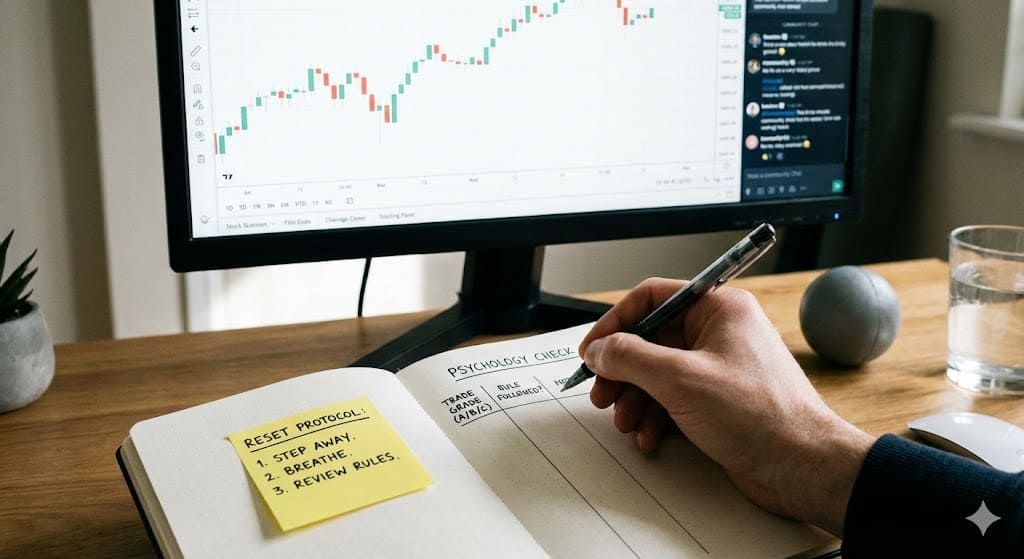
Tip 4: Grade trades by rule-following, not by profit
A good trade can lose. A bad trade can win. If you judge only by P and L, your brain will learn the wrong lesson.
Use A/B/C grades:
- A: followed rules, valid setup, correct size
- B: mostly followed rules, small mistake
- C: broke rules, emotional decision
If you want your psychology to improve, your goal is to increase A trades.
“A-grade losses are acceptable. C-grade wins are dangerous.”
Tip 5: Separate “analysis time” from “execution time”
Many traders mix them. They analyze while in a position, then change the plan mid-trade.
Try this routine:
- Analysis window: define scenarios and levels
- Execution window: follow the plan, reduce new analysis
- Review window: learn, adjust, reset
This reduces the urge to micromanage trades.
Tip 6: Use a reset protocol after a loss
Losses often trigger revenge trading. You need a short script to interrupt it.
A reset protocol can be:
- Stand up, water, 2 minutes away from the screen
- Write: “What rule was tested?”
- Decide: trade again only if a fresh A-setup appears
This sounds basic, but it works because it breaks the loop.
Tip 7: Reduce exposure to “market noise” during your session
Noise increases emotional volatility. If your attention is split between chats, headlines, and charts, your decisions will degrade.
Practical steps:
- Mute social feeds during execution
- Check news at scheduled times only
- Avoid watching other traders’ P and L live
Your brain mirrors environments. Make the environment calm.
The role of a stock trading community in psychology
A stock trading community can help psychology because it reduces isolation and normalizes the learning curve. It can also hurt psychology if it becomes a comparison engine.
When community improves psychology
A good stock trading community provides:
- Clear risk language (stops, invalidation, sizing)
- Accountability for journaling and rules
- Post-trade reviews that include mistakes
- Education focused on process
It makes trading feel like a craft you practice, not a performance you prove.
When community worsens psychology
Community becomes harmful when it:
- Rewards constant action
- Celebrates oversized wins without showing risk
- Creates pressure to “keep up”
- Turns chat into a hype feed
If your heart rate rises when you open the chat, treat that as a signal.
“If the room makes you rush, it is not teaching you; it is triggering you.”
Live trading community: benefits and boundaries
A live trading community can be useful for timing and market context. It can also create FOMO because trades happen fast and social proof is strong.
Use a live trading community as context, not permission
A clean approach:
- Take levels and scenario notes from the room
- Execute only your written setups
- Post your review after the trade
- Mute chat during the trade if it distracts you
This keeps the community as a tool rather than a trigger.
A simple “anti-FOMO” rule set
Before entering any trade inspired by the live room, answer:
- Does it match my setup rules?
- Where is invalidation?
- Is my size correct for the stop?
- Is this within my trading window?
- Can I accept the loss calmly?
If any answer is no, it’s a pass. Passing is part of discipline.
A psychology-friendly workflow you can run daily
Here is a routine that strengthens psychology through repetition.
Pre-session (10 minutes)
- Define max loss and max trades
- Mark key levels
- Write two scenarios: bullish and bearish
- Set alerts
Session (60–120 minutes)
- Take only A setups
- Place stop immediately (bracket order if possible)
- After each trade, log a one-line note
- Stop after reaching max loss or max trades
Post-session (10 minutes)
- Grade trades A/B/C
- Identify one mistake pattern
- Write one adjustment for tomorrow
This works because it reduces decisions. Fewer decisions means fewer emotional mistakes.
“A routine is psychology management by design.”
Common psychological traps and practical fixes
Trap: moving stops because you “feel it will bounce”
Fix: stops are for invalidation, not hope. If your stop is too tight, reduce size or change entry, not the stop.
Trap: doubling down to “get back to even”
Fix: the market does not know your entry. Use a daily loss limit and stop trading when hit.
Trap: taking profits too early
Fix: scale out. Take partial profits at 1R and let the rest follow the plan.
Trap: comparing yourself to others in a community
Fix: compare yourself to your own rule-following rate. If your A-trade percentage is rising, you are improving.
Trap: trading when tired or distracted
Fix: write “no trade conditions” and treat them like real rules.
Next step before the FAQ
If you want better results, don’t start by changing indicators. Start by applying three trading psychology tips for the next 10 sessions: fixed risk per trade, A/B/C trade grading, and a reset protocol after losses. If you participate in a stock trading community or live trading community, use it for context and review, not for trade triggers, and mute it during execution if it pulls you into FOMO. The goal is simple: calmer decisions, fewer unforced errors, and a process you can repeat.
FAQ
Which trading psychology tips help beginners the most?
Fixed risk per trade, immediate stop placement, and trade grading by rule-following. These reduce the most common early account damage: oversizing and impulsive decisions.
Can a stock trading community improve discipline?
Yes, if it emphasizes risk language, journaling, and honest reviews. If it focuses on hype and constant calls, it often increases overtrading and comparison stress.
Is a live trading community good for learning?
It can be helpful for market context and timing, but it also increases FOMO. The safest approach is to use it for scenarios, then execute your own plan.
How do I stop revenge trading?
Use a daily loss limit and a reset protocol: step away, write the rule that was tested, and only re-enter on a fresh A-quality setup.
Why do I keep moving my stop loss?
Usually because the position size is too large or the stop is not tied to invalidation. Reduce size and place stops where the trade idea is objectively wrong.
How do I measure psychological improvement?
Track your A-trade percentage, your average loss versus planned loss, and how often you violate your rules. If those improve, results often follow.