


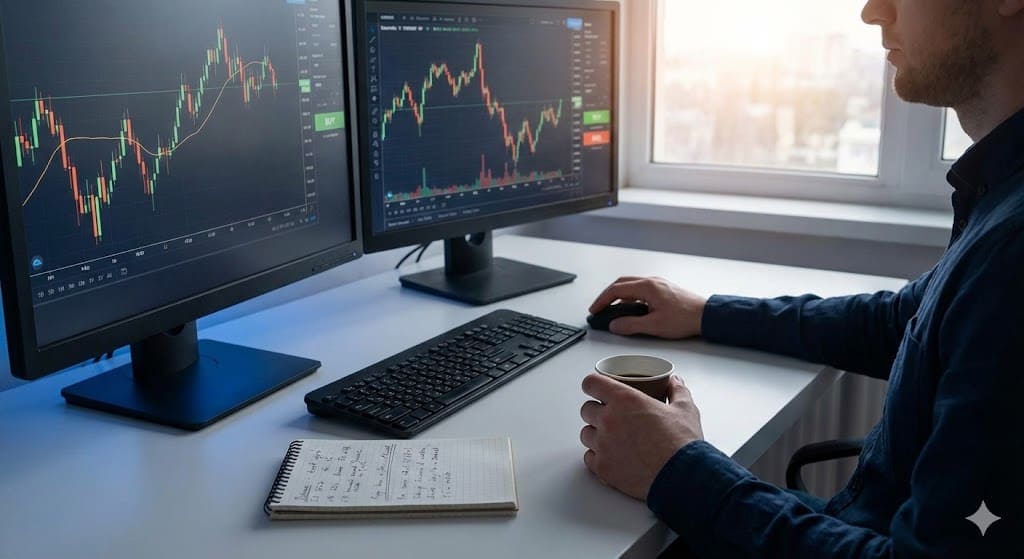
The bell is close, spreads breathe, and your cursor hovers over buy. A trading live account rewards routines that shrink decisions, not adrenaline that inflates them.
“Small size plus strict exits beats perfect entries.”
What changes the moment it’s live
Real fills bring slippage, swaps, and emotions that a demo never triggers. The fix is a simple operating sheet you can follow on busy minutes.
Readiness scorecard
| Area | Green flag | Red flag |
| Risk rule | Fixed cash loss per trade written down | Size changes with mood |
| Levels | Marked the night before | Drawn after every wiggle |
| Costs | Spread, commission, swap known | Surprise fees on statement |
| Journal | Screenshot and two notes per trade | Vague memory of why you clicked |
Your first routine that actually scales
Risk and sizing that survive volatility
- Pick a fixed dollar risk per trade and keep it for two weeks
- Place the stop when you enter, not after price moves
- Cap total daily loss so one session cannot erase your week
Costs you’ll feel in real money
| Cost layer | Where it bites | Keep it honest |
| Spread | At entry during busy minutes | Log quoted vs traded spread for 10 sessions |
| Slippage | Stops and fast moves | Track by symbol and hour, then avoid worst windows |
| Commission | Per trade or per million | Reconcile fills with statements monthly |
| Swap | Overnight holds | Check today’s swap list before planning a multi day idea |
Order flow that keeps you calm
- One setup per instrument per day
- Trade the retest rather than the first break when unsure
- Let profits scale out at your first target; do not improvise the exit
A two week plan you can finish
- Trade one session window and one setup at tiny size
- Write one line per idea before entry: level, stop, first target
- After exit, note spread at entry and slippage at exit
- Review on Friday and drop the hour that hurts most
- Keep only what the notebook confirms
Forex specifics for new capital
If you want to start investing in forex, treat it like a language with a few rules.
| Topic | Plain-English takeaway |
| Session rhythm | Asia is thinner, London sets tone, New York adds speed |
| Pairs to begin with | Liquid majors first; they teach clean structure |
| Event windows | CPI, jobs, and central bank days change behavior—size smaller |
| Holding overnight | Swaps can turn a decent idea into a drag—check before you hold |
“Liquidity is a personality trait. Trade the pairs whose rhythm matches your schedule.”
Platform and broker habits that help you think
- Save a layout with prior high and low, opening range, and one midline like VWAP
- Use bracket orders so risk attaches to every click
- Export fills with timestamps weekly; your notes become evidence, not memory
Bringing it together
If this fits your style, pick one pair and one hour, then start trading with a Live account at the smallest size your platform allows. Keep a two line journal per trade and a hard daily stop. When your notes look calmer and your errors shrink, scale slowly. That is the steady way to grow a trading live account while you Start investing in forex with discipline.
FAQ
Does live feel different from demo
Yes. Slippage, spreads, and emotion show up together. Your cure is fixed cash risk and a rule that the stop goes in with the entry.
How big should first size be
As small as your platform allows for two weeks. You are testing routine and costs, not hunting returns.
Which instruments are friendliest for new forex traders
Majors with tight spreads and deep liquidity. Leave exotic pairs for later.
How many trades per day is sensible
Often one or two ideas you can explain in a sentence. More volume rarely equals more edge.
What if I cannot watch markets all day
Trade one planned window only. Put alerts at your level and let the rest of the day go.