
A trading learning journey is rarely a straight line. Most people start with excitement, then hit the messy middle: inconsistent results, too many strategies, and the feeling that everyone else is “getting it” faster. The issue is not talent. It is structured. Learning trading is closer to learning a craft than collecting tips.
A strong environment can speed things up. A trading community-powered approach can help you get repetition, feedback, and accountability, especially when it is guided by professional traders who can explain decisions, not just post outcomes.
“Progress in trading looks boring from the outside: same routine, better decisions.”
This guide maps a realistic learning path, the milestones that matter, and a practical way to use community and mentorship without falling into copying and FOMO.
The real phases of a trading learning journey
Most traders cycle through similar phases. The goal is to move through them intentionally rather than getting stuck.
Phase 1: Orientation (weeks 1–4)
You are learning the language:
- Order types, spreads, margin vs risk
- Position sizing basics
- What a “setup” actually means
- How your platform behaves
The win condition here is not profit. It is competence: you can place orders correctly, use stops consistently, and explain your risk.
Phase 2: Structure (weeks 4–12)
You reduce chaos:
- One or two markets only
- One setup style
- Fixed risk rules
- A basic journal
This is where most people quit because it feels slow. It is also where the foundation is built.
Phase 3: Repetition and feedback (months 3–6)
You stop strategy-hopping and start getting reps:
- Trade the same setup through different conditions
- Review mistakes weekly
- Tighten execution
A trading community-powered environment helps most at this stage, because repetition plus feedback accelerates skill.
Phase 4: Specialization (months 6+)
You refine:
- Deeper understanding of market regimes
- Second strategy only after the first is stable
- Portfolio heat control and correlation awareness
- Measurable performance by setup
This is where traders start to look “professional” because their process is consistent.
“A trader becomes dangerous when they stop changing the plan every week.”
The non-negotiables that make learning faster
Regardless of market or style, three elements tend to predict progress.
1) Fixed risk rules
Set them early and keep them simple:
- Fixed risk per trade (in dollars or percentage)
- Daily loss limit (stop trading after 2R to 3R)
- Trade limit per session (prevents spirals)
Learning is faster when losses are controlled. If losses are large, psychology collapses and the learning loop breaks.
2) A single teachable setup
Pick a setup you can explain and repeat:
- Trend pullback to a key level
- Breakout and retest
- Opening range framework (for session traders)
It is better to be average at one setup than confused about five.
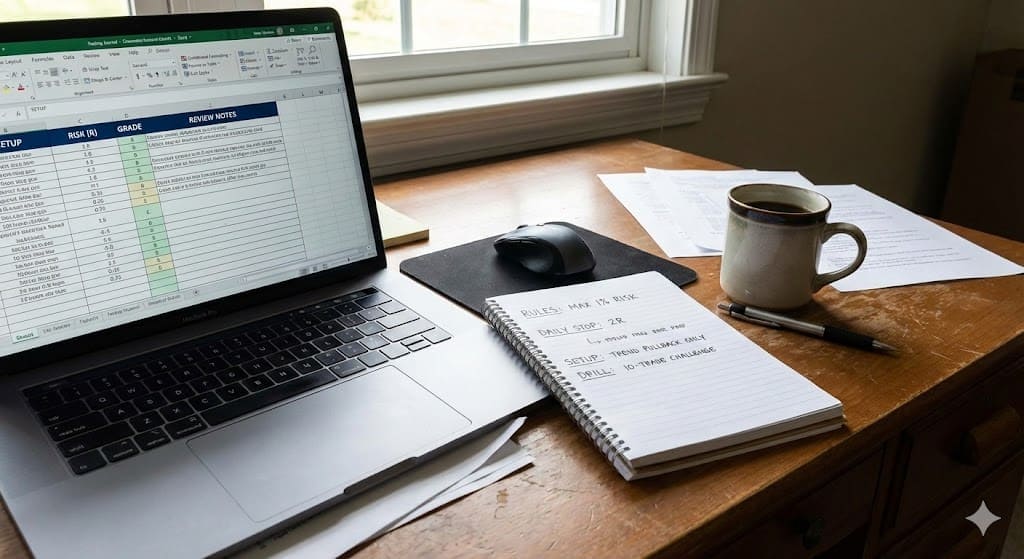
3) Review, in writing
A journal does not need to be pretty. It needs to exist. If you cannot review decisions, you cannot improve them.
“Your journal is your second coach. It catches what you forgot.”
Trading community-powered: how community should actually be used
A trading community-powered approach works when the community improves the learning loop, not when it replaces your decision-making.
What a healthy community provides
- Clear risk language (invalidation, sizing, no-trade conditions)
- Scenario planning (if X then Y)
- Honest recaps including mistakes
- Feedback on your execution and discipline
- Moderation that limits noise and hype
What to avoid
- Communities that reward constant action
- Rooms that post entries without stops
- Performance culture focused on screenshots
- Unclear accountability (nobody owns mistakes)
If a community increases your urgency, it is probably training impulsivity.
“Community should reduce isolation, not increase pressure.”
Professional traders: what “professional” should mean to you
“Professional traders” is a broad label. For learning, the useful definition is not fame or follower count. It is whether the trader can teach process.
Signals you are learning from professionals
- They explain invalidation, not only targets
- They discuss sizing and risk openly
- They take “no trade” days without drama
- They review losses with clarity
- They show the same setup repeatedly (not a new one daily)
Signals to be cautious
- Certainty language and guarantees
- Lack of transparency about risk
- Focus on wins without context
- Incentives tied to volume (encourages overtrading)
Professional behavior is mostly visible in how someone handles losing streaks.
A simple learning roadmap you can follow
Here is a structured roadmap that works for most people, regardless of market.
Step 1: Pick your market and schedule
Choose one market where you can trade consistently:
- A daily window you can actually show up for
- A product you understand (forex, indices, stocks, futures)
Consistency beats the “perfect” market.
Step 2: Define your setup in plain language
Example template:
- “I trade trend pullbacks. I enter on reclaim of a key level. Stop is beyond the swing that breaks structure. The first target is 1R.”
If you cannot write it, you cannot execute it consistently.
Step 3: Build a checklist
Keep it short:
- Market regime fits setup
- Level is clear
- Entry trigger is present
- Stop is logical and placed immediately
- Size fits risk rule
- Trade fits time window
Step 4: Track results in R
R is your risk unit. This makes results comparable and keeps you focused on the process.
Step 5: Weekly review with one change only
Most traders fail by changing everything. Make one improvement at a time.
“Change one variable. Otherwise you never learn what worked.”
Drills that accelerate skill without gambling
A trading learning journey improves faster with drills than with random trading.
Drill 1: 10-trade rule-following challenge
Goal: ten trades where success is A-grade execution.
Rules:
- One setup only
- Fixed risk per trade
- Stop placed immediately
- Journal within 15 minutes of exit
Drill 2: Position sizing repetition (daily)
Do three sizing calculations per day for hypothetical trades. The goal is automatic sizing under stress.
Drill 3: Replay review (weekly)
Pick two trades:
- One A-grade loss
- One C-grade win (if you have one)
Learn from both. C-grade wins are usually the most dangerous teachers.
A practical journaling template
Keep it simple enough that you actually use it.
| Field | Example | Why it matters |
| Market | EURUSD | Focus |
| Setup | Breakout retest | Repeatability |
| Risk | 1R | Consistency |
| Result | +1.3R | Comparable outcomes |
| Grade | A/B/C | Discipline metric |
| Note | Entered late | One fix |
If you are in a trading community-powered environment, share your grade and thesis, not just the outcome. You get better feedback and you avoid turning discussion into applause hunting.
How to use community feedback without copying
Copying feels efficient, but it often delays learning because it bypasses your decision process.
A better approach:
- Post your plan before the trade (if possible)
- Ask for feedback on invalidation and sizing
- Compare your execution to the plan afterward
- Track which feedback improved your rule-following rate
This is the difference between “social trading” and learning.
“Borrow frameworks, not triggers.”
Milestones that show you are improving
Profit is a lagging metric. Here are leading indicators:
- Fewer rule violations per week
- Average loss close to planned loss
- Consistent trade count (no revenge spikes)
- Clearer “no trade” decisions
- Performance stabilizes by setup type
If you can keep your worst days small, you are getting better.
Next step before the FAQ
If you want your trading learning journey to move faster, build a 20-session plan: one market, one setup, fixed risk, and a weekly review. Make it trading community-powered by posting your trade thesis and rule grade for feedback, and use professional traders as a reference for process: sizing, invalidation, and disciplined “no trade” decisions. After 20 sessions, you will have evidence of what you do well and exactly what to fix next, which is the point where learning stops feeling random.
FAQ
How long does a trading learning journey usually take?
It varies, but most people need months of consistent practice to stabilize execution and risk control. Progress accelerates when you reduce variables and track rule-following.
Can a trading community-powered approach replace a strategy?
No. Community can improve feedback and accountability, but you still need a written setup and risk rules. Without that, the community becomes noisy.
How do professional traders think differently from beginners?
They focus on risk, process, and consistency. They plan scenarios, accept losses quickly, and measure performance over samples rather than single trades.
What is the best way to avoid strategy hopping?
Commit to one setup for 20 sessions and grade trades by rule-following. If you change strategies too quickly, you never gather enough evidence to learn.
What should I post in a community to get useful feedback?
Post your thesis, invalidation level, risk size, and your A/B/C grade afterward. Avoid posting only results screenshots, which usually attracts shallow feedback.
What is a good first milestone before aiming for profitability?
Consistent execution: stops on every trade, stable position sizing, and fewer rule violations week to week. Profitability becomes more realistic once discipline is stable.