


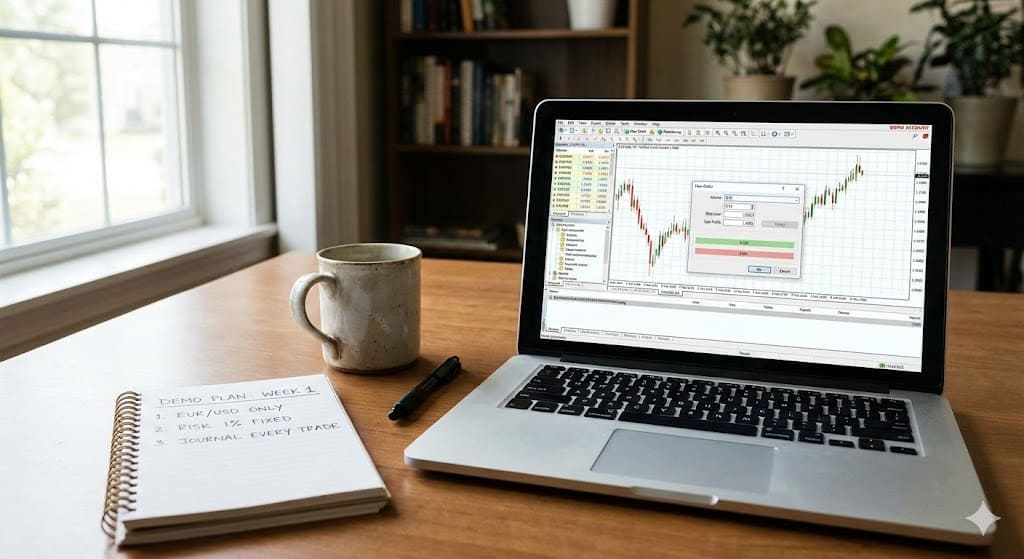
A trading demo account is one of the few “free” tools in trading that can actually save you money later. Not because it predicts the market, but because it lets you practice the parts that usually cause expensive mistakes: order placement, position sizing, stops, and routine.
The mistake is treating demo like a video game. When demo is used casually, it builds habits that collapse the moment real money is involved. When demo is used intentionally, it becomes a training environment, especially for people taking the first steps to trade in forex and trying to choose a premier trading platform that fits their workflow.
“Demo is not for proving you can win. It is for proving you can follow rules.” (Trading journal)
This guide shows how to use a trading demo account the right way, what to practice first, and how to transition into a small live account with fewer surprises.
Why a trading demo account matters more than beginners think
Forex is not only analysis. It is execution. And execution mistakes are common early on:
- Entering the wrong lot size
- Forgetting a stop loss
- Placing a stop on the wrong side of the market
- Confusing pips and points
- Trading during a high-volatility release without realizing it
- Opening too many positions because margin “allows it”
A trading demo account gives you space to make these mistakes cheaply and then remove them from your process.
What demo does well
- Teaches platform mechanics (orders, charts, trade management)
- Lets you practice risk sizing without pressure
- Supports journaling and review routines
- Helps you test whether your schedule fits the market
What demo does not replicate perfectly
- Real slippage during fast markets (it can be smoother in demo)
- Emotional pressure and hesitation
- The temptation to “save a loser” with real money
- Actual spreads and execution quality in all conditions (varies by broker)
If you keep those limits in mind, demo is still one of the smartest starting points.
First steps to trade in forex using demo as a training plan
The phrase “first steps” can mean anything, so let’s make it concrete. Your first steps should produce a repeatable routine, not just a few random trades.
Step 1: Learn the basic building blocks (without overloading)
Focus on these items first:
- Pip value basics: understand what one pip means for your position size
- Order types: market, limit, stop, and how stops trigger
- Spread: the cost built into the quote
- Margin vs risk: margin is required collateral, risk is your potential loss
- Stop loss placement: invalidation-based, not “comfort-based”
A beginner who understands these five areas is already ahead of many traders who jump straight into indicators.
“Your edge begins when you can explain your risk in one sentence.” (Risk note)
Step 2: Pick one pair and one timeframe
Start with one major pair and one manageable timeframe (many people use 15-minute or 1-hour charts). This reduces decision fatigue and makes your learning measurable.
Good early goals:
- One pair you will track daily
- One session window you can trade consistently
- One setup style you will practice (not five)
Step 3: Choose a premier trading platform that supports clean execution
A premier trading platform is not “the one with the most features.” It is the one that helps you avoid mistakes and makes your routine easy.
Look for:
- Simple order entry with clear stop and take-profit fields
- Easy modification of orders (especially stops
- Saved chart templates and watchlists
- Readable account history and export options
- Alerts for price levels and margin conditions
A platform can be “popular” and still be clunky for your workflow. Demo is how you find out.
Set demo up like a real account, not a fantasy account
This is the most important part. Most people sabotage the demo by using unrealistic settings.
Use realistic capital
If you plan to start live with $500, do not demo with $100,000. You will learn the wrong sizing instincts.
Use realistic leverage assumptions
High leverage in a demo feels harmless until it isn’t. Keep leverage assumptions conservative and focus on position sizing.
Track results in R, not just dollars
R means risk units. If you risk $10 per trade, a +1R trade makes $10. This allows you to compare trades fairly and keeps your focus on consistency.
Place the stop immediately
Treat “no stop” as a rule violation, even in demo. If your platform supports bracket orders, use them.
“In the demo, you practice what you will do under pressure.” (Journal line)
The three drills that build confidence fast
A trading demo account becomes powerful when you treat it like training, not entertainment.
Drill 1: The 10-trade rule-following challenge
Goal: complete ten trades where success is rule compliance, not profit.
Rules:
- Take only one setup type
- Risk the same amount each trade
- Stop placed immediately
- Journal within 15 minutes of closing
This drill exposes your weak points quickly: late entries, moving stops, overtrading.
Drill 2: Position sizing repetition
Once per day, calculate position size for three hypothetical trades:
- Different stop distances
- Same dollar risk
The goal is to make sizing automatic. Most early losses come from sizing mistakes, not from “bad analysis.”
Drill 3: Session discipline
Trade only within a defined window for a week. Outside that window, you can analyze, but you cannot trade.
This helps you find a routine that works with your real life, which is a core part of the first steps to trade in forex.
A simple beginner playbook to practice in demo
You do not need a complex strategy. You need something structured.
Setup: trend pullback with clear invalidation
- Identify direction on a higher timeframe
- Mark a support or resistance zone
- Wait for pullback into that zone
- Enter on a clear reaction (reclaim candle, break of pullback structure)
- Stop goes beyond the swing point that breaks the idea
- Target: 1R first, then optional trailing or scaling
This setup teaches patience, structure, and clean stop placement.
Journaling: the part that turns demo into growth
A demo account without journaling is just clicking.
Keep the journal small:
| Field | Example | Why it matters |
| Pair | EURUSD | Keeps focus |
| Setup | Trend pullback | Tracks repeatability |
| Risk | 1R | Normalizes results |
| Result | +1.2R | Measures edge |
| Rule grade | A/B/C | Process improvement |
| Note | Entered late | One fix for next time |
If you do this consistently for two weeks, you will learn more than most traders learn in two months of casual demo trading.
“If you cannot grade a trade, you cannot improve it.” (Weekly recap)
Common demo traps and how to avoid them
Trap: overtrading because it is “not real”
Fix: set a trade limit per day and treat it as non-negotiable.
Trap: taking random setups
Fix: commit to one setup for 20 sessions. Variety can come later.
Trap: ignoring spreads and session conditions
Fix: trade during the same hours you plan to trade live. Track spread behavior.
Trap: turning demo into a performance contest
Fix: measure rule-following rate, not only profit.
Trap: switching platforms every three days
Fix: demo each platform for at least a week with the same routine, then compare.
How to transition from demo to live without shock
A clean transition lowers the emotional gap.
Step 1: Go from demo to micro risk, not from demo to full size
Trade the smallest size that still makes you care. The goal is to practice calm execution with real emotions.
Step 2: Keep the same routine
Same setup, same trading window, same journal. Do not “upgrade strategy” at the same time you upgrade to real money.
Step 3: Expect new emotions
Live trading adds hesitation, fear, and “revenge energy.” That is normal. Your rules exist to prevent those emotions from driving decisions.
“Live trading does not reveal the market. It reveals you.” (Coach note)
A 14-day demo plan you can follow
If you want a clear plan inside your trading demo account, use this:
First 3 days: platform mastery
- Place market, limit, and stop orders
- Practice modifying stops and targets
- Export trade history
- Set up templates and watchlists
Days 4 to 7: one setup, fixed risk
- Trade only one setup type
- Fixed risk per trade
- Stop placed immediately
- Journal every trade
Days 8 to 10: quality over quantity
- Trade maximum 1 to 2 trades per session
- Require checklist compliance
- Track rule grades
Last 3 days: review and refine
- Calculate rule-following rate
- Identify top 2 mistakes
- Adjust one rule only
- Repeat
This plan helps your first steps to trade in forex feel structured, not random.
Next step before the FAQ
If you are taking the first steps to trade in forex, open a trading demo account on the premier trading platform you are considering and run the 14-day plan exactly as written: one pair, one setup, fixed risk, and daily journaling. At the end, you should be able to answer two questions with confidence: “Can I execute cleanly on this platform?” and “Can I follow my rules consistently?” Those answers are more valuable than any indicator you could add.
FAQ
How long should I use a trading demo account before going live?
Long enough to execute orders confidently, size positions correctly, and follow your rules for at least 20 trading sessions. If you still forget stops or oversize, stay in demo a bit longer.
What are the first steps to trade in forex if I feel overwhelmed?
Start with one major pair, learn order types, practice stop placement, and focus on position sizing. Build a small routine before you add complexity.
Does a premier trading platform guarantee better results?
No. A premier trading platform helps you execute cleanly and track performance, but results still depend on your strategy, risk management, and discipline.
Should I demo multiple platforms?
Yes, but compare them fairly. Use the same watchlist, same setup, and same routine for at least a week per platform so the comparison is meaningful.
Why does demo feel easier than live trading?
Demo removes emotional pressure. Live trading adds hesitation and impulsive behavior. That is why demo should be used to build habits that hold under stress.
What is the biggest mistake beginners make in demo?
Treating demo like a game: overtrading, ignoring risk, and skipping journaling. Demo should train discipline, not ego.