



Paper trading is practicing trading with virtual money instead of real cash. You place trades on live market prices, track the results, and learn how a platform and a strategy behave — all without risking a cent. It is the single cheapest way to get better, and every beginner should start here. This guide covers what paper trading is, why it works, its limits, and how to start.
What is paper trading?
Paper trading — also called demo or simulated trading — lets you buy and sell on real, live prices using a virtual balance. The name comes from the old days when traders tracked hypothetical trades on paper. Today it runs inside a demo account that mirrors the real platform, so everything looks and works the same except the money isn’t real.
You get a virtual balance (often $10,000 to $100,000), place trades exactly as you would live, and watch your simulated profit and loss update in real time.
Why paper trading works
- Zero financial risk. Mistakes cost virtual dollars, not real ones — so you can afford to make them while you learn.
- Learn the platform. Order types, charts, stop-losses, and position sizing all work as they do live. You build muscle memory before real money is at stake.
- Test a strategy. Run a setup dozens of times and see whether it actually holds up, without paying tuition in losses.
- Build a routine. Practicing entries, exits, and a trading journal turns theory into habit.
The evidence for practicing first is stark. A study tracking every retail day trader in Brazil’s futures market who persisted for more than 300 days found that 97% lost money, and a landmark analysis of 66,000 US brokerage households showed the most active traders badly underperformed the market after costs. Paper trading is how you move as much of that learning curve as possible off your real balance.
Paper trading vs live trading
Most of the mechanics are identical — but two things change the moment real money is involved, and they matter more than beginners expect.

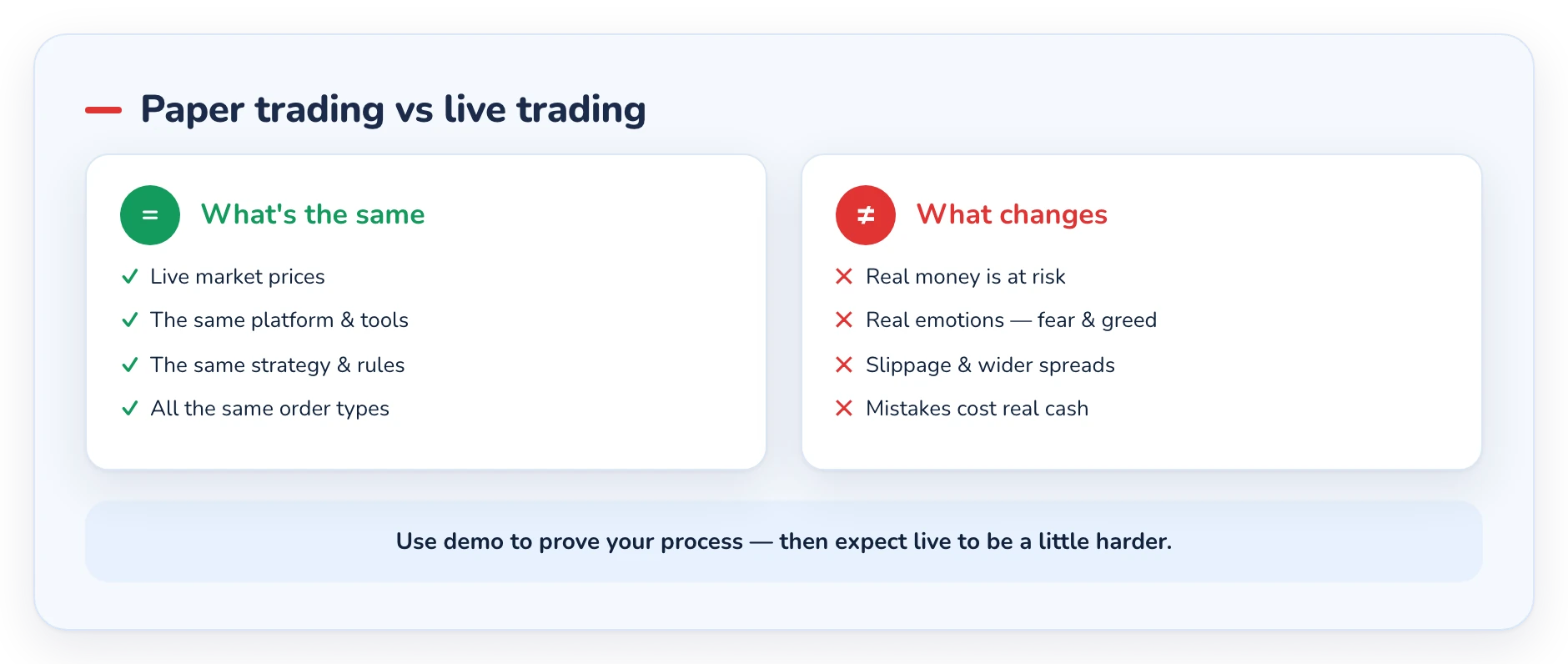
| Aspect | Paper trading | Live trading |
|---|---|---|
| Money at risk | Virtual (e.g. $10,000–$100,000) | Real |
| Prices | Live market data | Live market data |
| Platform & tools | Identical | Identical |
| Emotions | None | Fear, greed, revenge-trading |
| Order fills | Often perfect | Slippage, requotes, wider spreads |
| Cost of a mistake | $0 | Real losses |
- Emotions. A virtual $200 loss feels like nothing; a real one triggers fear and the urge to revenge-trade. Discipline is the hardest thing to simulate.
- Execution. Demo fills are often perfect. Live, you can face slippage, requotes, and wider spreads in fast markets, so real results are usually a little worse than demo.
The takeaway: use paper trading to prove your process, but expect live results to be tougher, and transition with small size.
How to start paper trading
- Open a demo account. Most brokers offer one free. Tradeview Markets provides demo accounts on the MetaTrader and cTrader platforms.
- Set a realistic balance. Fund the demo with roughly what you plan to trade live — practicing with $100,000 when you’ll deposit $1,000 teaches the wrong habits.
- Trade one strategy with real rules. Risk a fixed 1% per trade, use a stop-loss, and log every trade as if it were real.
- Track your stats. Aim for a few weeks of consistent results — win rate, average win vs. loss, and whether you followed your plan.
How to know you’re ready for live
Paper trading has done its job when you can tick these boxes:
- You follow your plan without hesitation, including taking stop-losses.
- Your results are consistent over several weeks, not one lucky run.
- You understand every order type and can size a position correctly.
When you get there, open a live account and start with the smallest position sizes — real emotions are the last lesson, and small size lets you learn them cheaply. New to the whole process? Our how to start trading guide lays out the full roadmap.
Common paper-trading mistakes
Paper trading only helps if you do it honestly. Avoid these:
- Funding an unrealistic balance. Practicing with $100,000 when you’ll deposit $1,000 builds habits that blow up live. Match the demo to your real plan.
- Not journaling. Without a log of your trades, you can’t tell skill from luck. Record entry, exit, reason, and result on all of them.
- Trading bigger than you would live. Risking 10% per demo trade proves nothing — hold to a real 1% risk cap.
- Judging on too few trades. Five wins is noise. A strategy needs 30+ trades before its results mean anything.
- Skipping the emotional test. Because demo removes fear, plan to re-learn discipline with small real size once you go live.
The limits of paper trading
Paper trading is essential, but it is not a perfect mirror:
- It removes the emotion that decides most real outcomes.
- Fills can be unrealistically good, hiding slippage and spread costs.
- It can breed overconfidence — a great demo run is not proof you’ll profit live.
Treat a strong demo record as a green light to start small, not as a guarantee.
Frequently asked questions
Is paper trading really free?
Yes. Reputable brokers offer demo accounts at no cost, with virtual funds and live prices. You can practice as long as you like before depositing real money.
How long should I paper trade before going live?
There’s no fixed rule, but a few weeks to a few months of consistent, plan-following results is a reasonable bar. Go live only when your process is routine — then start small.
Is paper trading accurate?
The prices and mechanics are accurate; the experience is not perfectly. Demo fills can be better than live, and there’s no real emotion. Expect live results to be somewhat harder than your demo.
Can you make real money paper trading?
No — the profits are virtual. Its value is learning and testing, which protects your real capital when you do go live.
What is the difference between paper trading and a demo account?
They’re effectively the same thing. “Paper trading” is the practice; a “demo account” is the tool brokers provide to do it with virtual funds on live prices.
Sources
- Chague, F., De-Losso, R., & Giovannetti, B. (2020). Day Trading for a Living? — of retail day traders in Brazil’s futures market who persisted beyond 300 days, 97% lost money and only 0.4% earned more than a bank teller. papers.ssrn.com
- Barber, B. M., & Odean, T. (2000). Trading Is Hazardous to Your Wealth: The Common Stock Investment Performance of Individual Investors. The Journal of Finance, 55(2), 773–806. Households that traded most earned 11.4% annually versus the market’s 17.9%. doi.org/10.1111/0022-1082.00226
Risk warning. Trading Forex and CFDs carries a high level of risk and may not be suitable for all investors. Demo results do not guarantee live results — live trading involves real emotion, slippage, and costs. This article is for educational purposes only and does not constitute financial advice.