


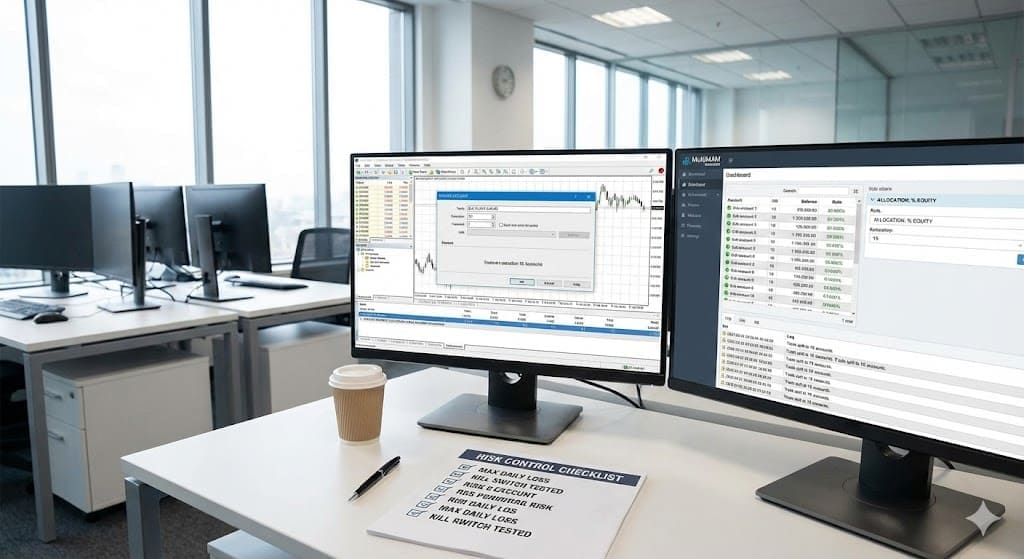
Scaling from one account to many changes everything. What once felt simple becomes a juggling act: different balances, different risk limits, and clients who expect consistent results across all sub-accounts. This is where a MultiMAM tool to boost trading becomes a practical necessity, not a luxury.
MultiMAM setups are designed for money managers, signal providers, and prop-style teams who need to place one trade and replicate it across many accounts with rules. When implemented well, they reduce operational errors, standardize risk, and make reporting far easier. When implemented poorly, they amplify mistakes at scale.
“Replication multiplies both discipline and chaos. Choose which one you scale.”
This guide explains what a MultiMAM setup really does, how a plugin-based approach works, and the guardrails that help you unfold all trading operations without turning your desk into a risk factory.
What a MultiMAM setup really is
At its core, a MultiMAM system lets a master account distribute trades to connected sub-accounts based on predefined allocation rules. The goal is consistency:
- One trade idea
- Many accounts
- One risk framework
Most implementations use a plugin to allow users to assign multiple sub-accounts to a single master, with allocation models that determine how size is split.
Common use cases
- Portfolio managers handling dozens or hundreds of client accounts
- Prop desks distributing strategies across internal books
- Educators or signal providers managing follower accounts
- Family offices separating mandates but sharing execution
The value is not speed alone. It is control and auditability at scale.
The real benefits, in plain language
A well-run MultiMAM environment helps you:
- Reduce manual trade errors
- Keep position sizing consistent
- Apply risk changes instantly across all accounts
- Generate cleaner reports for clients or partners
- Respond faster during volatility
“Standardization is the hidden profit center of multi-account trading.”
A quick benefit-to-problem map
| Problem | MultiMAM benefit | Practical result |
| Inconsistent sizing | centralized allocation | predictable risk |
| Manual replication | one-to-many execution | fewer mistakes |
| Slow reactions | instant rule updates | faster risk control |
| Messy reporting | unified logs | easier audits |
| Scaling pressure | systemized flow | calmer operations |
How the plugin architecture works
Most MultiMAM environments rely on a plugin layer that connects the master account to many sub-accounts. Think of it as a traffic controller for orders.
The basic flow
- You place a trade on the master account.
- The plugin reads the order.
- Allocation logic calculates size for each sub-account.
- Orders are sent simultaneously to sub-accounts.
- Fills, rejects, and modifications are tracked and logged.
This plugin to allow users to assign multiple sub-accounts is where the “brains” live. It decides who gets what, and under which rules.
Allocation models you should understand
Allocation is the heart of MultiMAM. Choose a model that fits your business and risk philosophy.
| Model | How it works | When it fits | Main risk |
| Fixed lot | same size to all | equal mandates | ignores balance differences |
| Percentage of equity | proportional to balance | varied account sizes | drawdown sync |
| Risk-based | size from stop distance | risk consistency | needs clean data |
| Performance-weighted | more to better accounts | dynamic scaling | can chase luck |
| Custom rules | hybrid logic | complex books | harder to audit |
Risk-based and percentage-of-equity models are the most common because they scale naturally.
Risk controls that must exist
A MultiMAM tool to boost trading only works if it includes safeguards that stop one error from affecting everyone.
Essential guardrails
- Max risk per sub-account
- Portfolio heat cap across all accounts
- Daily loss limit per account and per master
- Trade count limits
- Spread and volatility filters
- Manual “kill switch” to pause replication
“If one click can open 100 positions, one rule must be able to close them.”
A simple control table
| Control | Example rule | Why it matters |
| Max risk | 0.5% per sub-account | caps downside |
| Portfolio heat | 3% total open risk | prevents stacking |
| Daily stop | stop after 2R loss | avoids spirals |
| Spread filter | skip if spread > baseline | protects fills |
| Kill switch | pause all replication | emergency brake |
Common mistakes to avoid
- Scaling before rules are stable
- Overcomplicating allocation early
- Ignoring execution logs
- No emergency stop
- No weekly review
If you plan to grow beyond a handful of accounts, a MultiMAM tool to boost trading can turn replication into a controlled process instead of a daily risk. Start with a clear allocation model, add a plugin to allow users to assign multiple sub-accounts, and wrap it in simple risk guardrails so you can unfold all trading operations without multiplying errors. If you share how many accounts you manage and your preferred risk model, I can outline a starter configuration and monitoring checklist.
FAQ
Who should use a MultiMAM setup?
Money managers, prop desks, and signal providers who need to replicate trades across multiple accounts with consistent rules.
Is a plugin required?
Yes. The plugin layer reads master trades, applies allocation logic, and distributes orders to sub-accounts.
What is the safest allocation model?
Risk-based or percentage-of-equity models, because they scale naturally with account size.
Can MultiMAM reduce execution errors?
Yes, by removing manual replication and standardizing order flow.
How do I stop everything in an emergency?
Use a global kill switch or pause function built into the MultiMAM system.
How often should I review performance?
Weekly reviews of risk, rule adherence, and execution quality keep the system stable.