



To start trading, you learn the basics, choose a market, open an account with a broker, practice on a demo, and then place your first small trade with strict risk limits. It sounds simple, and the setup is — the discipline is the hard part. This guide walks through the exact seven steps, plus the risk rules that keep beginners in the game.
What trading actually is
Trading is buying and selling financial assets — currencies, shares, indices, commodities — to profit from price changes. Unlike long-term investing, trading is usually shorter-term and more active. It is a skill you build with practice, not a lottery ticket. The goal at the start is not to get rich; it is to survive and learn while risking as little as possible.
The 7 steps to start trading

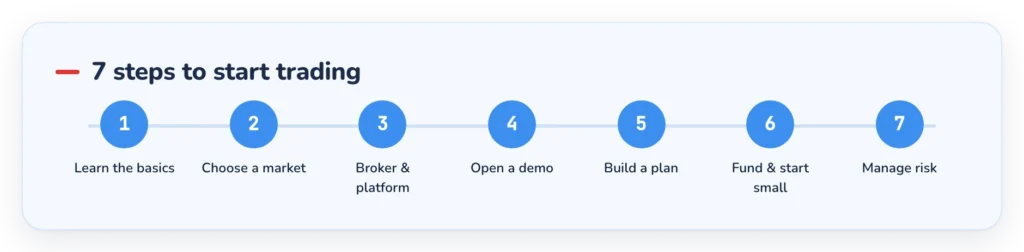
1. Learn the basics
Before risking a cent, learn how markets work: what a spread is, how leverage magnifies gains and losses, and how orders like stop-loss and take-profit function. A few weeks of reading and free tutorials saves you far more than it costs.
2. Choose what to trade
Pick one market to focus on first rather than spreading yourself thin:
| Market | What you trade | Leverage | Hours | Beginner-friendly? |
|---|---|---|---|---|
| Forex | Currency pairs (EUR/USD) | High | 24/5 | Yes — liquid, readable trends |
| CFDs | Shares, indices, commodities (long or short) | Yes | Market-dependent | With care — leveraged |
| Stocks | Company shares | Low / none | Exchange hours | Yes — familiar, simpler |
Beginners often start with one or two major forex pairs, because they trade nearly 24 hours a day, 5 days a week, carry tight spreads, and move in readable trends. CFDs open up shares, indices, and commodities from one account — see our guide to CFD trading.
3. Choose a broker and platform
Your broker is your gateway to the market. Look for clear regulation, transparent costs, reliable execution, and a platform you find easy to use. Tradeview Markets offers the industry-standard MetaTrader and cTrader platforms, which give you charts, indicators, and every order type you will need.
4. Open a demo account
A demo account lets you trade live prices with virtual money. Use it to learn the platform and test a strategy with zero financial risk. Do not skip this — it is the cheapest lesson you will ever get. Spend at least a few weeks here until your process feels routine.
5. Build a simple trading plan
A plan turns guessing into a repeatable process. Decide four things in advance:
- Your market and timeframe — what you trade and on which chart.
- Your entry signal — the exact setup that puts you in a trade.
- Your exit — a stop-loss and a profit target on every position.
- Your risk per trade — many beginners cap it at 1% of the account.
Start with a single strategy. Our guide to forex trading strategies covers beginner-friendly options like trend and breakout trading.
6. Fund a live account and start small
When you are consistently profitable on demo, open a live account and fund only what you can afford to lose. Start with the smallest position sizes — trading real money feels different, and small size lets you adjust to the emotions without serious damage.
7. Manage risk and keep a journal
This is what separates traders who last from those who don’t:
- Risk 1% or less per trade, and use a stop-loss every time.
- Cap your losses for the day or week, and walk away when you hit the limit.
- Log every trade — entry, exit, reason, result. Reviewing the journal is how you actually improve.
A quick example of risk in action
Say you fund an account with $1,000 and risk 1% per trade — $10. You place a stop-loss so a losing trade costs about $10, and you target roughly $20 of profit (a 2:1 reward). With those numbers, you can lose more trades than you win and still come out ahead over time. The size of any single win matters far less than sticking to the rule on every trade.
Common beginner mistakes to avoid
- Trading too big — risking 10–20% on one trade turns a normal losing streak into a blown account.
- No stop-loss — hoping a loser turns around is how small losses become huge ones.
- Over-trading — more trades mean more costs and more emotional decisions, not more profit.
- Chasing losses — trying to “win it back” after a loss usually deepens the hole.
- Skipping the demo — real money is a costly place to learn what a demo teaches for free.
How Tradeview Markets helps you start
- Practice on a demo account, then open a live account when you are ready.
- Trade forex and CFDs on the MetaTrader and cTrader platforms.
- Prefer to learn by following experienced traders? Copy trading mirrors their positions to your account while you build your own skills.
Frequently asked questions
How much money do I need to start trading?
Less than most people think. Many brokers let you open a forex or CFD account with a small deposit, and demo accounts are free. The key is to fund only what you can afford to lose and to start with tiny position sizes.
Can I teach myself to trade?
Yes. Most traders are self-taught through free resources, a demo account, and a lot of practice. The main challenge is information overload — pick one market and one strategy and go deep rather than wide.
How long does it take to become a profitable trader?
Often months to years, not weeks. Treat early results as tuition. Consistency on a demo account, then on small live sizes, is a better milestone than any single big win.
Is trading the same as investing?
No. Investing is usually long-term — buying assets to hold for years. Trading is shorter-term and more active, aiming to profit from price moves over minutes, days, or weeks.
What is the safest way to start trading?
Learn the basics, practice on a demo, risk no more than 1% per trade with a stop-loss, and start live with the smallest sizes. Safety comes from risk control, not from picking winners.
Sources
- Chague, F., De-Losso, R., & Giovannetti, B. (2020). Day Trading for a Living? Of persistent retail day traders in Brazil, 97% lost money. papers.ssrn.com
- Barber, B. M., & Odean, T. (2000). Trading Is Hazardous to Your Wealth: The Common Stock Investment Performance of Individual Investors. The Journal of Finance, 55(2), 773–806. doi.org
Risk warning. Trading Forex and CFDs carries a high level of risk and may not be suitable for all investors. Leverage can work against you as well as for you. This article is for educational purposes only and does not constitute financial advice. Only trade money you can afford to lose.