


The global foreign exchange market is the financial nervous system of the world. Moving trillions of dollars daily, it offers retail traders access to the same liquidity pools used by international banks and hedge funds. However, access does not equal guaranteed profit. The technical barriers to entry are practically nonexistent today, but the educational and psychological barriers remain immense.
Attempting to trade currencies without a highly structured framework is a rapid path to capital loss. This guide details the exact mechanics, platforms, and risk management protocols you need to build a sustainable trading operation.
Table of Contents
What is Forex Trading?
What is forex trading?
Forex trading is the continuous process of buying one currency while simultaneously selling another to speculate on the changing exchange rates between them. Operating as a decentralized global market, it facilitates international trade and investment while allowing traders to profit from the fluctuating values of national currencies.
Unlike purchasing a physical stock, currency trading always involves pairs. When you look at your trading terminal, you will see pairs like the EUR/USD (Euro and US Dollar) or the USD/JPY (US Dollar and Japanese Yen). The first currency in the pair is the “base currency,” and the second is the “quote currency.” The numerical price on your screen tells you exactly how much of the quote currency you need to buy one unit of the base currency.
If your macroeconomic analysis indicates the Euro will strengthen against the US Dollar due to shifting central bank policies, you execute a “buy” order on the EUR/USD. If the exchange rate climbs, you close the position to secure a profit. If the Euro weakens and the price drops, your position takes a loss. You can also “sell” or “short” a pair if you believe the base currency will lose value against the quote currency.
Understanding the Foreign Exchange Market
To operate effectively, you must understand the underlying structure of the market. The foreign exchange market has no central physical exchange. It is a massive Over-the-Counter (OTC) electronic network connecting commercial banks, central banks, institutional investors, and retail brokers.
Because it lacks a centralized physical location with strict opening and closing bells, the forex market remains open 24 hours a day, five days a week. Trading activity seamlessly rolls from one major financial hub to the next. The week kicks off in Sydney, moves to Tokyo, shifts to London, and closes out in New York. The highest market liquidity and price volatility typically trigger when these geographic sessions overlap, specifically during the window when both London and New York are actively trading.
Forex Trading for Beginners
For new participants, the sheer speed of the currency markets can trigger overwhelming anxiety. Before you place any actual capital on the line, you must drill the fundamental mathematical mechanics that dictate how money moves in your account.
- Pips: A pip (Percentage in Point) is the standard baseline unit of price movement. For most currency pairs, it represents the fourth decimal place in the exchange rate. If the GBP/USD pair moves from 1.2500 to 1.2501, that is a one-pip shift.
- Lot Sizes: Forex contracts are traded in standardized batches called lots. A “standard lot” represents 100,000 units of the base currency. A “mini lot” represents 10,000 units, and a “micro lot” represents 1,000 units. The lot size you choose dictates the exact monetary value of a single pip movement.
- Leverage: Leverage allows you to control a large market position using a relatively small deposit. For instance, a 30:1 leverage ratio lets you control a $30,000 position with just $1,000 in your account. Leverage amplifies your profits, but it equally amplifies your losses.
- Margin: This is the actual physical deposit your broker requires to open and hold a leveraged position. If a losing trade depletes your available margin, the broker will trigger a margin call and forcefully close your positions to prevent your account from going into a negative balance.
How to Become a Forex Trader
Transitioning from a complete beginner into a consistent market operator requires treating trading exactly like a risk management business. Amateurs view the market as a casino; professionals view it as an environment of probabilities.
You must establish a rigid daily routine. You are the risk manager, and your account equity is your business inventory. Your goal is not to win every single trade—an impossible feat—but to execute a mathematically sound strategy perfectly over a series of hundreds of trades without emotional deviation.
Learn Forex Trading: Essential Tools and Platforms
Professional execution requires professional-grade technology. Your trading platform is your direct lifeline to global liquidity.
Standard platforms like MetaTrader 4 (MT4), MetaTrader 5 (MT5), and cTrader offer powerful charting capabilities, technical indicators, and low-latency execution speeds. Beyond charting software, you must integrate an economic calendar into your daily routine. Currency values react aggressively to scheduled data releases, such as interest rate decisions, inflation reports, and employment numbers.
Insight from Tradeview Markets:
Tradeview Markets data reveals that traders using our economic calendar and price alerts experienced 32% fewer catastrophic drawdowns during high-impact news events like US Non-Farm Payrolls. Additionally, automated educational support via our CommuniTraders network reduced early client drop-off by 20% in the first month. By prioritizing education and demo practice over immediate live trading, client survival rates significantly improved.
How to Trade Forex
Once you grasp the theory, you need a highly rigid operational workflow. Placing a live trade should never be a spontaneous reaction to a flashing green candle. It requires a systematic checklist confirming your technical setup aligns with your risk tolerance.
How to Start Forex Trading
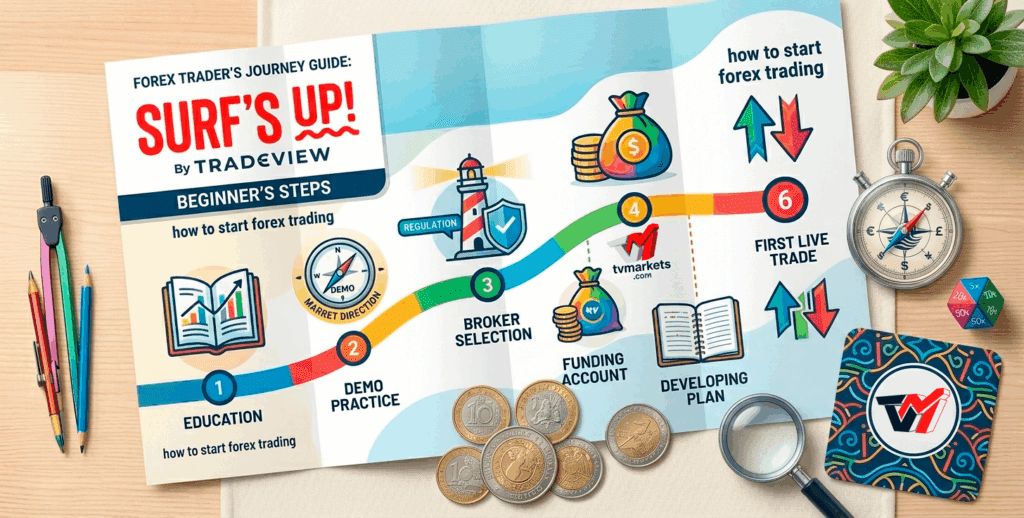
Getting physically set up to execute your first trade requires moving through specific, regulated checkpoints:
- Select a Regulated Broker: Never deposit funds with an offshore, unregulated entity. Ensure your broker is registered with top-tier financial authorities (like the CFTC in the US, the FCA in the UK, or ASIC in Australia). This ensures proper fund segregation and transparent pricing.
- Complete the Verification Process: Submit your required Know Your Customer (KYC) documentation, including government ID and proof of residence, to activate your live account.
- Fund Your Account: Deposit your initial risk capital. You must only trade with discretionary funds that you are fully prepared to lose. Never trade with money required for basic living expenses.
- Analyze the Charts: Open your platform and apply your specific technical indicators or fundamental analysis framework to identify a high-probability setup.
- Execute with Hard Stops: Before placing the order, definitively calculate where your automated stop-loss and take-profit levels must be placed to protect your downside.
Forex Trading Example: A Step-by-Step Trade
To see how these mechanics operate in real-time, let’s walk through a highly realistic trade on the GBP/USD pair.
Assume your technical analysis clearly indicates that the British Pound has bounced off a major historical support level and is trending upward. The current market price is 1.2500.
- The Setup: You execute a buy order (go long) for 1 standard lot of GBP/USD at 1.2500. Trading a full standard lot means every pip the market moves equates to exactly $10.
- Risk Management: You decide your trade thesis is invalid if the price drops below 1.2450. You immediately place a hard stop-loss order at 1.2450, establishing a 50-pip risk. Your total maximum monetary risk is locked at $500.
- Profit Target: Your chart analysis highlights the next major resistance zone at 1.2600. You place a take-profit order at 1.2600, establishing a 100-pip potential gain. Your potential reward is $1,000, creating a favorable 1:2 risk-to-reward ratio.
- The Outcome: Two days later, positive UK economic data pushes the GBP/USD aggressively to 1.2600. Your take-profit order triggers automatically, closing the trade. You secure a $1,000 gross profit.
how to start day trading with $500
A common reality is that many individuals begin their trading journey with limited capital, frequently starting with $500. Day trading with a small account is incredibly difficult because you possess zero margin for error during inevitable losing streaks.
To survive the initial learning curve with only $500, you must completely abandon the concept of making massive daily returns. Your sole objective is capital preservation and slow, fractional percentage growth.
You must restrict your execution exclusively to micro-lots (0.01 lot size). At this fractional size, pip values drop to approximately $0.10. If you utilize a 30-pip stop loss on a single micro-lot trade, your total monetary risk is just $3.00. This perfectly aligns with the strict institutional rule of never risking more than 1% to 2% of your total account equity on any single trade. If you attempt to trade standard lots on a $500 account, a single minor price fluctuation will wipe out your entire balance in seconds.
Forex Trading Strategies
A trading strategy is a strict, rules-based system dictating exactly when to enter the market, when to exit, and how much capital to expose. Operating without a tested strategy is just gambling. Consistent market operators typically build their systems around a few primary strategic frameworks.
- Trend Following: This involves utilizing technical indicators, like Moving Averages, to definitively identify the dominant market direction. Trend followers only execute trades that align with that broader macro trend, operating under the assumption that the trend will continue.
- Breakout Trading: Currency markets frequently consolidate in tight, sideways ranges for extended periods. Breakout traders patiently wait for the price to violently pierce these support or resistance levels, entering the market to capture the sudden surge in directional momentum.
- Mean Reversion: This methodology operates on the statistical assumption that extreme, parabolic price movements will eventually return to their historical averages. Traders use oscillators to identify overbought or oversold conditions and trade the resulting reversal.
Forex Day Trading vs. Long-term Trading
Your selected strategy must fit your personality type, emotional tolerance, and daily schedule.
Forex Day Trading involves opening and closing all positions before the daily market session ends, ensuring you hold no overnight risk. Day traders intensely monitor short-term timeframes like 5-minute and 15-minute charts, looking to repeatedly capture small price movements. This style requires intense, uninterrupted mental focus, the ability to process data rapidly, and the emotional resilience to bounce back from multiple minor losses in a single day.
Long-Term Trading (Swing or Position Trading) involves holding positions for days, weeks, or months. These traders focus on 4-hour, Daily, and Weekly macro charts, relying on fundamental analysis and economic policy cycles. This approach requires significant patience and the psychological fortitude to withstand temporary drawdowns while waiting for broader macro trends to materialize.
System Trading Forex: Automated vs. Manual
The physical execution of your chosen strategy can be handled manually by you or automatically by a machine.
Manual Trading requires the trader to conduct daily analysis and execute trades physically. It relies on discretionary judgment and experience but is highly vulnerable to emotional errors. Common pitfalls include revenge trading, closing winners too early out of fear, or widening stop-losses during a losing trade.
System Trading Forex uses algorithmic programs (Expert Advisors) to execute trades based on predefined rules. This removes human emotion and allows for rigorous backtesting over historical data. However, automated systems may struggle during unprecedented geopolitical events where human intuition and broader context are essential for adapting to sudden market shifts.