



Copy trading lets you copy the trades of experienced investors automatically. When they open a position, you open the same one. When they close it, so do you. It has become one of the most popular ways to join the forex and CFD markets without building a strategy from scratch. This guide covers what copy trading is, how it works, what it costs, and how to start.
What is copy trading?
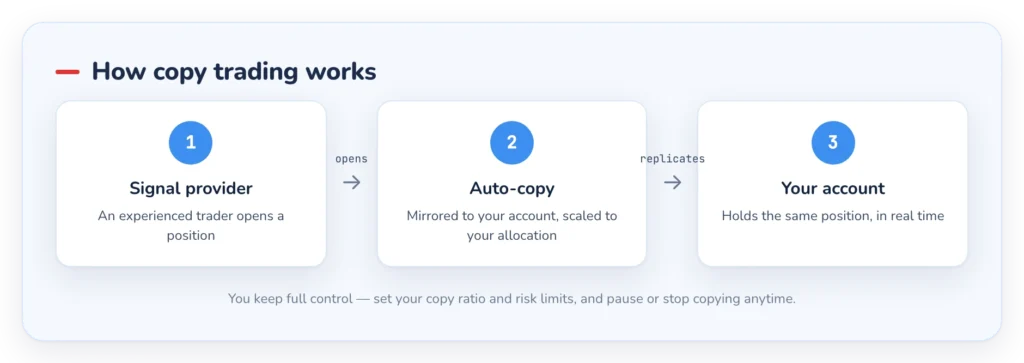
Copy trading is a form of automated investing. Your account copies the live positions of another trader — the “signal provider” — in proportion to the money you allocate. Every trade they open and close copies to your account on its own, so your results track theirs. It is one branch of social trading, alongside mirror trading and managed accounts.
The copying is automatic and matched to your size. If a provider risks 2% of their account on a trade, you risk about 2% of yours. You never hand over your funds. The trades simply appear in your own account, and you stay in control the whole time.
How does copy trading work?
Behind the scenes, copy trading follows five steps:
- Pick a platform. Most copy trading runs on MetaTrader 4, MetaTrader 5, or cTrader, or through a broker’s own social feed.
- Choose a signal provider. You browse a ranked list of traders and their track records.
- Set your allocation and risk limits. You decide how much to commit, your copy ratio, and a stop-copy level.
- Trades copy automatically. From then on, every position the provider opens mirrors to your account in real time.
- Review and adjust. You can pause, resize, or stop copying any provider whenever you want.

Copy trading vs. mirror trading vs. managed accounts
These terms overlap, so here is how they differ:
| Approach | What you copy | Best for |
|---|---|---|
| Social trading | Ideas and sentiment from a community | Learning and discovery |
| Copy trading | One trader’s live positions | Hands-off copying |
| Mirror trading | A fixed strategy or algorithm | Systematic traders |
| PAMM / MAM | A pooled account run by a manager | Fully managed money |
In a PAMM (Percentage Allocation Money Management) or MAM (Multi-Account Manager) account, a professional trades one pooled account. Your share of the profit or loss matches your share of the pool. Copy trading keeps every trade inside your own account instead.
A quick example
Say you fund an account with $2,000 and copy a provider at a 1:1 ratio. The provider opens a 0.10-lot buy on EUR/USD and risks 2% of their capital. Your account opens the same trade, scaled to your $2,000, so you also risk about $40. If the trade gains 30 pips, you earn your share of that move. If it loses, you lose in the same proportion. Nothing copies that you have not funded, and your loss on any trade is capped by the size you set.
How to choose a signal provider
Returns grab attention, but they are the worst way to pick. Look at these instead:
- Track record length. Favor at least 6 to 12 months of live results. A few strong weeks prove nothing.
- Maximum drawdown. This is the largest drop from a peak. A provider who once lost 60% is far riskier than one who stayed under 20%.
- Consistency. Steady, smaller gains usually beat one huge month followed by silence.
- Risk score. Most platforms publish a 1 to 10 risk rating. Match it to your comfort level.
- Copiers and capital. A provider managing real copied funds has more to lose from reckless trades.
What copy trading costs
Copy trading is rarely free. Watch for three costs:
- Spreads and commissions. You pay the normal trading costs on every copied position, just as if you traded yourself.
- Performance fees. Many providers take a cut of your profit, often 20% to 30%. Good platforms only charge it on new highs, so you are not billed twice for the same gains.
- Overnight (swap) fees. Positions held overnight can carry a financing charge.
Add these up before you copy. A provider with a great headline return but a 30% performance fee may net you less than a steadier one with lower costs.
Benefits and risks
The upside is clear. Copy trading lowers the learning curve. It saves you the hours that building a strategy takes. You can spread your money across several providers. And you learn by watching real traders make real decisions.
The risks are just as real. Past results never guarantee future ones. When you copy a provider, you take on their risk appetite too. Leverage boosts losses as much as gains. A provider’s style can drift over time. And “set and forget” can make you careless.
Be clear-eyed: copy trading does not remove market risk. You can lose money, including more than your deposit when trading leveraged products. Only commit money you can afford to lose.
How to start copy trading with Tradeview Markets
Tradeview Markets offers social and managed copy trading through CommuniTraders, plus multi-account allocation through MultiMAM. Both run on the MetaTrader platforms you already know. To start:
- Open and verify a live trading account, then fund it.
- Browse signal providers and filter by drawdown and risk score, not just returns.
- Set your copy ratio and risk limits, then turn on copying.
- Check your results regularly and rebalance across providers.
Frequently asked questions
Is copy trading profitable?
It can be, but nothing is guaranteed. Your results depend on the providers you copy and on the market. Spreading across several vetted providers and setting firm risk limits improves your odds. Losses are still possible.
How much money do I need to start?
It varies by broker and provider. Some let you start small. A larger balance gives you room to spread risk and to ride out normal drawdowns without being forced out early.
Is copy trading legal?
Yes. It is a legal, widely offered service at regulated brokers. Always check your broker’s regulatory status first.
What is the difference between copy trading and a PAMM account?
In copy trading, every trade sits in your own account and you can stop anytime. In a PAMM, your money joins a pool that a manager trades, and you share the pooled result.
Can I lose money copy trading?
Yes. It carries the same market risk as trading yourself, made larger by leverage. Never commit more than you can afford to lose.
Sources
- Berger, E. S. C., Wenzel, M., & Wohlgemuth, V. (2018). Imitation-related performance outcomes in social trading: A configurational approach. Journal of Business Research, 89, 322–327 (16,964 eToro observations) — copying only paid off when combined with experience and low risk. ideas.repec.org
- Joseph, B., Riedl, C., Pentland, A., & Moro, E. (2025). When Influence Misleads: Informational and Strategic Limits of Social Learning in Trading Networks — on eToro, traders who mirrored others underperformed on average, chasing popularity over performance. arenafi.org
Risk warning. Trading Forex and CFDs carries a high level of risk and may not be suitable for all investors. Leverage can work against you as well as for you. Past performance of any signal provider is not indicative of future results. This article is for educational purposes only and does not constitute financial advice.