
Commodity markets can feel like a different planet when you first look at them. One day gold drifts for hours, the next day it snaps 30 dollars in a burst. Oil can grind higher on headlines and then reverse on an inventory surprise. Agricultural contracts can move on weather and logistics in ways that do not “look technical” until you’ve watched them for a while.
That’s exactly why commodity trades attract people who want variety beyond stocks and forex. Commodities are tied to real-world supply and demand, which creates a rhythm that is sometimes cleaner and sometimes more chaotic. The upside is opportunity. The downside is that you need rules that survive gaps, volatility spikes, and different market hours.
“Commodities don’t care about your timeframe. They care about imbalance.” (Trading note)
This guide keeps it practical: the major commodity groups, the vehicles you can trade, the checklist for an online commodity trading account, and a straightforward plan to start trading gold and silver without turning it into guesswork.
Why commodity trades behave differently
Commodity pricing is anchored to physical reality, even if you never touch a barrel of oil or an ounce of metal. Production limits, transport issues, seasonal demand, inventories, and policy decisions can all change the narrative quickly.
A few patterns show up often:
- Event-driven volatility: scheduled reports and surprise headlines can move prices fast.
- Seasonality: some commodities have repeatable demand cycles.
- Inventory sensitivity: stockpiles and supply flows matter more than people expect.
- Macro crosswinds: rates, USD strength, and risk sentiment can amplify moves.
This does not mean technical analysis “doesn’t work.” It means the best technical setups are usually the ones that respect context and volatility.
“The chart is your map. The calendar is your weather report.” (Desk rule)
The main commodity categories worth knowing
You do not need to trade everything. In fact, trying to trade all commodities is a reliable way to trade none of them well. Start by understanding the big buckets and what tends to move them.
Metals
- Gold and silver: often react to real rates, USD strength, and risk sentiment. They also have strong technical participation.
- Industrial metals (copper, etc.): more sensitive to growth expectations and manufacturing demand.
Metals can be a friendly entry point for commodity trades because the narratives are relatively easy to track and liquidity is often strong in the most popular instruments.
Energy
- Crude oil and refined products: driven by supply, inventory data, geopolitics, and demand expectations.
- Energy can trend cleanly and then whip hard. It rewards patience and punishes oversized positions.
Agriculture
- Grains, softs, livestock: weather, harvest cycles, and logistics matter a lot.
- Agricultural markets can move sharply in short bursts and then go quiet.
If you’re new to commodity trades, metals are often simpler than energy, and energy is often simpler than agriculture. That’s not a rule, just a helpful starting order.
Picking the vehicle for commodity trades
Most people say “I trade commodities” but they are actually trading one of several vehicles. The vehicle changes your costs, your risk profile, and even your learning curve.
Common ways to trade commodities online
| Vehicle | Typical example | Pros | Cons | Best fit |
| Futures | Gold, oil futures contracts | Transparent structure, deep liquidity | Leverage, contract specs matter | Traders who like rules and math |
| CFDs | Commodity CFDs | Simpler sizing | Broker-dependent pricing/terms | Short-term traders in supported regions |
| ETFs/ETNs | Gold ETF, commodity funds | Familiar stock-like trading | Tracking error, market hours | Longer-term or lower leverage |
| Options | Options on ETFs or futures | Defined risk if used correctly | Complexity, spreads | Strategic hedging, advanced traders |
| Spot products | Varies by broker | Simple interface | Execution and pricing vary | Beginners who keep size small |
Your choice should match your goal. If you want clean structure and you’re willing to learn tick value and margin mechanics, futures are direct. If you want a gentler learning curve, ETFs can be a calmer way to build commodity awareness.
“The best instrument is the one you can size correctly when you’re tired.” (Journal note)
Online commodity trading account essentials
An online commodity trading account is not just a login. It’s your risk container. If the account tools are unclear, your decisions will be unclear too.
The checklist that prevents surprises
Costs and execution
- Clear spread or commission schedule
- Transparent swap/financing rules (if applicable)
- Realistic slippage expectations around reports and headlines
Risk controls
- Easy stop-loss placement and modification
- Alerts for price levels and margin levels
- Clear view of total exposure across positions
Data and reporting
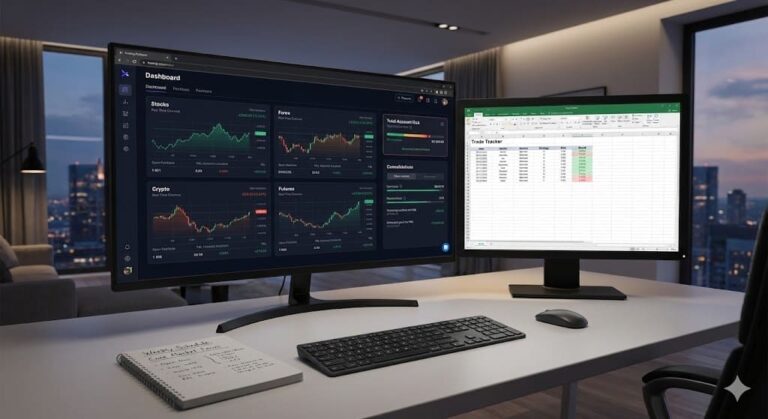
- Reliable charting and order history
- Downloadable statements (CSV or clean PDFs)
- Visible timestamps on fills and modifications
Operational basics
- Deposit and withdrawal clarity
- Customer support response standards
- Outage and maintenance communication
A quick test that reveals a lot: place a practice order in a demo environment, set a stop, modify the stop, then export the history. If that workflow feels clunky, it will feel worse when money is real.
Margin is not the same as risk
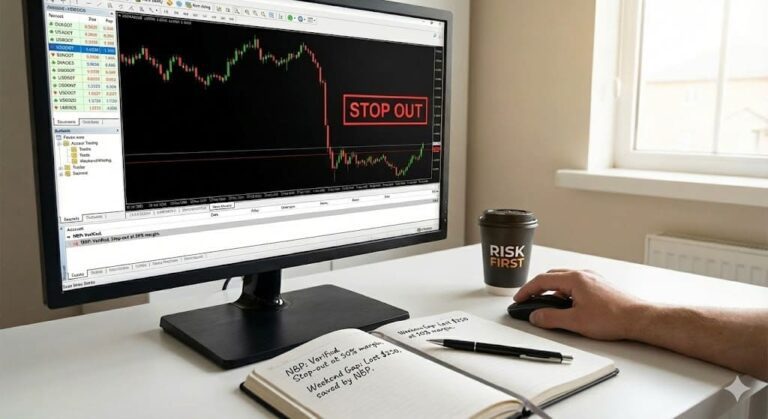
This is where many new commodity traders get burned. Margin is the broker’s required collateral. Risk is what you can lose if the trade hits your stop, or worse, gaps through it.
A simple rule:
- Size based on stop distance and dollar risk, not on available margin.
If your platform makes it hard to translate price movement into dollars, keep your size smaller until you can do the math comfortably.
Risk management in commodity trades
Commodity trades can be forgiving when they trend and brutal when volatility jumps. Risk rules keep you from paying full tuition on the first few mistakes.
Three rules that travel well across commodities
- Fixed risk per trade
Pick a percentage or a fixed dollar amount and keep it consistent. Consistency beats cleverness. - Portfolio heat cap
If you have multiple positions open, cap the total risk if all stops get hit. Commodities can correlate during macro shocks. - A hard daily loss limit
Stop trading after a defined loss. Most blowups are not one bad trade, they’re four emotional trades after the first one.
Here’s a practical starter framework:
| Control | Beginner-friendly range | Purpose |
| Risk per trade | 0.5% to 1% | Keeps losses boring |
| Daily max loss | 2R to 3R | Prevents spirals |
| Max open trades | 2 to 4 | Reduces stacked risk |
| News exposure rule | Reduce size or sit out | Avoids surprise slippage |
Volatility-aware stops
Commodities often have wider “normal” movement than stocks. If your stop is too tight, you’ll get stopped out by noise even if your idea was right.
A practical habit:
- Use the recent swing structure for invalidation, then adjust size so your dollar risk stays constant.
Start trading gold and silver with a simple plan
If you want a clean entry into commodity trades, start trading gold and silver with a narrow scope and repeatable routines. These markets have strong participation, plenty of educational resources, and often clearer technical behavior than more headline-sensitive commodities.
Build a small watchlist
Keep it minimal:
- One gold instrument
- One silver instrument
- Optionally, one proxy like a miners ETF if you’re trading equities
Do not add five related instruments on day one. They will all move together at the wrong time and you’ll think you are diversified when you’re not.
Two beginner-friendly setups
These are not “holy grail” patterns. They’re structured ways to practice.
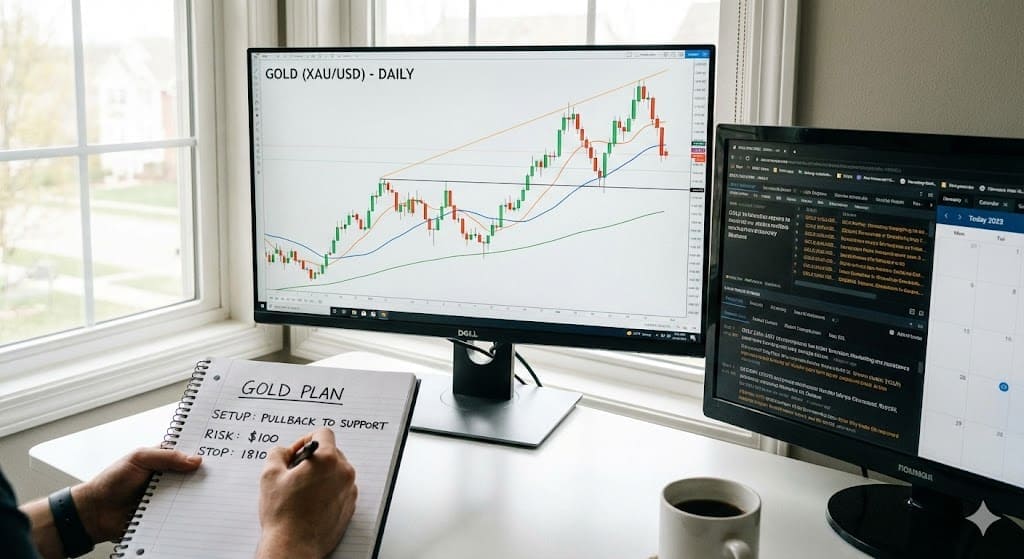
Setup 1: Trend pullback to a key level
When it fits: a clear daily trend, with pullbacks that respect prior levels.
What you do:
- Identify the trend on a higher timeframe (daily or 4H).
- Mark a prior breakout level or a clean support zone.
- Wait for the price to pull back into that zone.
- Enter on a reclaim candle or a break of a short-term pullback structure.
- Place the stop beyond the swing point that invalidates the idea.
Example: Gold breaks above a prior resistance zone, runs, then pulls back to retest the same area. If it holds and reclaims with a strong close, that’s a structured entry. If it loses the level and holds below, you walk away.
Setup 2: Range breakout with confirmation
When it fits: a well-defined consolidation with repeated touches.
What you do:
- Mark the range high and low.
- Do not buy the first spike.
- Wait for a breakout and a retest that holds.
- Enter on the retest confirmation.
- Stop goes below the retest low (for bullish breaks) or above (for bearish breaks).
This reduces the classic breakout trap: buying the loud candle that immediately reverses.
“The retest is the market asking you if you’re serious.” (Trading note)
Practical filters that reduce frustration
- Avoid taking new positions minutes before major scheduled releases if you’re still learning.
- If spreads widen or price starts jumping in thin liquidity, size down or step aside.
- Do not turn a swing trade into a long-term hold just because it’s red.
The routine that makes commodity trades repeatable
A solid process is boring on purpose. It keeps you consistent.
Weekly planning session
- Mark major levels on your primary commodity charts.
- Note scheduled events that can spike volatility (economic releases, inventory-style reports relevant to your market).
- Pick 3 to 5 scenarios: “If price breaks and holds, I’ll look for a retest entry; if it rejects, I’ll wait.”
Daily check-in
- Review open positions, stops, and alerts.
- Look for one high-quality setup, not five “maybe” trades.
- Update your journal with a screenshot and a one-sentence reason for the trade.
Simple journal fields
| Field | Example | Why it matters |
| Market | Gold | Keeps focus |
| Setup | Pullback | Tracks repeatability |
| Risk | 1R | Normalizes results |
| Outcome | +1.2R | Comparable across trades |
| Rule grade | A/B/C | Process over luck |
| Note | Entered late | Fixes next time |
“If you can’t grade it, you can’t improve it.” (Weekly recap)
Common mistakes in commodity trades and quick fixes
Oversizing because the move looks obvious
Fix: size from your stop distance. If the stop must be wide, your size must shrink.
Trading every headline
Fix: decide your “headline policy.” Either you trade event volatility intentionally with reduced size, or you avoid it. Drifting between the two is expensive.
Treating correlation as diversification
Gold and silver often move together. Oil and broader risk sentiment can drag other assets with it.
Fix: cap portfolio heat and avoid stacking positions that are essentially the same bet.
Forgetting the vehicle-specific risks
An ETF has market hours and possible tracking differences. A leveraged product has liquidation rules.
Fix: write down your instrument’s key rules in one place and review them monthly.
A practical next step before the FAQ
If you’re ready to try commodity trades without turning it into a scattershot experiment, set up your online commodity trading account in demo or micro size and commit to one market for 20 sessions. If your priority is a clean learning path, start trading gold and silver with just one setup (pullback or breakout retest), fixed risk, and a short weekly review. Share your account size range, the time of day you can trade, and whether you prefer short-term or multi-day holds, and I can map a simple schedule plus position-sizing examples tailored to your routine.
FAQ
Are commodity trades suitable for beginners?
They can be, if you start with liquid instruments and keep size small. Metals like gold and silver are often easier to learn than energy or agriculture because the narrative is simpler and participation is broad.
Does an online commodity trading account require special approval?
Some brokers require specific permissions for futures or margin products. Requirements vary by region and by broker, so check the account onboarding steps and product access rules before funding.
Start trading gold and silver with futures or ETFs?
ETFs can be a calmer starting point because sizing feels familiar. Futures offer direct exposure but require comfort with contract specs, tick value, and margin. Choose the vehicle that you can size and manage confidently.
How many commodities should I trade at the same time?
Start with one. Add a second only after you can follow your risk rules consistently for several weeks. More markets increase complexity and correlation risk.
Why do commodities sometimes ignore technical levels?
They often do not ignore them; they override them with new information. Inventory shifts, policy surprises, and macro changes can change the narrative quickly, which is why the calendar matters alongside the chart.
What is the simplest risk rule for commodity trading?
Fixed risk per trade plus a daily loss limit. Those two rules prevent most of the emotional damage that turns normal volatility into account-ending decisions.