



CFD trading lets you profit from the price movement of an asset without ever owning it. A CFD — a “contract for difference” — tracks the price of shares, forex, indices, or commodities, and you can go long or short. This guide covers what CFDs are, how they work, what they cost, the role of leverage, and how to start trading them safely.
What is CFD trading?
A contract for difference (CFD) is an agreement between you and a broker to exchange the difference in an asset’s price between when you open and close the trade. You never take ownership of the underlying share or barrel of oil — you simply profit, or lose, based on which way the price moves.
That single idea gives CFDs three defining traits:
- You can go both ways. Buy (go long) if you expect a rise; sell (go short) if you expect a fall.
- You trade on margin. A small deposit controls a larger position through leverage.
- You access many markets from one account. Shares, forex, indices, and commodities all trade the same way.
How does CFD trading work?
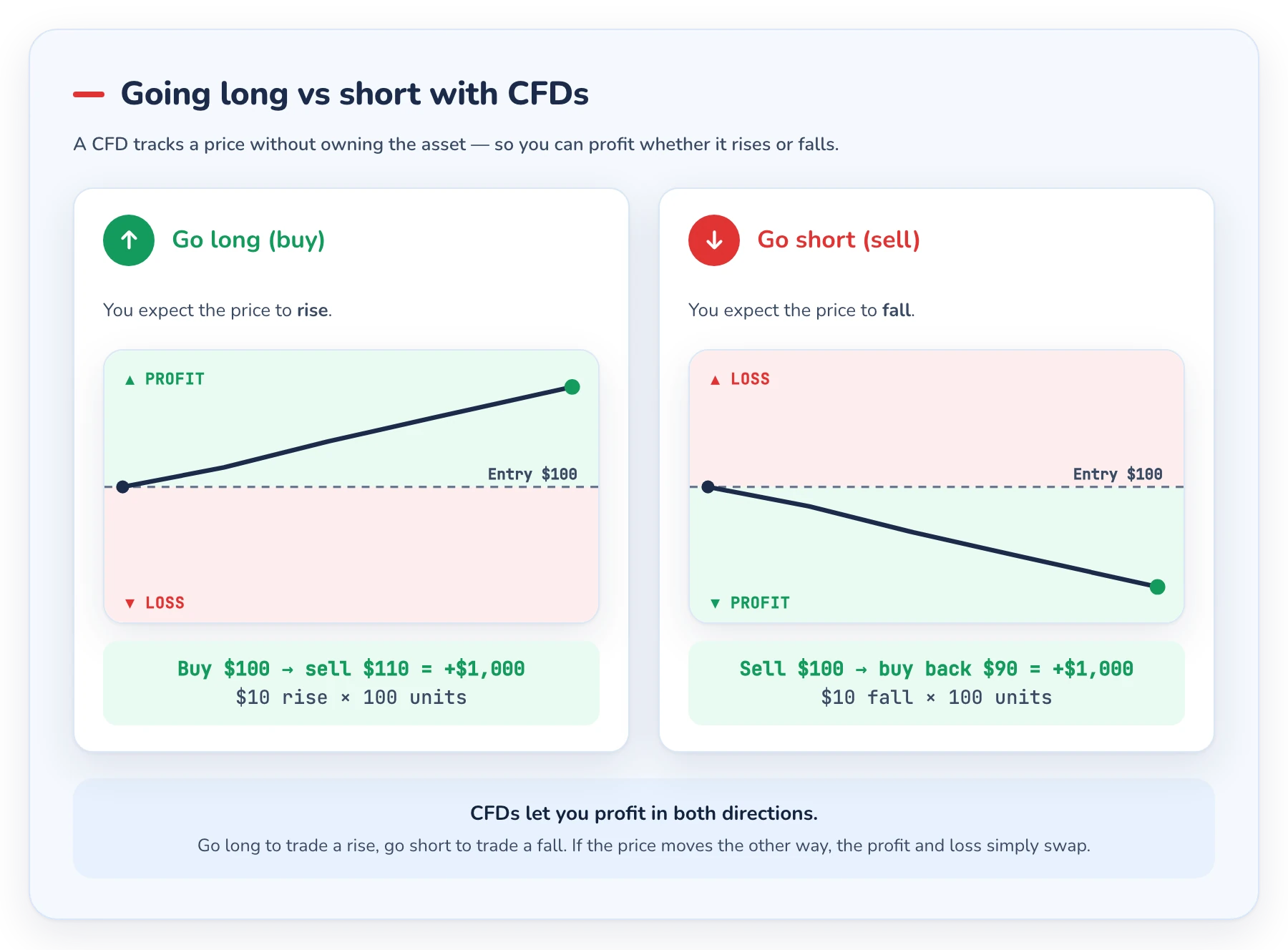
When you open a CFD, you choose a direction and a position size. Your profit or loss is the price difference multiplied by the number of units you hold.

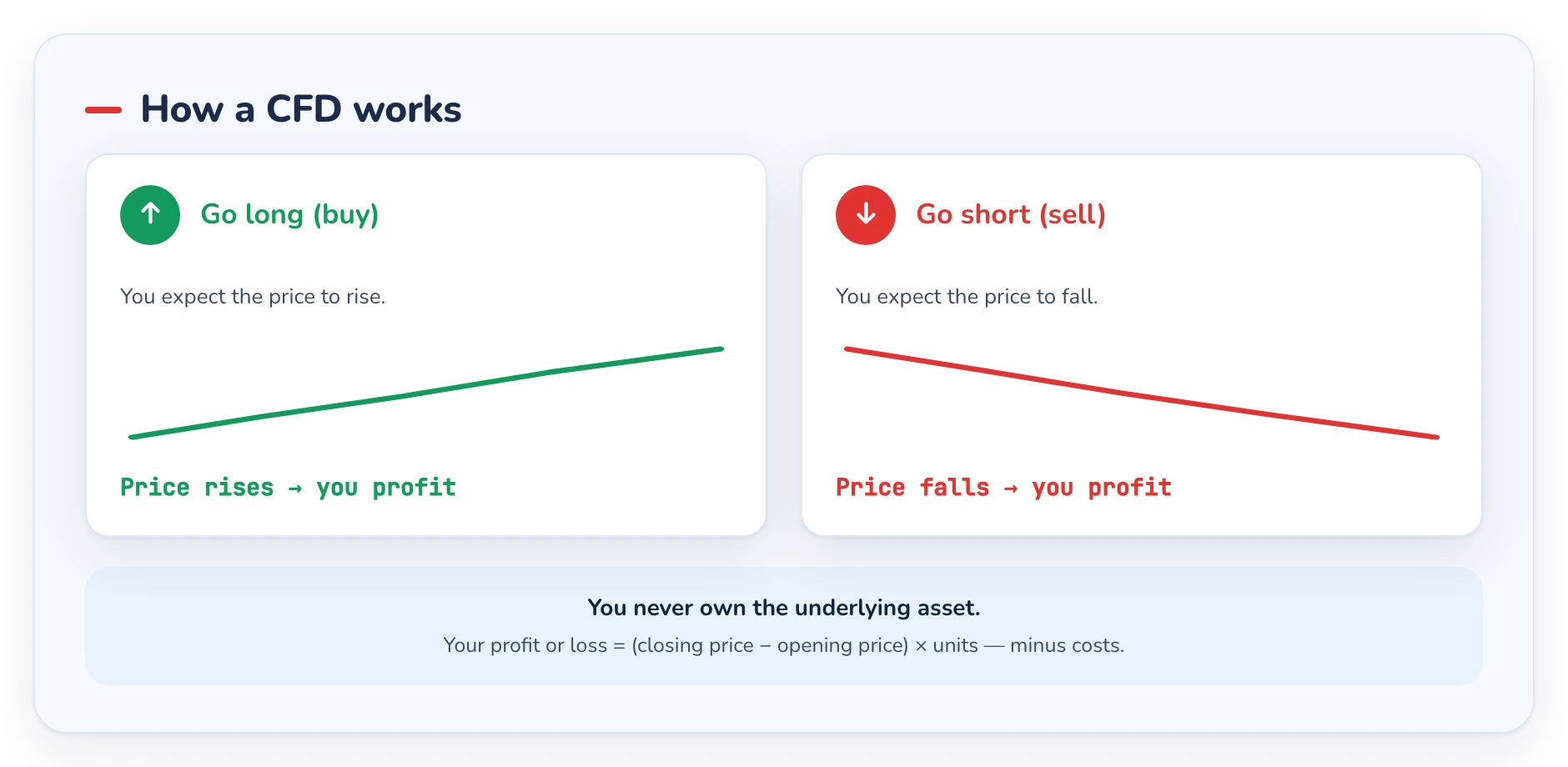
Say a share trades at $100 and you buy 100 share CFDs. If the price rises to $110, you gain the $10 difference on 100 units — $1,000, minus costs. If it falls to $90, you lose $1,000. Go short instead, and the outcome flips: you profit when the price falls. Because you never own the share, you can trade the fall as easily as the rise.

What you can trade as CFDs
One CFD account opens several markets:
- Shares — go long or short on individual companies.
- Forex — the major currency pairs, the deepest market in the world.
- Indices — baskets like the S&P 500 or the FTSE 100.
- Commodities — gold, oil, and other raw materials.
This breadth is why CFDs are popular: you can trade rising and falling markets across asset classes without opening separate accounts.
Leverage and margin
Leverage is the heart of CFD trading — and its biggest risk. It lets a small deposit (the margin) control a much larger position.
At 1:10 leverage, a $1,000 margin controls a $10,000 position. If that position gains 5%, you make $500 — a 50% return on your margin. But a 5% move against you loses $500, half your deposit. Leverage magnifies gains and losses equally. Caps vary by region and asset: in Europe, retail forex is limited to 1:30, major indices to 1:20, and individual shares to 1:5, while other jurisdictions allow more. The higher the leverage, the smaller the move needed to wipe out your margin.
Because losses can exceed your initial margin, disciplined position sizing and a stop-loss on every trade are essential — the same rules that govern day trading.
What CFD trading costs
CFDs are rarely free to trade. Watch three costs:
- The spread — the gap between the buy and sell price. You pay it on every trade; tighter spreads mean lower costs. On a $10,000 position, a 0.1% spread costs roughly $10 to open.
- Commission — some markets, especially share CFDs, charge a commission per trade — often around 0.1% of the trade value — on top of the spread.
- Overnight (swap) financing — because you trade on leverage, holding a position overnight carries a daily financing charge, typically a small percentage annualised. Day traders who close before the session ends avoid it entirely.
Always confirm the current spreads, commissions, and financing rates for your account before you trade, since they vary by broker and market.
Benefits and risks
The appeal is clear. You can go long or short, access many markets from one account, use leverage to make capital go further, and trade without the costs of owning the underlying asset.
The risks are just as real. Leverage amplifies losses as much as gains, and you can lose more than your deposit. Overnight financing eats into longer holds. And the ease of shorting and sizing up can tempt over-trading. CFDs are complex, leveraged products — across the EU, regulators found that 74–89% of retail CFD accounts lose money.
Be clear-eyed: CFDs are leveraged and high-risk. You can lose more than you put in. Only trade money you can afford to lose, and never risk more than a small percentage of your account on one position.
CFD trading vs owning the asset
Buying a share outright makes you an owner; a share CFD only tracks its price. Here is how they compare on a hypothetical $10,000 position:
| Feature | Buying the asset | CFD |
|---|---|---|
| Ownership | Yes — you own the share | No — you track the price |
| Direction | Long only | Long or short |
| Leverage | Usually none | Yes (e.g. 1:10 to 1:30) |
| Upfront cost | Full $10,000 | Margin only — ~$1,000 at 1:10 |
| Dividends / voting | Yes | No |
| Overnight cost | None | Daily financing charge |
| Max loss | Your $10,000 | Can exceed your margin |
| Best for | Long-term investors | Short-term traders |
Ownership suits long-term investors who want to hold and collect dividends. CFDs suit shorter-term traders who want leverage, flexibility, and the ability to profit from falling markets — while accepting the higher risk that comes with it.
How to start CFD trading with Tradeview Markets
- Open and verify a live trading account, or start on a demo first.
- Trade CFDs on the MetaTrader and cTrader platforms, across forex, indices, shares, and commodities.
- Set your position size so you risk only a small percentage of your account, and attach a stop-loss.
- Prefer to follow experienced traders while you learn? Copy trading mirrors their positions to your account automatically.
Frequently asked questions
Is CFD trading good for beginners? CFDs are complex, leveraged products, so beginners should start carefully — on a demo account, with tiny position sizes and a stop-loss on every trade. The ability to lose more than your deposit makes risk management non-negotiable.
What is the difference between CFD and forex trading? Forex trading is buying and selling currency pairs. CFD trading is a broader method that includes forex, but also shares, indices, and commodities — all traded the same leveraged, no-ownership way. In short, forex is one of the markets you can trade as a CFD.
Can you lose more than you invest with CFDs? Yes. Because CFDs are leveraged, a sharp move against you can cost more than your initial margin. This is why stop-losses and conservative sizing matter, and why you should only trade money you can afford to lose.
How is CFD profit calculated? Profit or loss equals the price difference between opening and closing, multiplied by your number of units, minus costs (spread, any commission, and overnight financing).
Is CFD trading legal? CFDs are legal and widely offered in many countries, though some regulators restrict or ban them for retail clients. Always check the rules in your jurisdiction and trade with a properly regulated broker.
Sources
- European Securities and Markets Authority (2018). ESMA agrees to prohibit binary options and restrict CFDs to protect retail investors — 74–89% of retail CFD accounts lose money. esma.europa.eu
- Barber, B. M., & Odean, T. (2000). Trading Is Hazardous to Your Wealth: The Common Stock Investment Performance of Individual Investors. The Journal of Finance, 55(2), 773–806. doi.org
Risk warning. CFDs are complex instruments and come with a high risk of losing money rapidly due to leverage. 64% of retail investors’ accounts lose money when trading CFDs with Tradeview. You should consider whether you understand how CFDs work and whether you can afford to take the high risk of losing your money. This article is for educational purposes only and does not constitute financial advice. Issued by Tradeview Ltd, Cayman Islands.