


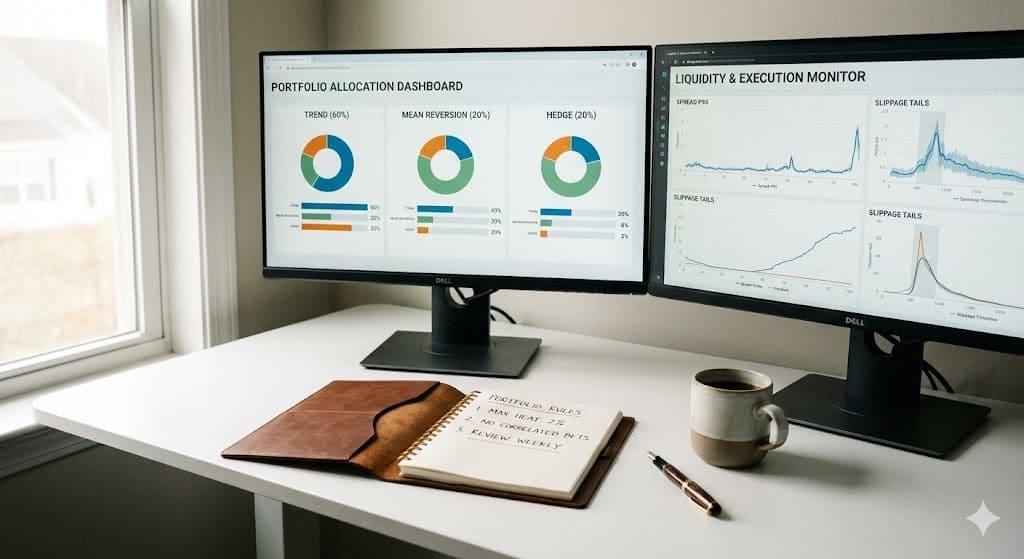
Most traders treat a “portfolio” like a screenshot: a few positions, a couple of charts, and a hope that diversification will handle the rest. A real portfolio is more like a system. It has roles, limits, and a reason each position exists. When you build your trading portfolio that way, you stop relying on luck and start relying on repeatable decisions.
The other part people underestimate is liquidity. You can have a solid idea and still get chewed up by wide spreads, thin depth, or sloppy execution. Portfolio work is not only about choosing markets. It’s also about choosing the conditions you’ll trade them in, and the infrastructure that keeps fills and costs predictable.
“A portfolio is a set of decisions you can defend on a bad day.”
This guide is a practical roadmap: portfolio roles, allocation rules, risk controls, and where liquidity tooling fits when you’re trying to keep performance from leaking out through costs.
Portfolio building starts with roles, not tickers
Before you pick instruments, decide what jobs you need your portfolio to do. This sounds obvious, but it prevents the classic mistake: owning five positions that are basically the same trade wearing different outfits.
Common portfolio “jobs” for active traders:
- Trend capture: ride sustained moves (swing trades, position trades)
- Mean reversion: fade extremes in range-bound conditions
- Event risk plays: trade around scheduled catalysts with strict rules
- Hedge layer: reduce drawdowns when your main exposure is under stress
- Cash and patience: the underrated job that keeps you from forcing trades
If you’re trying to build your trading portfolio, make sure each position can answer one sentence:
- “This trade exists to do X, and it fails if Y happens.”
“If a position has no job, it becomes emotional baggage.”
A quick role map you can copy
| Role | Typical holding time | Instruments that fit | Best use case |
| Trend capture | days to weeks | major FX pairs, indices, liquid stocks | directional phases |
| Mean reversion | minutes to days | indices, FX during ranges | chop and compression |
| Hedge layer | days to months | index hedge, FX hedge, gold proxy | drawdown control |
| Tactical add-ons | minutes to days | news-aware setups | selective opportunities |
| Cash | always | none | protects decision quality |
This is not a rigid model. It’s a sanity check so your portfolio isn’t accidental.
The allocation rules that keep you consistent
Allocation is where portfolio talk becomes real. Even a great strategy becomes unstable if sizing is inconsistent or exposure clusters in one driver.
Start with a simple risk budget
Instead of thinking “I want to allocate 30% to X,” think in risk units:
- Risk per trade: the maximum you’re willing to lose on one trade if your stop hits
- Portfolio heat: the maximum open risk across all positions at once
Example structure:
- Risk per trade: 0.5% of account
- Portfolio heat: max 2% to 3% open risk total
That one rule prevents the hidden problem: several “small” trades combining into one big portfolio bet.
“Most blowups are not one trade. They are a stacked risk.”
Use guardrails that scale with you
Here’s a straightforward set of guardrails that works for many active traders:
- Max open trades: 3 to 6 (depending on timeframe)
- Max correlated positions: 1 to 2 in the same driver bucket
- Max risk per asset class: for example, no more than 60% of open risk in FX
- Max daily loss: stop trading after 2R to 3R
| Guardrail | Example | Why it helps |
| Risk per trade | 0.5% | keeps mistakes affordable |
| Portfolio heat | 2% open risk | prevents hidden leverage |
| Correlation cap | 1 USD-long theme | avoids “fake diversification” |
| Daily stop | 2R | prevents spiral trading |
These rules make it easier to power up your trading strategy because you’re not constantly renegotiating risk at the moment.
Power up your trading strategy with portfolio thinking
A strategy can be profitable on paper and still disappoint in practice if it’s deployed in the wrong mix. Portfolio thinking helps you use strategies like ingredients, not like competing religions.
Strategy stacking without chaos
If you want to power up your trading strategy, stack strategies only when their failure modes differ.
Good stack example:
- Trend strategy on a higher timeframe
- Mean reversion strategy only when volatility compresses
- Hedge layer that activates when equity risk spikes
Bad stack example:
- Three momentum strategies trading the same session breakout in correlated markets
A practical test:
- If two strategies tend to lose money on the same days, treat them as one risk bucket.
Timeframe separation is a cheat code
A lot of frustration comes from mixing timeframes inside the same account psychology.
Try separating:
- Swing positions you manage once or twice per day
- Intraday positions you manage actively
- Automated systems that need monitoring but not meddling
Even if everything is in one account, separate them in your rules and journal categories. It reduces “portfolio noise” and improves decision quality.
“Timeframe clarity reduces impulse more than any indicator.”
Liquidity is the quiet cost center in active trading
If you trade frequently, liquidity is not a detail. It’s a recurring expense.
Liquidity shows up as:
- Spread: the visible gap between bid and ask
- Slippage: the difference between expected price and fill
- Depth: whether size can be filled without moving price
- Rejects/partial fills: friction that breaks strategy assumptions
You can make great calls and still underperform if your execution environment bleeds costs.
A simple liquidity checklist per instrument
Before adding an instrument to your portfolio, ask:
- Does the spread stay stable during my trading hours?
- Does liquidity thin out during session transitions?
- Do I often see slippage spikes around my entry style?
- Is the instrument jumpy around scheduled news?
Here’s a table you can use for quick screening:
| Instrument | Spread behavior | Slippage risk | Best trading window | Notes |
| Major FX pair | often stable | moderate in news | active sessions | avoid thin hours |
| Major index | can spike at open | higher at open/close | home session | respect first minutes |
| Single stock | varies by name | varies | cash session | avoid illiquid names |
This isn’t about fear. It’s about choosing environments where your edge survives.
The place of an innovative Liquidity Connector
The phrase innovative Liquidity Connector sounds fancy, but the concept is simple: a connector that links your execution layer to multiple liquidity sources, collects pricing, routes orders, and provides monitoring so you can detect degradation early.
For brokerages, this can be part of a broader execution stack. For advanced traders or prop-style teams, the takeaway is the same: execution quality improves when routing and monitoring are systematic, not reactive.
Where a connector concept helps in practice:
- Routing that avoids “best price that is not executable”
- Redundancy when one venue degrades
- Monitoring that catches spread blowouts and quote staleness
- Logging that makes disputes explainable
Where it does not help:
- It does not create an edge if your strategy has none
- It does not eliminate slippage in fast markets
- It does not replace risk rules
“Execution tooling is a leak plug, not a profit engine.”
If you’re evaluating tooling in this category, focus on boring questions:
- Can you quantify slippage tails?
- Do you see rejection reasons clearly?
- Can you segment execution by session and instrument?
- Can you prove what happened on a disputed fill in minutes?
Portfolio templates you can adapt
Below are three portfolio structures that can help you build your trading portfolio with clarity. These are examples, not recommendations.
Template A: FX-first swing trader
Goal: ride medium-term trends without constant screen time.
- Instruments: 2 to 4 major FX pairs
- Risk per trade: small and consistent
- Hedge layer: optional, light
| Bucket | Allocation idea | Rules |
| Core swing positions | 70% of risk budget | max 2 concurrent trades |
| Tactical adds | 20% | only A+ setups |
| Experiment | 10% | micro risk only |
Simple rule: no more than one position with the same USD driver at once.
Template B: Indices plus hedge awareness
Goal: trade broad sentiment with clear session behavior.
- Instruments: 1 to 2 major indices
- Special handling: open and close windows
- Hedge: small FX or defensive proxy when risk-off spikes
| Bucket | Allocation idea | Rules |
| Index trend | 60% | avoid first 10 minutes |
| Mean reversion | 20% | only in ranges |
| Hedge layer | 20% | activates on volatility triggers |
Template C: Multi-asset, low clutter
Goal: avoid overtrading while keeping optionality.
- Instruments: 1 FX pair, 1 index, 1 commodity proxy
- Strict portfolio heat
- Weekly review required
| Bucket | Allocation idea | Rules |
| Primary market | 50% | one main focus |
| Secondary market | 30% | only when clean |
| Diversifier | 20% | reduce correlation |
This template works well when you want variety without living in five markets.
The weekly routine that makes portfolio work pay off
A portfolio improves through review, not through constant tinkering.
A simple weekly review agenda
- Performance in R: wins and losses normalized by risk
- Rule violations: where you broke your own constraints
- Exposure clusters: moments you accidentally stacked drivers
- Liquidity notes: spreads and slippage during your trading hours
- Next week constraints: one improvement focus only
A useful habit is to grade each trade:
- A: followed plan cleanly
- B: mostly followed plan, small deviation
- C: rule breaks or emotional entry
“Better grades lead to better PnL, but not always in the same week.”
Rebalancing for active traders
Rebalancing is not only for long-term investors. Active traders rebalance risk and attention.
Examples:
- If your mean reversion strategy is in a drawdown phase, reduce its risk allocation temporarily.
- If trend conditions return, increase allocation slowly, not all at once.
- If a market’s spreads worsen during your session, rotate focus rather than forcing trades.
This keeps “portfolio drift” from silently changing your risk profile.
Common mistakes that sabotage multi-position portfolios
Mistake 1: Mistaking many positions for diversification
Five trades can still be one idea. Watch drivers, not symbols.
Quick fix:
- Group positions by driver (USD, rates, risk sentiment)
- Cap open risk per driver bucket
Mistake 2: Ignoring transaction costs in strategy evaluation
A strategy that looks fine gross can fall apart on the net.
Quick fix:
- Track average spread cost at entry
- Track slippage p95, not only average slippage
Mistake 3: Adding tools before stabilizing rules
Tools amplify whatever structure you already have. If structure is weak, tools amplify chaos.
Quick fix:
- Write your rules on one page
- Enforce portfolio heat before adding more automation
Mistake 4: Over-optimizing parameters
If your strategy works only with one exact setting, it’s fragile.
Quick fix:
- Test parameter ranges
- Prefer robust behavior over perfect backtests
Final note before the FAQ
If you want to build your trading portfolio with less guesswork, start by assigning roles to each position, cap your portfolio heat, and track liquidity behavior during the exact hours you trade. From there, add process improvements that keep execution predictable, whether that is cleaner order templates, better monitoring, or an innovative Liquidity Connector style approach that improves routing and visibility across liquidity sources. If you tell me your time zone, the markets you trade, and whether you’re more trend or mean reversion focused, I can help you turn this into a one-page portfolio blueprint with risk limits, allocation bands, and a weekly review checklist you can reuse.
FAQ
Does a trading portfolio need diversification if I trade short-term?
Yes, but diversification should be based on drivers and behavior, not just the number of symbols. Short-term portfolios still suffer when everything is exposed to the same sentiment shift.
Best way to power up your trading strategy using portfolio rules?
Use portfolio heat limits, correlation caps, and strategy role separation. These reduce the damage from “good idea, bad sizing” and improve consistency.
Should I track spreads and slippage even if my broker shows tight pricing?
Yes. Tight visible spreads can still produce slippage tails during fast markets. Track percentiles by session so you see stress conditions, not only averages.
What does an innovative Liquidity Connector actually change?
In simple terms, it can improve routing, redundancy, monitoring, and logging across liquidity sources. It can reduce execution friction, but it does not replace strategy edge or risk discipline.
How many positions should I hold at once in an active trading portfolio?
Enough to match your risk budget and attention, not your ambition. Many active traders do better with fewer high-quality positions than many low-quality ones.
How often should I review and rebalance an active trading portfolio?
Weekly review is a solid baseline. Adjust allocation slowly and only after enough trades to separate luck from behavior, especially when market regimes shift.