



After-hours trading is buying and selling stocks after the regular market closes. In the US, that means trading between roughly 4:00 PM and 8:00 PM ET, once the closing bell has rung. It lets traders react to late-breaking news the same day — but thin liquidity makes it riskier than the regular session. This guide covers the hours, why traders use it, the dangers, and how to trade it safely.
What is after-hours trading?
After-hours trading — part of “extended hours” — takes place after the main exchange closes at 4:00 PM ET. Like premarket, orders are matched through electronic communication networks (ECNs) that pair buyers and sellers directly, rather than through the exchange’s usual auction.
It exists because news keeps coming after the bell. Most companies release earnings after the close, and a single report can move a stock sharply while the regular market is shut.
After-hours trading times
The US trading day has three windows (Eastern Time):

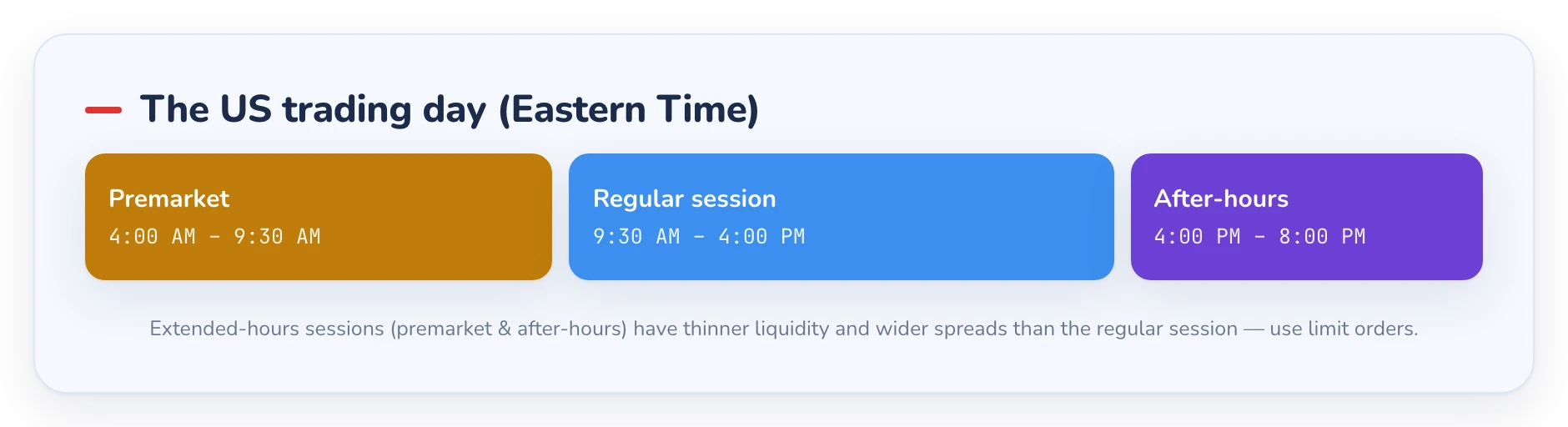
- Premarket: ~4:00 AM – 9:30 AM ET (see our premarket trading guide)
- Regular session: 9:30 AM – 4:00 PM ET
- After-hours: 4:00 PM – 8:00 PM ET
The busiest after-hours stretch is the first hour, 4:00 to 5:00 PM ET, when most earnings hit and volume is highest. Exact windows vary by broker.
Why traders use after-hours
- Trade earnings. The majority of companies report after the close — after-hours lets you react at once instead of waiting for tomorrow’s open.
- React to breaking news. Late announcements, product launches, or economic events can be traded the same day.
- Manage positions. You can adjust or exit a position in response to news rather than sitting on overnight risk.
The risks of after-hours trading
The post-close session carries the same dangers as premarket — often sharper:
- Thin liquidity. Volume drops steeply after 4:00 PM, so filling an order at a fair price is harder.
- Wide spreads. Fewer participants mean a bigger bid–ask gap and higher trading costs.
- Sharp volatility. Earnings reactions can swing prices double digits in minutes, and moves often reverse by the next open.
- Limit orders only. Many brokers restrict after-hours trading to limit orders to shield you from bad fills.
Be clear-eyed: an earnings pop or drop after-hours can reverse hard by morning. Use limit orders, size small, and don’t assume the after-hours price is where the stock opens tomorrow.
How to trade after-hours
- Use a broker that supports extended hours. Tradeview Markets offers real US-stock trading on direct-access platforms — Sterling, Takion, and DAS — plus MT5. Extended-hours availability and order-entry rules (windows, permitted order types) vary by platform and account, so check the specifics on the trading platforms page before you trade.
- Always use limit orders to control the price you pay in thin conditions.
- Focus on liquid, news-driven names rather than illiquid tickers with no volume.
- Keep positions small and your risk tight — the same discipline that governs day trading.
Frequently asked questions
What are after-hours trading times? In the US, after-hours generally runs from 4:00 PM to 8:00 PM ET, though many brokers offer a shorter window. The busiest hour is right after the 4:00 PM close, when most earnings are released.
Is after-hours trading risky? Yes — thinner liquidity, wider spreads, and sharp volatility make it riskier than the regular session. Limit orders and small position sizes are essential.
Can anyone trade after-hours? Most brokers that offer extended hours let retail traders participate, but usually with limit orders only. It’s more advanced than regular-hours trading, so beginners should approach carefully.
Why do stocks move so much after hours? Earnings and news land after the close, and with far fewer participants, even modest orders can move the price sharply — so reactions are exaggerated.
Does the after-hours price become the opening price? Not necessarily. After-hours moves often partly reverse by the next open as the full market reprices, so treat the after-hours quote as provisional.
Sources
- U.S. Securities and Exchange Commission, Office of Investor Education and Advocacy. After-Hours Trading: Understanding the Risks (lower liquidity, wider spreads, greater volatility). sec.gov
- FINRA (2024). Extended-Hours Trading: Know the Risks — pre-market 7:00–9:30 a.m. ET, after-hours 4:00–8:00 p.m. ET; less liquid, more volatile, no NBBO protection. finra.org
Risk warning. Trading stocks and CFDs carries a high level of risk and may not be suitable for all investors. Extended-hours trading involves additional risks including low liquidity and higher volatility. This article is for educational purposes only and does not constitute financial advice.