
A lot of people start trading by collecting strategies like playlists. A few indicators here, a “killer setup” there, and a bunch of screenshots that look amazing in hindsight. Then real market noise hits, and suddenly nothing feels clear.
When you learn trading with professionals, the biggest difference usually isn’t a secret entry. It’s the routine around the entry: preparation, risk control, execution standards, and a review loop that forces honesty. Professionals aren’t perfect, but they tend to be consistent in the boring parts, and that’s where most beginners struggle.
“Professionals don’t avoid losses. They avoid sloppy losses.”
This guide lays out a practical path to train like a pro without pretending you’re one yet. It also explains where a social trading platform and a copy trading live room can help, and where they can quietly sabotage learning if you use them the wrong way.
The professional advantage is mostly process
Pros are usually better at three things:
- Filtering: fewer trades, better reasons
- Risk behavior: smaller mistakes, faster containment
- Review quality: turning outcomes into specific improvements
If you’re learning, you don’t need to copy their confidence. Copy their structure.
A simple “pro process” checklist
When a pro takes a trade, they typically have:
- A defined setup category (trend, breakout, mean reversion, event-aware)
- A clear invalidation point (not a vibe-based stop)
- Planned position size based on risk, not excitement
- A management plan (partials, trailing, time stop, or none)
- A post-trade note they can reuse later
“If you can’t explain the trade in one calm sentence, you’re not ready to size it.”
Picking the right kind of professional guidance
Not all “professional” learning is the same. Some pros teach process. others sell motivation. Some are legit but not good teachers. Your job is to choose the kind of professional environment that matches your learning style.
Three common ways people learn trading with professionals
| Learning format | What it feels like | Best for | Watch-out |
| Mentored routine | structured drills + feedback | disciplined learners | mentor quality varies |
| Live room observation | seeing decisions in real time | learning execution flow | can trigger impulse trades |
| Social copy learning | follow + review trade history | pattern recognition | blind copying without review |
A copy trading live room can be useful if it emphasizes explanation and risk context, not hype and “instant wins.”
The skill stack pros build first
Most beginners start with entries. Pros usually start with constraints.
Skill 1: Market context in two minutes
Pros tend to scan context quickly:
- Trend or range?
- Volatility normal or elevated?
- Any scheduled event risk?
- Where is liquidity likely thin?
You don’t need complex macro views. You need a repeatable scan.
Skill 2: Risk math that stays stable
This is the difference between “learning” and “gambling.”
Core habits:
- Fixed risk per trade (example: 0.25% to 1%)
- Maximum open risk (portfolio heat)
- Daily stop (a hard cap that ends the session)
Skill 3: Execution clarity
Professionals reduce mistakes through standardization:
- Bracket orders when appropriate
- Consistent order types
- Fewer last-second changes
Skill 4: Review that produces one improvement
Pros don’t review to feel bad. They review to create one change.
A good weekly review produces:
- One mistake pattern
- One rule adjustment or drill
- One focus for next week
“A strategy improves faster when you measure rule-following, not just PnL.”
Using a social trading platform without turning it into a distraction
A social trading platform can be either a learning accelerator or a dopamine trap. The difference is how you use it.
The healthy way to use it
Use it for:
- Trade examples with timestamps
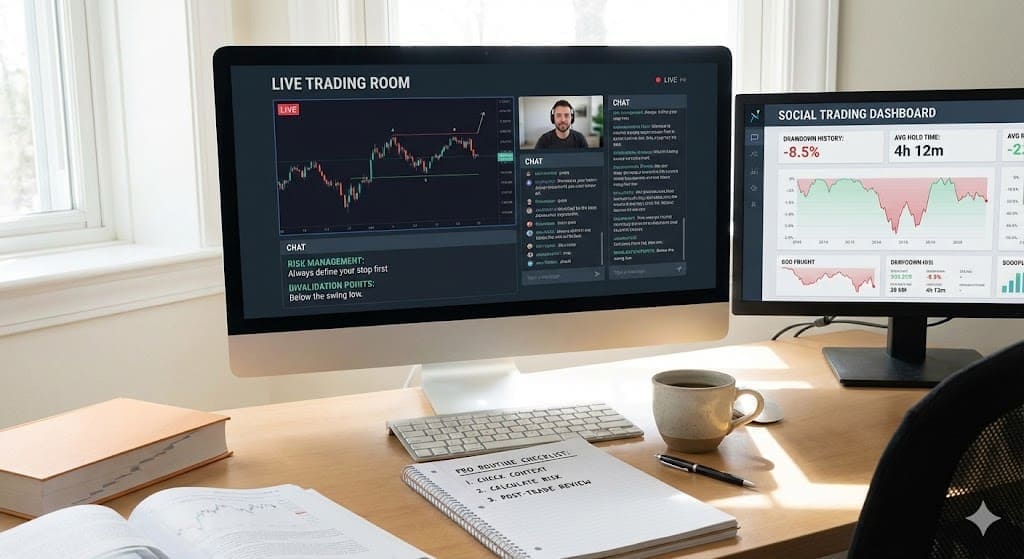
- Risk and drawdown history
- Explanation of why trades were taken
- Seeing how pros handle boredom and uncertainty
- Comparing different styles in similar market conditions
The unhealthy way to use it
Avoid using it for:
- Chasing leaderboards
- Copying the highest weekly return
- Jumping between ten traders
- Trading because the feed is active
“A social feed can train urgency. Your job is to train patience.”
A quick evaluation checklist for any social trading platform
Look for:
- Transparent drawdown stats and trade history
- Clear fee disclosure (subscriptions, performance fees, spreads)
- Ability to limit copying (caps, pause, drawdown stops)
- Educational context, not only signals
- Moderation that discourages profit guarantees
Copy trading live room: when it helps, when it hurts
A copy trading live room can be powerful because you see decision-making in real time. You learn pacing, restraint, and trade management. But it can also push you into reactive trading if the room is loud, fast, or performance-flex heavy.
Green flags in a live room
- Trades are explained before, not after
- Risk per trade is stated clearly
- Losses are treated normally, not as drama
- There are “no trade” calls and they’re respected
- Review is part of the routine (not optional)
Red flags in a live room
- Constant “must take this now” energy
- No discussion of drawdown or limits
- Oversized trades presented as normal
- Vague explanations like “trust me”
- People mocked for asking risk questions
If you join a room, treat it like a classroom. You’re there to observe and log, not to mimic every click.
A practical learning framework that feels professional
Here’s a structured path you can follow whether you learn through mentorship, a social trading platform, a copy trading live room, or a mix.
Phase 1: Build a one-page trading plan
Keep it short. One page is the point.
Include:
- Your primary setup category
- Your timeframe (intraday, swing, position)
- Your risk per trade
- Your daily stop
- Your “no trade” conditions
- Your execution template (order type, stop logic, management)
Phase 2: Run drills before you chase performance
Treat trading like training, not like proving yourself.
Useful drills:
- Level drill: mark 3 key levels and wait, no trades allowed until a level is touched
- Invalidation drill: for each potential trade, write the invalidation first
- Size drill: calculate size from stop distance for 10 scenarios
- Patience drill: take only 1 trade per day for a week
“Your first edge is not a prediction. It’s not forcing trades.”
Phase 3: Track three metrics that keep you honest
Forget complicated dashboards at first.
Track:
- Rule-following rate (percent of trades that followed your plan)
- Average loss vs planned loss (did you respect stops?)
- Maximum daily drawdown (did you stop?)
Copying professionals without becoming dependent
Copying can be a learning tool if you frame it correctly.
If you’re using a platform to copy, treat it as:
- An apprenticeship model
- A way to study trade selection and management
- A controlled exposure strategy with strict caps
Not as:
- A replacement for learning
- A guarantee of returns
- A reason to ignore risk
The “study copy” method
If you copy trades, do this:
- Copy with small allocation
- Write a one-line hypothesis for each trade: “This looks like trend continuation after X”
- Record the context: volatility, session, nearby news
- Review outcomes weekly and categorize the losses
- Keep copying only if the provider’s behavior stays consistent
Controls that should always be turned on
- Max allocation per trader
- Max loss stop for the copied strategy
- Pause function
- Conservative scaling or fixed amount allocation
The tools professionals lean on
Tools don’t replace skill, but the right tools reduce mistakes.
Tools that improve decision quality
- Clean chart templates (one primary, one context)
- Alerting at planned levels
- Calendar awareness for volatility windows
To improve execution quality
- Bracket orders (entry, stop, target)
- One-click modify and cancel/replace
- Position sizing calculator based on stop distance
Tools that improve review quality
- Automated journaling exports
- Screenshots at entry and exit
- Tagging trades by setup type
Here’s a simple “tool-to-problem” table:
| Problem | Tool feature | Practical improvement |
| impulse entries | level alerts | fewer random trades |
| inconsistent sizing | risk-based sizing tool | stable loss profile |
| messy management | bracket orders | fewer mid-trade improvisations |
| vague review | tags + screenshots | faster pattern recognition |
Examples that make this real
These are simplified examples, not signals.
Example A: Learning trend trading with professional structure
You’re in a copy trading live room and the lead trader says:
- Market is trending
- Entry is after a pullback
- Invalidation is below the pullback low
- Risk is 0.5R (small size because volatility is elevated)
Even if the trade loses, you learn:
- Why the entry exists
- Where the idea is wrong
- How risk adapts to conditions
Example B: Using a social trading platform as a study library
You follow three traders:
- One trend-focused
- One mean reversion
- One slower macro style
Instead of copying all three immediately, you:
- Compare their drawdowns
- Identify which days they struggle
- Pick one to copy with a cap
- Keep notes on how they behave after losses
This turns the platform into a structured learning environment rather than a performance casino.
Mistakes that slow learning the most
Mistake 1: Confusing activity with progress
More trades usually means more noise while you’re learning.
Fix:
- Cap trades per day
- Require A-grade setups only
Mistake 2: Copying a trader whose risk personality doesn’t match yours
A trader can be skilled and still be wrong for you.
Fix:
- Choose based on drawdown tolerance and trade frequency, not returns
Mistake 3: No daily stop
Without a stop, you turn a bad session into an emotional spiral.
Fix:
- Set a daily loss cap and honor it
Mistake 4: Reviewing only wins
Wins are fun. Losses are informative.
Fix:
- Review losses first, then wins
- Look for repeated behavior patterns
“The fastest improvement often comes from deleting one bad habit, not adding one new indicator.”
Final paragraph before the FAQ
If you want to learn trading with professionals in a way that actually translates into your own skill, focus on structure: one clear setup, fixed risk rules, and a review loop that creates one improvement per week. Use a social trading platform to study behavior and drawdowns, and treat any copy trading live room like a classroom where you log decisions and context instead of reacting to every callout. If you share your timeframe (day or swing), the markets you trade, and your current biggest struggle (entries, stops, or overtrading), I can map a two-week practice routine with drills, risk limits, and a simple journal template you can reuse.
FAQ
Can I learn trading with professionals without copying their trades?
Yes. Observation with structured journaling can teach selection, risk behavior, and management. Copying is optional, and learning is faster when you review actively.
Is a social trading platform helpful for beginners?
It can be, if it emphasizes transparency: trade history, drawdowns, and risk metrics. It becomes harmful when you chase leaderboards or copy without controls.
What should I look for in a copy trading live room?
Clear explanations before trades, consistent risk limits, normal treatment of losses, and a review routine. Avoid rooms that hype urgency or promise guaranteed results.