
You’re searching for ways to trade futures online without exchange account paperwork. Maybe you want smaller capital requirements, fewer forms, and a workflow that still lets you act on big macro moves.
Good news and clear reality both apply. This guide explains what is actually possible, answers “can you trade futures without futures account”, and highlights the best futures markets to trade in volatile times while keeping your routine simple and safe.
The short answer
- If by “exchange account” you mean a direct membership at CME or ICE, retail traders do not need that at all. Your broker or clearing firm holds the relationship with the exchange.
- If you mean a broker-approved futures account, then yes, you normally need one to place real exchange-traded futures.
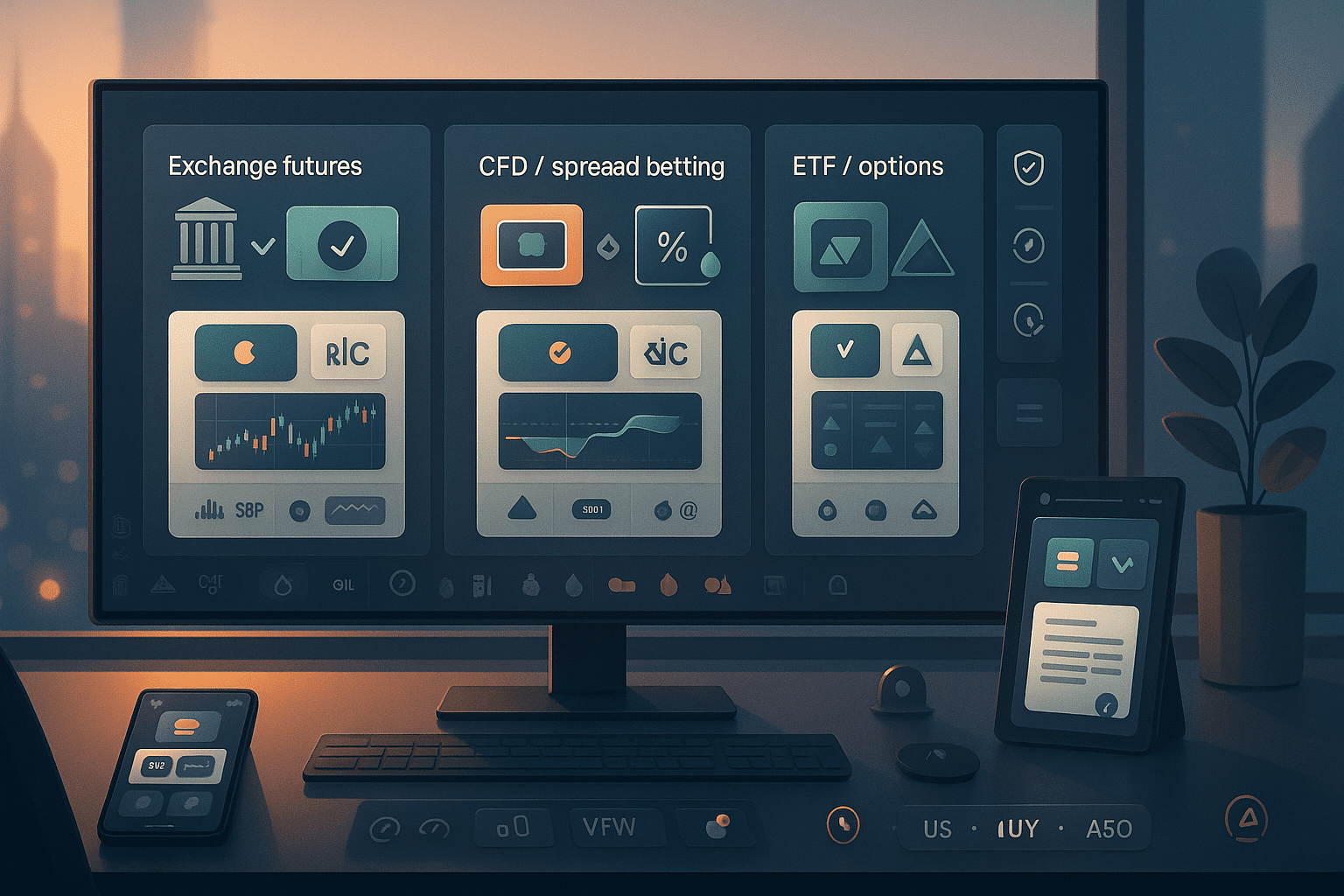
- You can still get futures-like exposure without a futures-designated account through alternative products like CFDs, spread betting accounts in some regions, or exchange-traded funds that track futures baskets. These are not the same as owning the listed futures contract, and they come with different costs, regulations, and tax treatment.
“Own the exposure that matches your paperwork tolerance, not the headline.”
Paths to futures-style exposure, compared
| Path | Do you need a futures account | What you actually trade | Pros | Considerations |
| Exchange-traded futures via broker/FCM | Yes | Real futures contracts (ES, NQ, CL, GC, ZN) | Deep liquidity, transparent specs, clean hedging | Margin calls, exchange hours and rules, futures paperwork |
| Micro futures | Yes | 1/10th sized contracts on major indices, gold, crude | Smaller tick value, friendly to modest balances | Still a futures account, exchange margins apply |
| CFDs on futures indices or commodities | No (varies by region) | Broker-issued contracts referencing futures prices | Lower entry size, simple onboarding | Not exchange-traded, broker risk model, regional restrictions |
| Financial spread betting (UK/IE) | No futures account | Tax-advantaged directional bets on futures prices | Small sizes, simple tax rules in many cases | Only in certain jurisdictions, wider spreads at times |
| ETFs and ETNs that track futures | No | Exchange-traded funds like commodity or volatility trackers | Pure securities account, familiar settlement | Management fees, tracking error, no direct futures benefits like margin offsets |
| Options on ETFs | No | Calls and puts on futures-linked ETFs | Defined risk strategies | Greeks learning curve, option liquidity varies |
If you want pure exchange benefits and standardized rules, open a futures-enabled account. If you mainly want directional exposure with small size and simple onboarding, a non-futures route can fit, provided you respect the differences.
Can you trade futures without futures account
Strictly speaking, no for true, listed futures. You place those through a broker or FCM that opens a futures-enabled account for you.
Practically speaking, sometimes yes for similar exposure, if you use products that track futures prices without being the futures contract itself. That includes CFDs, spread bets, or futures-tracking ETFs. Match the product to your region, risk tolerance, and capital.
“Ask for the contract spec, the tick value in cash, and the fees. If the numbers are unclear, the product is unclear.”
A decision tree that keeps it simple
- Do you require exchange-standardized rules and deep central order books
Choose a broker with a futures account, then consider micro contracts first. - Do you prefer smaller sizes and fast onboarding over exchange membership perks
Check your region’s access to CFDs or spread betting. - Are you investing through a securities account and want futures-linked exposure
Use ETFs that track energy, metals, or volatility baskets, and add options later if you need defined-risk plays.
Platform checklist for non-futures and futures routes
Must-haves
- Cash risk shown on the order ticket before submit
- Bracket presets saved as default for stop and target
- Symbol specs shown in cash terms: tick value, hours, typical spreads
- Per day loss cap, max position size, symbol filters
- Export that equals your statement totals without edits
Nice-to-haves
- One-click screenshot for journaling
- Price and time alerts in your local time zone
- Session templates for US, Europe, and Asia
Best futures markets to trade in volatile times
Pick contracts with deep liquidity and clear catalysts. If you use non-futures proxies like CFDs or ETFs, choose the same underlying themes.
| Theme | Futures symbols to research | Why traders gravitate here |
| US equity beta | S&P 500, Nasdaq index futures and their micro versions | Liquid order books, clear event calendar, strong session rhythm |
| Energy | WTI crude oil and micro crude | Macro sensitivity, inventory data cadence, trending periods |
| Metals | Gold and micro gold | Risk-on or risk-off barometer, reacts to rates and dollar moves |
| Rates | Treasury note and bond futures | Volatility during policy cycles, flight to quality dynamics |
| Europe equity pulse | DAX or Euro Stoxx index futures | Structured European session, frequent catalysts |
Selection tips
- Favor the contracts that remain liquid in your window
- Use a short menu and learn the rhythm of each product
- Trade retests after prints instead of first bursts when volatility is elevated
“Volatility rewards patience. Wait for the retest and let brackets do the heavy lifting.”
A calm workflow for each path
If you open a futures account
- Start with micro contracts on the same themes you follow already
- Trade only your real session for 7 to 10 days
- Record spread or depth, slippage, and time to fill
- Export and reconcile fills each day to ensure statements match
If you use CFDs or spread betting
- Confirm the provider’s typical spread bands during your session
- Read the financing or overnight rules in cash terms
- Use a fixed cash risk per trade and limit the number of instruments
- Reconcile daily exports against the portal statement
If you use ETFs
- Note the fund’s methodology and roll schedule if it tracks futures
- Expect tracking differences during volatile weeks
- Consider defined-risk option structures once you master the base ETF
- Keep a weekly log of fees and realized slippage
Low capital plan that avoids traps
- Pick one equity index product and one commodity product.
- Lock a fixed cash risk per trade, for example 10 to 30 dollars.
- Attach brackets by default and cap yourself at two attempts per idea.
- Avoid first bursts around scheduled prints. Trade the retest.
- Keep a two-screenshot journal before and after every entry.
- Measure all-in cost for ten sessions before raising size.
“Progress is a series of small, boring upgrades.”
Cost lines that decide more than headlines
| Cost line | Where it hides | Practical move |
| Spread and slippage | At entry and exit during peak minutes | Favor overlap windows and retests |
| Commission and fees | Ticket and daily statements | Add them to your per-trade log in cash |
| Financing or funding | Overnight holds on CFDs or ETFs | Match hold time to cost or favor day holds |
| Exchange and routing | Futures venues and sessions | Trade when depth is high and spreads are honest |
| Data bundles | Optional extras you may not need | Keep only what changes your decisions |
Clarity turns uncertainty into a choice you can live with.
Safety habits that protect the month
- Set a per day loss cap that pauses new orders until server reset
- Limit max open positions per product to avoid concentration
- Use session filters or personal rules to skip thin hours
- Post a one-line “reason in” and “reason out” for every idea
- Keep leverage modest until two calm weeks pass
FAQ
Can you trade futures without futures account
Not the listed contracts. You need a broker-approved futures account to place exchange-traded futures. If you only need directional exposure, consider CFDs, spread betting in eligible regions, or futures-tracking ETFs that live in a standard securities account.
Is a futures exchange membership required for retail traders
No. Your broker or clearing firm handles exchange access. You only need a properly enabled account with that firm.
Are micro futures good for small accounts
Often yes. Micro contracts reduce tick value so your cash risk and drawdowns stay smaller while you learn. They still require a futures account and exchange margins.
What are the best futures markets to trade in volatile times
Index futures like S&P 500 and Nasdaq, crude oil, gold, and liquid rate futures are common choices due to depth and regular catalysts. Pick the ones that are active during your trading window.
How do I minimize slippage during news
Size down, avoid the first spike, and trade the first clean retest. Use brackets so exits are honest and repeatable.
A calm nudge before you decide
Write a one-page plan with your preferred path, two products you will trade, fixed cash risk per idea, and the three numbers you will track for ten sessions: spread, slippage, export parity. If you need standardized rules, open the futures route with micro contracts. If you need small size and fast onboarding, choose a reputable non-futures proxy and measure costs carefully. That is how you trade futures online without exchange account hassles while staying honest about the product you are actually using.