

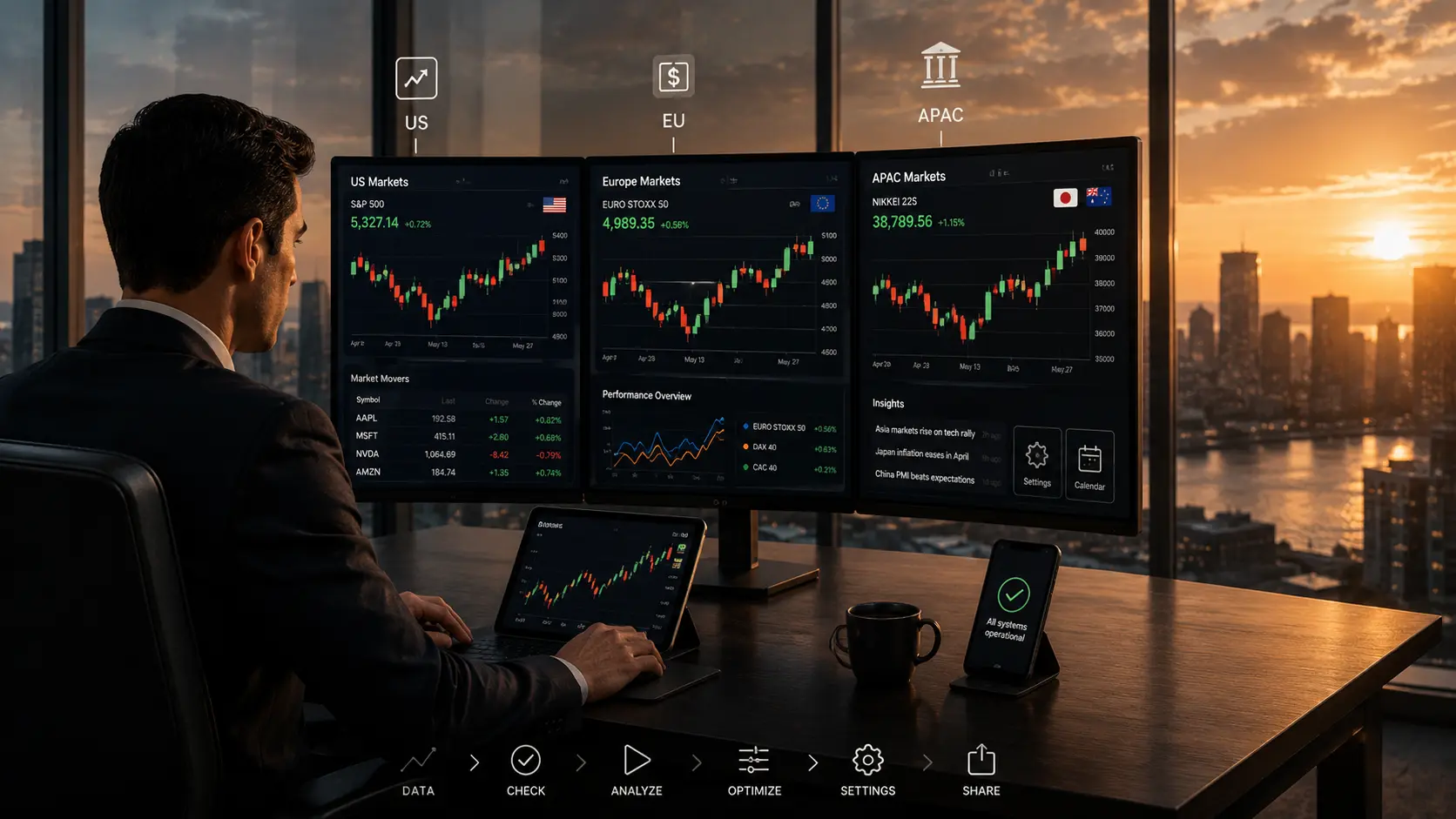
An index is a basket that tracks the collective price of selected stocks. Instead of picking a single company, you trade the overall direction of a market segment. Most retail traders use index derivatives or contracts-for-difference (CFDs). These products reflect the price of the underlying index.
Why traders like index products
- Broad exposure in one instrument
- Usually deep liquidity during cash hours
- Cleaner charts than many single names
- Frequent, well-telegraphed catalysts (earnings seasons, macro data, central banks)
“A tidy routine outperforms a clever hunch.”
If you make decisions simple and repeatable, you can trade global stock indices without stressing out your day.
The best indices to trade (and how they feel)
Use this snapshot to match personality, session, and goals. Times are indicative and will vary by platform.
| Index | Region | Typical active window (local) | Personality | Common drivers | Better for |
| S&P 500 (US500) | United States | 9:30–16:00 ET | Smooth rotations, strong liquidity | Earnings, Fed tone, macro data | New and intermediate traders |
| Nasdaq 100 (US100) | United States | 9:30–16:00 ET | Faster, tech-tilted swings | Growth sentiment, yields | Momentum and breakout traders |
| Dow Jones (US30) | United States | 9:30–16:00 ET | Slower, price-weighted quirks | Industrials, big components | Mean-reversion intraday |
| DAX 40 (GER40) | Germany | 9:00–17:30 CET | Sharp opens, clean trends | Euro data, EURUSD, earnings | European session specialists |
| FTSE 100 (UK100) | United Kingdom | 8:00–16:30 GMT | Heavily influenced by commodities | GBP, energy/metals | Range and rotation tactics |
| Euro Stoxx 50 (EU50) | Eurozone | 9:00–17:30 CET | Broad EU risk barometer | ECB tone, EU data | Morning momentum in Europe |
| Nikkei 225 (JP225) | Japan | 9:00–15:00 JST | Gaps, currency-sensitive | USDJPY, BOJ moves | Asia session traders |
| Hang Seng (HK50) | Hong Kong | 9:30–16:00 HKT | Volatile, news-reactive | China data, policy | Advanced risk control |
| ASX 200 (AUS200) | Australia | 10:00–16:00 AEST | Steady, commodity-linked | AUD, metals | After-work sessions (APAC) |
| Nifty 50 (IND50) | India | 9:15–15:30 IST | Trendy opens, midday lull | RBI tone, local flows | Breakout + retest plays |
“Pick two indices that live in your daily schedule, then learn their open, midday, and close behaviors like a language.”
Account and platform choices that make life easier
- Unified watchlists by region (US, EU, APAC) so you can rotate cleanly
- Bracket orders that place stop loss and target with your entry
- Cash risk display on the ticket so size is obvious before you click
- Session templates to gray out dead hours and high-impact data minutes
- Journal + tags to filter by index, setup, and time of day
- Mobile risk controls for editing stops if you step away
A single routine that scales across markets
Pre-market (15 minutes)
- Mark yesterday’s high/low and the overnight range.
- Note two catalysts: economic prints or top earnings.
- Set level alerts and write your cash risk per trade and daily stop.
During session (60–120 minutes)
- Wait for an A-setup. Two attempts per idea.
- Screenshot before entry. Log “reason in” in a single sentence.
- Respect the daily stop; end on time whether you win or lose.
Post-market (10 minutes)
- Tag trades by setup and session.
- Note slippage and any broken rules.
- Save one good chart and one lesson chart.
“Consistency is invisible today and obvious in your monthly report.”
Three simple setups for index traders
Opening drive and first pullback
- Watch the first 5–15 minutes. If price drives cleanly away from the open, wait for a measured pullback into VWAP or a prior micro-range.
- Enter with a bracket. Partial profit at 1R, trail behind a structure pivot.
Range break and retest
- Box a clear pre-market or intraday range.
- When the break holds for a full candle, look for a retest from above/below and enter on the first sign of continuation.
Reversion to value
- If price stretches far from VWAP without fresh news, fade back toward it in quiet periods.
- Keep size smaller; exits should be quick and mechanical.
“If you cannot state the entry in one sentence, the setup is not ready.”
Risk, size, and correlation
- Cash risk unit: a fixed dollar amount per trade you can lose without stress.
- Stop placement: behind structure, not a round number alone.
- Correlation traps: Nasdaq and S&P often move together; trading both doubles risk. Choose one or split size.
Sizing quick math
- Risk unit: 50 dollars.
- Stop: 10 points.
- Value per point on your instrument: 2.50 dollars.
- Size = 50 ÷ (10 × 2.50) = 2 contracts.
Costs that quietly shape results
| Cost | Where it bites | How to reduce it |
| Spread/commission | Every entry/exit | Favor liquid hours, compare broker tiers |
| Slippage | Opens, news, thin moments | Use limits on breaks, avoid chasing |
| Overnight funding (CFDs) | Swings held overnight | Favor day trades or choose futures |
| Data/exchange fees | Futures platforms | Pick only what you use; reassess monthly |
Track total cost per trade for 20 sessions. Keep the times and tactics that minimize drag.
Event rhythm: earnings, data, and central banks
- Earnings seasons: watch index leaders; one big miss can sway the open.
- Macro prints: CPI, jobs, PMIs, retail sales; plan to stand down or switch to breakout-retest with smaller size.
- Central banks: FOMC, ECB, BOE; widen stops or skip the first move entirely.
“You can’t control news, but you can control whether you’re exposed during it.”
Sample day plans you can borrow
- US morning focus: Trade the S&P 500 only. First 90 minutes max. One opening drive or range-retest, then stop.
- EU morning focus: DAX 40 from 9:00–11:00 CET. If no clean break by 10:30, stand down.
- After-work window: ASX 200 or a late US futures session with half size and strict time box.
Building your “two-index portfolio” for routine
Choose one primary index and a secondary in a different time zone. This gives you options without splitting focus.
| Goal | Primary | Secondary | Reason |
| Smooth learning curve | S&P 500 | Euro Stoxx 50 | Liquidity + modest volatility |
| Momentum practice | Nasdaq 100 | DAX 40 | Strong moves during cash hours |
| After-work sessions | ASX 200 | Nikkei 225 | Fits evening schedules (APAC/US) |
| Commodity tilt | FTSE 100 | S&P 500 | Miners/energy influence vs broad US |
Platform checklist before you press go
- One-click brackets on every index you trade
- Cash risk preview on the ticket
- Price/time/news alerts
- Clean statement breakdown by instrument and day
- Stable mobile app for risk edits, not entries
“If the platform can’t show risk in cash before you click, keep shopping.”
Common mistakes (and quick fixes)
| Mistake | Fix |
| Trading three indices at once | Choose one per session or split size |
| Chasing the first spike at the open | Wait 5 minutes; trade the first pullback |
| Random position sizing | Lock a cash risk unit and stick to it |
| Trading through major data with no plan | Stand down or use breakout-retest with smaller size |
| Ignoring costs | Track spread + commission + slippage per trade |
One small push to get moving
Open your calendar and block a 90-minute window that fits a cash session. Choose two instruments from the list of the best indices to trade. Write your cash risk per trade on a sticky note. Then, set three alerts at important levels. The next time your A-setup appears, place a bracketed order and log “reason in” and “reason out” in one sentence each. You’ll feel the difference the very next week you trade global stock indices with the same calm process.
FAQ
What are indices in trading
They are baskets of selected stocks that move as one. You trade their direction using derivatives or CFDs that mirror the underlying index price.
Which are the best indices to trade for beginners
The S&P 500 and Euro Stoxx 50 usually provide good liquidity and steady behavior during cash hours. This makes them easier to work with as you learn a routine.
Is the Nasdaq 100 too volatile for new traders
It moves faster than the S&P. If you choose it, use smaller size and focus on a single setup like range break and retest.
Do I need different strategies for each index
No. One or two simple setups can work across indices. The main differences are session rhythm and catalyst timing.
When is the cleanest time to trade an index
Often the first 60–90 minutes of the local cash session. After that, expect slower rotations or wait for scheduled catalysts.