

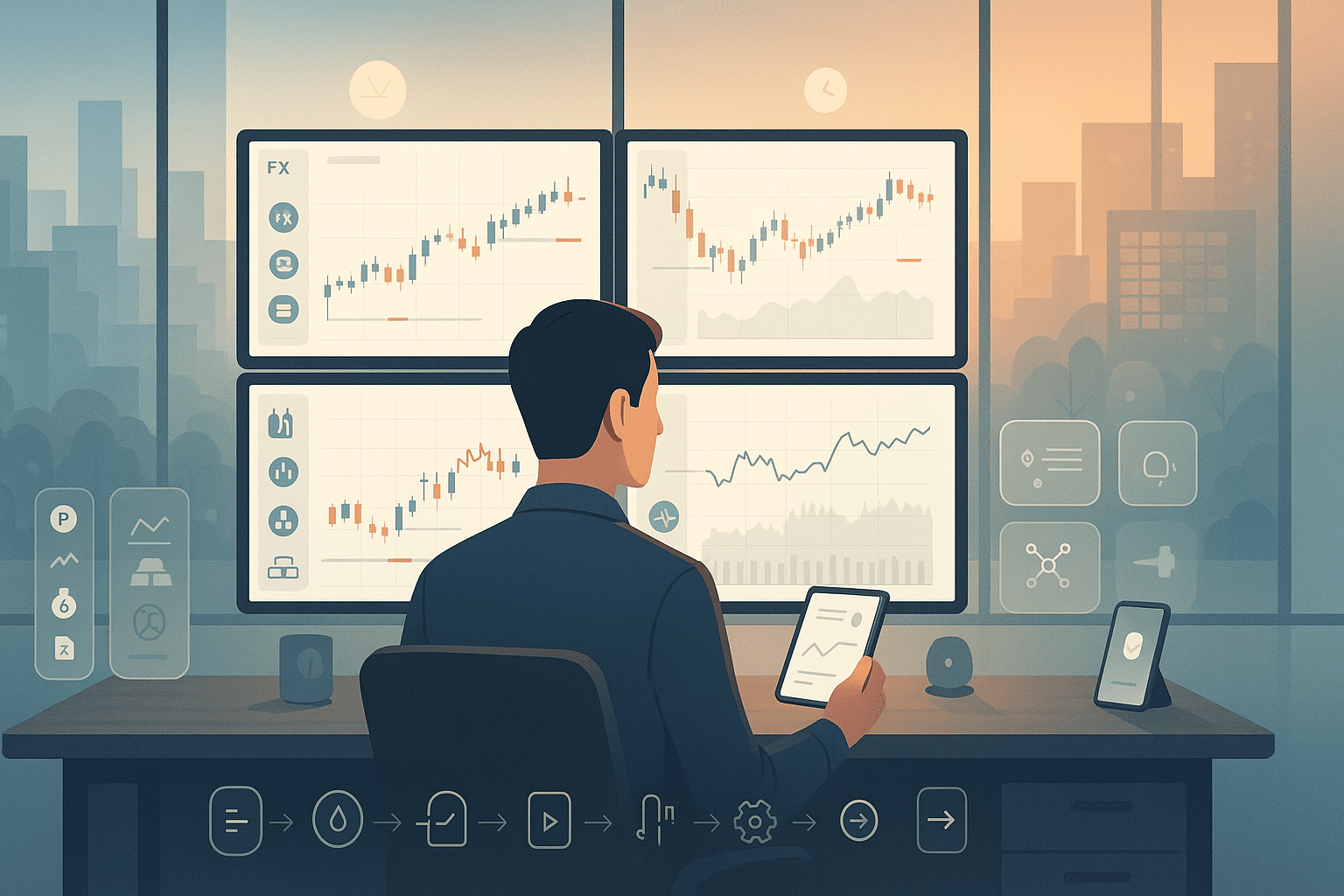
You start the morning with currencies, check equity indices over lunch, and finish the day with commodities or crypto. One login, one workflow, several liquid venues. That is the promise of online market trading when your tools, habits, and risk rules point in the same direction.
“The edge is not a secret indicator. The edge is a clean routine that you actually follow.”
Why a multi-market approach can work for real people
Benefits you will feel quickly
- More opportunities per week. Several assets means more quality setups without forcing trades.
- Time zone flexibility. FX during London, indices near New York, and select crypto pairs after hours.
- Diversified drivers. Currencies may react to rates, metals to supply, indices to earnings.
- Skill transfer. Risk sizing, entries, and exits carry over once you standardize your playbook.
Pitfalls to avoid
- Chasing every tick across five asset classes
- Using different rules for each symbol
- Ignoring fees and slippage during volatile periods
- Overlapping risk by trading correlated instruments at once
“More markets do not require more screens. They require clearer rules.”
Building a single workflow for multiple asset account trading
Multiple asset account trading works best when you keep platform muscle memory consistent. That means the same order ticket, risk unit, and checklist across symbols.
Core habits to standardize
- Risk per trade. Fixed percent or fixed currency amount.
- Entry method. Limit, stop, or market, chosen before you open the ticket.
- Exit logic. Predefined stop distance and take-profit plan.
- Session filters. Hours you will trade each asset and hours you will skip.
- Daily stop. A fixed loss limit that pauses you until tomorrow.
“If you cannot explain the plan for a trade in one sentence, you are not ready to place it.”
Market primers in one table
Use this quick map to set expectations and pick your starting mix.
| Asset class | Typical hours to watch | Liquidity feel | Common drivers | Notes for beginners |
| Major FX pairs | London and early New York | Very deep | Rates, macro data, central bank tone | Tight spreads, respect news windows |
| Equity indices CFDs | US and EU cash sessions | High near opens | Earnings, risk sentiment, flows | Index moves can be sharp at the bell |
| Large cap stocks | Local market hours | Variable | Company news, sector data | Mind borrow rules and corporate actions |
| Gold and silver | London morning, US session | High | Real rates, dollar strength | Often trends well around macro events |
| Oil benchmarks | European morning, US session | High | Inventories, OPEC, growth | Can gap on headlines more than FX |
| Liquid crypto pairs | Evenings and weekends | Varies by venue | Liquidity cycles, risk appetite | Use hard stops and smaller size at first |
“Volatility is not the villain. Unplanned volatility is.”
Platform features that keep you consistent
Trading interface essentials
- Clean charts, one-click entry, and visible risk in currency terms
- Alerts for price, time, and economic releases
- Watchlists grouped by asset class and correlation
Order and risk controls
- Bracket orders that place stops and targets automatically
- Partial close options for scaling out
- Hard daily loss limit that locks trading after the threshold
Back office and reporting
- Trade journal with tags for asset, setup, and session
- PnL by asset class and by day of week
- Exportable fills for deeper analysis
“If the platform shows risk in cash before you click, your future self will thank you.”
Fees, slippage, and the cost of doing business
Costs shift by market and venue. Use the table below to keep surprises out of your PnL.
| Cost type | Where you see it | How to reduce it |
| Spread | Tightest in majors and index futures, wider in exotics | Trade liquid sessions, avoid dead hours |
| Commission | Per lot or per contract | Choose a tier that fits your average volume |
| Swap or funding | Overnight on leveraged products | Hold during low-cost periods or reduce size |
| Slippage | Fast markets, thin books | Use limits when possible, skip news spikes |
| Borrow fees | Shorting stocks or thin ETFs | Check rates before entries, avoid crowded shorts |
A simple routine for online market trading
Daily warm-up
- Review overnight moves and your calendar.
- Pick a small watchlist for each asset class.
- Set alerts at key levels so you are not glued to the screen.
- Decide your risk per trade and daily stop.
- Commit to the sessions you will trade today.
During the session
- Take screenshots before and after entries
- Log reasons for entries and exits in one sentence
- Respect your loss limit and your time boundaries
Cool-down
- Tag trades by asset and setup
- Note any rule breaks and fixable causes
- Archive a chart of your best execution for the day
“Consistency is invisible in the moment and obvious in the monthly report.”
Example playbook for three markets in one day
- Morning focus: EURUSD around London lunch. Look for pullbacks into prior day value. Two attempts maximum.
- Midday focus: US index CFD near cash open. Wait five minutes after the bell before first order.
- Evening focus: BTCUSD only if a level from the morning alert triggers. Size at half of FX risk.
This keeps attention narrow while still letting you trade multiple markets online.
Position sizing that works across assets
One risk unit to rule them all
Pick a cash amount you can lose per trade without stress. Convert that unit into size based on stop distance and the instrument tick value.
- If your risk unit is 50 dollars and your stop is 10 ticks at 2.50 dollars per tick, your size is 2 contracts.
- If your risk unit is 50 dollars and your stop on EURUSD is 10 pips at 0.10 dollars per pip per micro lot, your size is 5 micro lots.
“You will never control the market. You can always control position size.”
Correlation and overlap you should track
Trading different symbols does not always mean different risks. Consider these overlaps:
- EURUSD and DXY often move inversely
- S&P 500 and oil can rise together during risk-on stretches
- Gold and USDJPY can diverge when rates shift
Use a small dashboard that shows current correlations so you do not double your risk without noticing.
Choosing an account setup that supports multiple assets
When you open or upgrade your account, make sure the platform and back office allow easy trading of multiple assets.
Checklist for a practical setup
- One login for FX, indices, metals, and selected stocks or crypto
- Unified cash balance with clear margin rules by product
- Bracket orders available across all instruments
- Stable mobile app for alerts and emergency exits
- Simple statement that breaks down PnL by asset class
“Fewer moving parts means fewer excuses.”
Research and preparation without overwhelm
- Keep a compact calendar for rate decisions, CPI, jobs, earnings, and inventories.
- Write a two-line preview for each day and asset class you plan to trade.
- Save two annotated charts per week that show your best and worst entries.
- Delete indicators that do not change your decisions.
Education that actually compounds
- Learn one setup at a time. Pullback, breakout, or fade.
- Apply it across two asset classes before adding a third.
- Record a short audio note after sessions to catch patterns in your thinking.
- Re-read your top ten journal entries each month and refine your rules.
“Your journal is a mirror. It shows your edge long before your equity curve does.”
A 30-60-90 day plan you can follow
Days 1 to 30
- Pick two asset classes and define session windows
- Set a fixed cash risk per trade and daily stop
- Build two checklists: pre-trade and post-trade
- Take twenty screenshots of A-quality setups without trading them
- Place five small live trades only when the screenshots match
From days 31 to 60
- Add one more asset class during a different session
- Review slippage and fees by asset and time of day
- Move from random alerts to planned level alerts
- Start a weekly review with three metrics: win rate, average risk-reward, and rule breaks
Days 61 to 90
- Increase size only if your rule-break count trends down
- Build a correlation view for your watchlist
- Create playbooks for open, mid-session, and late-session behaviors
- Publish a one-page trading policy for yourself and stick it near your desk
Real-world case studies in brief
- The focused evening trader. Works a day job, trades gold two evenings per week and a crypto pair on Sunday. One setup, one risk unit, tight time box. Results stabilize because decisions are repeatable.
- The session hopper who simplified. Used to juggle five assets at once. Cut to FX in the morning and indices near the US open. PnL improved after daily stops and preset alerts reduced impulse trades.
- The small account builder. Started with micro FX lots and a tiny risk unit. Added an index micro later. Gains were modest, but drawdowns stayed shallow and confidence grew.
“Small and repeatable beats big and random.”
Comparison table to pick your first two markets
| Goal | Better first pick | Reason |
| Learn with low cost per mistake | Major FX pair with micro lots | Tight spreads and flexible sizing |
| Midday trading window | US index CFD | Liquidity and clean levels near the open |
| Macro-sensitive trends | Gold | Reacts well to rates and dollar tone |
| After work session | A liquid crypto pair | Availability and volatility, size down |
Troubleshooting common roadblocks
Overtrading
Cut your watchlist to three symbols. Remove market order hotkeys for a week and use limits only.
Choppy days
Stand down after two scratches. Not every day offers clean rotations.
Rule fatigue
Make the checklist shorter, not longer. Keep three items and print them big.
Fear after a loss
Reduce size to half for the next three trades. Confidence returns faster with small wins.
“If you respect your stop and your time, the market will give you another chance.”
One small push to get you moving
Grab a notebook and write three lines. Which two assets will you focus on for the next month, which session you will trade for each, and the cash amount you can risk per trade without stress. Set level alerts now, align your order ticket with bracket exits, and take your first carefully planned entry. You will feel the difference as you trade multiple markets online with the same calm process every time.
FAQ
How does online market trading change my daily routine
You will plan sessions around liquid hours for each asset, standardize risk per trade, and rely on alerts rather than constant screen time. The routine becomes a series of short, focused blocks.
Can multiple asset account trading hurt my focus
It can if you add assets too fast. Start with two that trade in different sessions. Keep one checklist and one risk unit so decisions feel familiar.
Which markets suit small accounts
Major FX pairs with micro lots and index micros allow precise sizing. Gold and liquid crypto pairs can work with reduced position size and firm stops.
Are fees higher when I trade several assets
Not always. Spreads vary by symbol and session. Track your total cost per trade over thirty days and favor times and instruments that keep costs predictable.
Do I need different strategies for each asset
You can apply one setup across assets. The context changes but the entry and risk math can stay the same. Document any asset-specific tweaks inside your journal.
How do I handle correlation risk
Check simple correlations on your watchlist each week. Avoid doubling up on highly correlated trades at the same time, or reduce size to compensate.
What tools matter most in the platform
You can count on reliable bracket orders. There is a clear display of cash risk. You will receive alerts. Mobile access for risk management is stable. The journal makes tagging easy.
Is weekend trading a good idea
Only with reduced size and hard stops. Liquidity can thin out, slippage can widen, and fatigue is real. Plan rests the same way you plan sessions.